Mentioned:Destinus
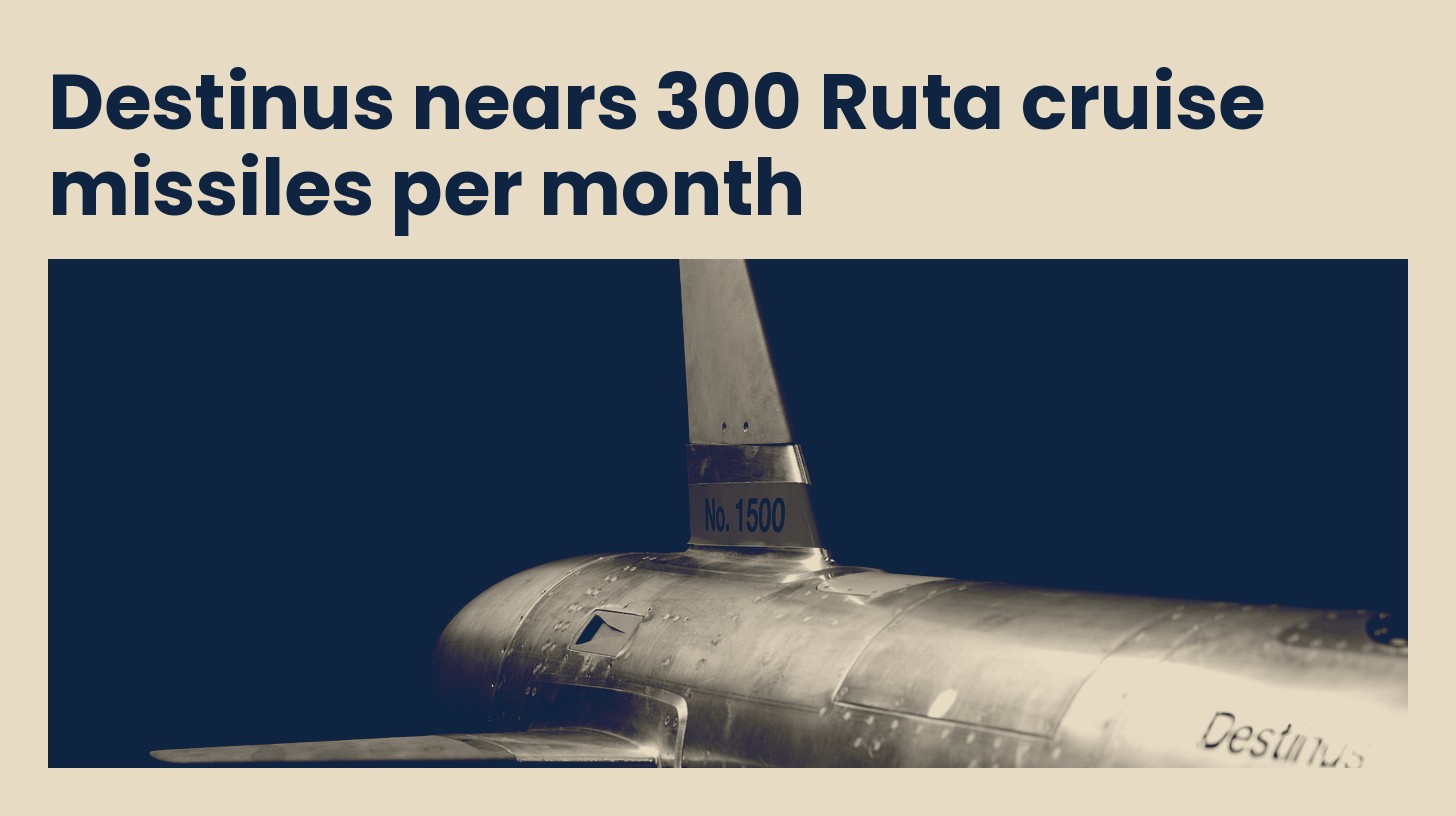
Dutch startup Destinus has reached monthly production of nearly 300 Ruta cruise missiles, surpassing Europe's total pre-war annual output. The company has also begun supplying turbojet engines to other missile manufacturers and started production of the longer-range Block 2 variant.
What's happening
- Destinus has produced more than 1,750 Ruta missiles and now manufactures nearly 300 units monthly, exceeding Europe's pre-invasion annual cruise missile production.
- The company produces Block 2 variants designed to carry 250-kg payloads and travel more than 700 km, with integrated storage and launch containers.
- Destinus supplies turbojet engines in the 1.5-kilonewton thrust class to other manufacturers and expects to meet European demand for these propulsion systems from next year.
Why it matters
- Europe's precision-strike manufacturing capacity has expanded dramatically during the Ukraine war, reducing dependence on pre-war inventory and shifting production constraints to integration challenges.
- Turbojet engine supply from Destinus addresses a critical bottleneck that has constrained Ukrainian and European manufacturers from scaling jet-powered cruise missile production.
- Block 2 containerized design enables larger European military stockpiles by simplifying logistics for storage, transport and deployment of precision-strike weapons.
Going deeper
- CEO Mikhail Kokorich argues European militaries face a military integration challenge rather than production constraints, requiring new storage, maintenance and targeting infrastructure to operate tens of thousands of missiles.
- Destinus uses no Chinese components in its supply chain, contrasting with wartime production elsewhere in Ukraine where access to Chinese suppliers could reduce manufacturing costs and timelines.
- Kokorich expects shorter-range, cheaper missiles below 1,000 km to dominate future demand alongside long-range strike systems, reshaping European precision-strike strategy.
The intrigue
- European militaries must rethink how they stockpile, maintain and deploy massive precision-strike arsenals, signaling a shift from manufacturing capacity to operational readiness as the limiting factor.
Source: Defense News · Oct 29, 2026 · Drafted with Claude, reviewed by Industrial Base Alpha.