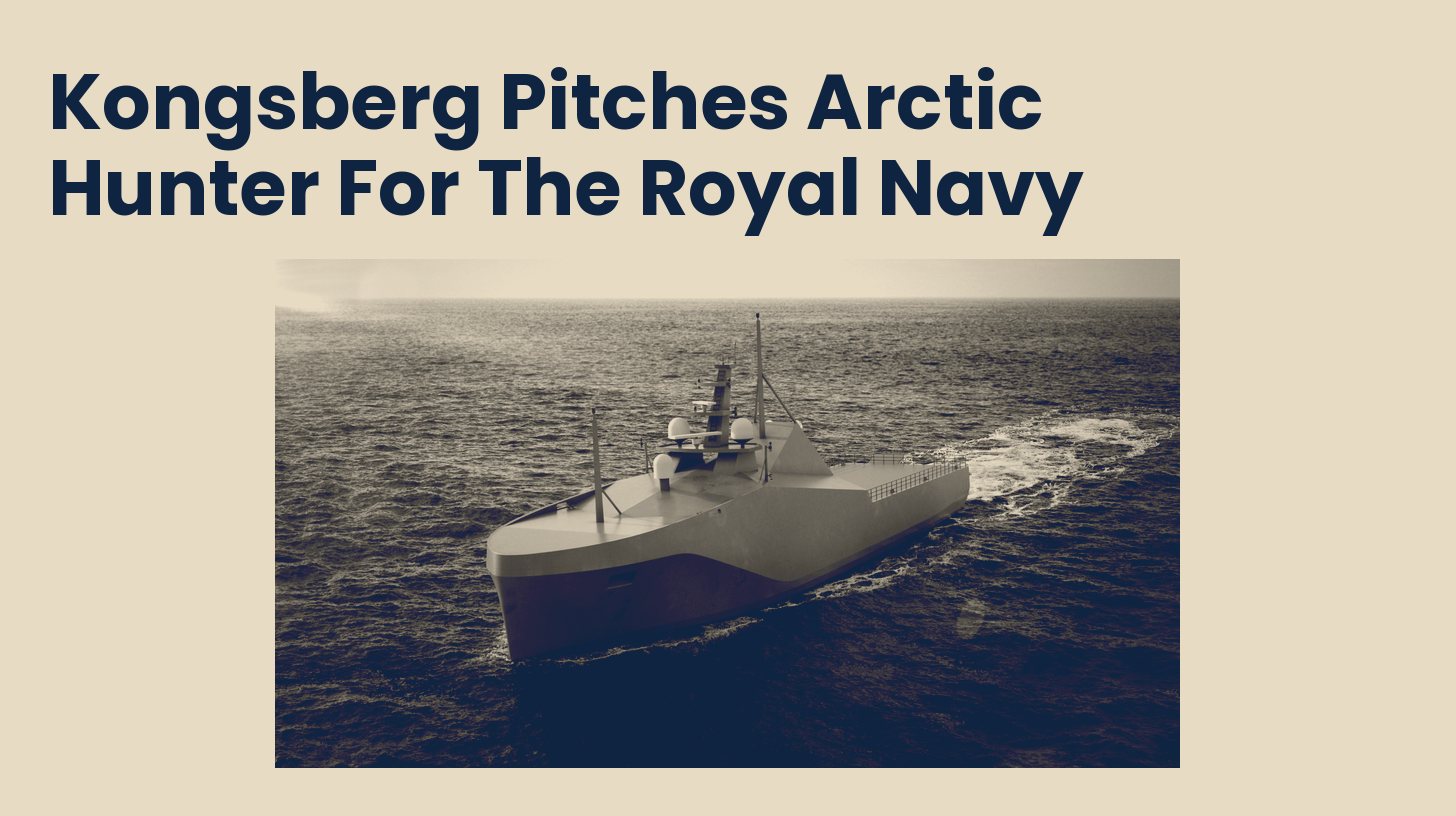
Kongsberg Maritime is proposing its Arctic Hunter concept to the British Royal Navy as a solution for detecting Russian submarines transiting the Arctic. The design converts standard 56-meter fishing trawlers into autonomous platforms capable of 60-day patrols.
What's happening
- Kongsberg Maritime pitched Arctic Hunter, a converted 56-meter trawler equipped with Thales UK sonar and autonomy technology, to meet Royal Navy Type 92 unmanned vessel requirements.
- The concept envisions a flotilla of 10 unmanned ships based west of the Bear Gap, a critical Arctic transit route for Russian submarines between Svalbard and Norway.
- Each vessel can operate unattended for approximately 60 days, with propeller redesign planned to reduce acoustic signature and avoid sonar interference.
Why it matters
- Arctic Hunter fills Royal Navy's requirement for surface drones to augment Type 26 frigates in anti-submarine warfare missions across the high north.
- Positioning 10 unmanned vessels near operational areas west of the Bear Gap reduces deployment time and sustains persistent surveillance of Russian submarine transit routes.
- The proposal leverages proven commercial trawler designs rather than developing purpose-built naval platforms, potentially reducing development risk and cost.
Going deeper
- Arctic Hunter echoes World War 2 British naval doctrine using converted whaler-type vessels to counter submarine threats, adapted for modern autonomous and sensor technology.
- Kongsberg Maritime frames the effort as a maritime engineering problem suited to the commercial shipbuilding base rather than a traditional naval armament challenge.
- Thales UK provides submarine-hunting sonar and secure communications, integrating UK defense industrial capability into the unmanned platform architecture.
The fine print
- The proposal is a concept pitch to the Royal Navy with no contract award disclosed or funding amount announced.
- Kongsberg Maritime states it would perform shipbuilding work in the United Kingdom if selected, subject to contract terms not yet disclosed.
Source: Defense News · Nov 9, 2026 · Drafted with Claude, reviewed by Industrial Base Alpha.