Mentioned:Machina$9M · Contract Award
Machina, a California robotics company, won a $9 million Defense Department contract to prove it can manufacture LUCAS low-cost uncrewed attack drones at forward-deployed locations using its RoboCraftsman containerized robotic system. The 18-month effort aims to enable tactical customization and resilience against degraded supply chains in major conflicts.
What's happening
- Machina received a $9 million contract from DoD's Organic Industrial Base Modernization Challenge to develop Edge Factories for distributed LUCAS drone production.
- The 18-month contract calls for Machina to set up two Edge Factories initially at continental U.S. locations, with potential deployment to forward locations like Kuwait.
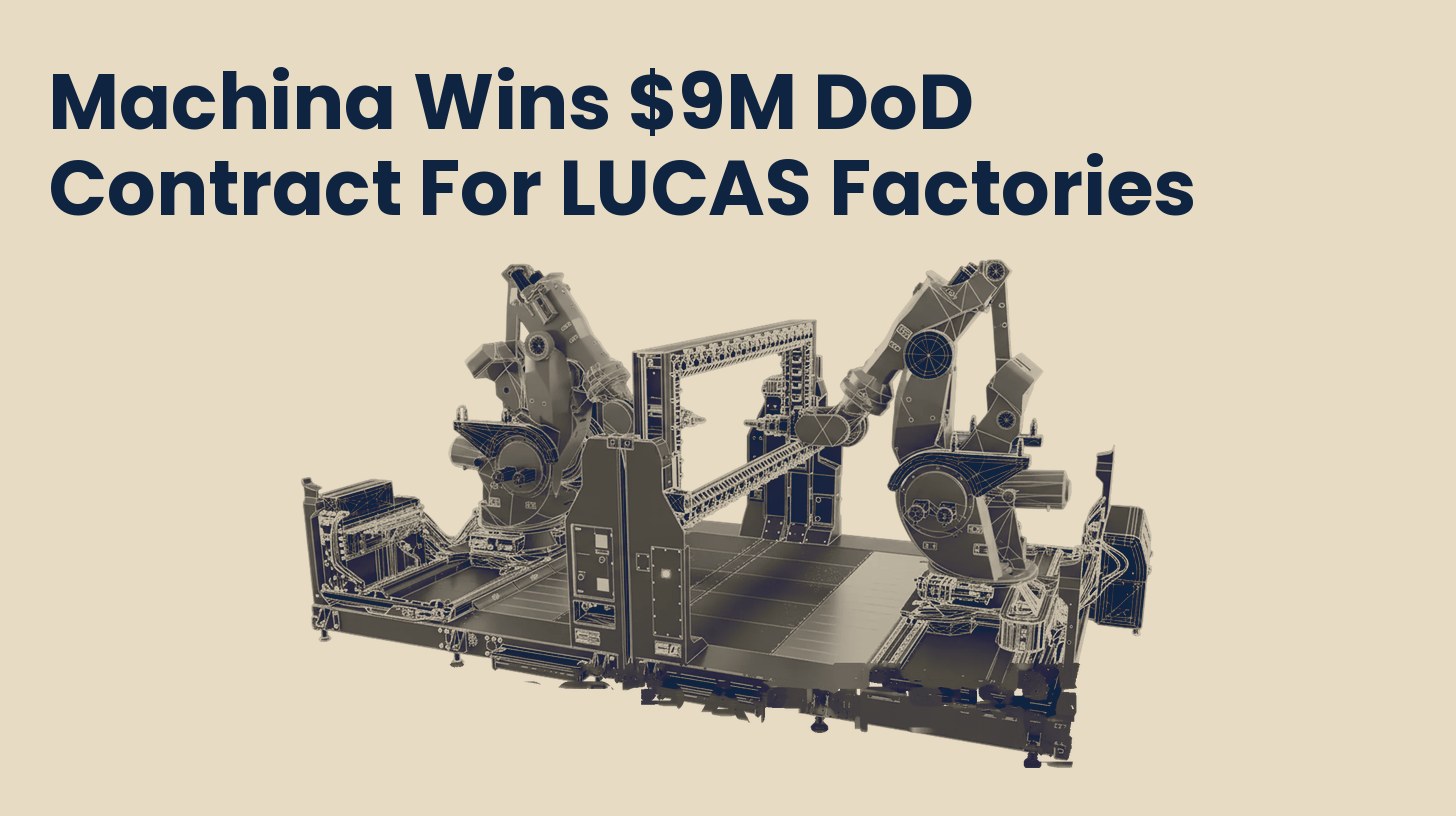
- Each RoboCraftsman cell, a 20-foot by 36-foot system weighing 120,000 pounds, can produce one LUCAS airframe in two to five days depending on size.
- The system uses metal forming guided by AI-generated design parameters rather than composite hand layup, allowing production of 20 to 50 design variants in software before manufacturing.
Why it matters
- Forward-deployed drone manufacturing removes dependency on centralized supply chains vulnerable to disruption in great-power conflict scenarios.
- Tactical units gain flexibility to customize airframe designs for specific mission requirements rather than accepting pre-built inventory, improving operational effectiveness.
- Containerized production systems reduce manufacturing lead times and enable rapid iteration on designs, accelerating capability deployment to theaters.
- Metal-based reductive manufacturing at scale eliminates hand layup processes, lowering LUCAS production costs to an estimated $15,000 to $40,000 per airframe.
Going deeper
- A half-scale six-foot prototype tested at Edwards Air Force Base revealed crosswind mitigation challenges; Machina expects three-month iteration cycles to resolve design issues.
- The contract funds capability demonstration at two U.S. locations; scaled deployment of 10 or more cells would occur under a separate future contract.
- Machina uses nTop software to parameterize airframe requirements, allowing agentic AI to generate and simulate design alternatives before manufacturing.
- The system ships in two ISO 668 containers, enabling rapid deployment and setup at forward locations.
Financial impact
- The $9 million award represents obligated contract value for the 18-month development phase; revenue recognition will follow milestone completion or time-and-materials billing tied to contract execution.
- Machina has secured multiple defense contracts for Edge Factory systems; this award signals DoD commitment to distributed manufacturing as a defense industrial strategy.
- Unit economics of $15,000 to $40,000 per airframe reflect competitive pricing with Russian Shahed-136 variants, enabling high-volume production scenarios if scaled deployment proceeds.
The intrigue
- SpektreWorks, which designed and supplied LUCAS drones to the U.S. military for combat use, declined comment on Machina's manufacturing partnership, leaving unclear whether SpektreWorks will transition to the new containerized production model.
- The contract explicitly funds only two initial Edge Factories in the continental U.S.; DoD decision on 10-plus cell deployments to actual forward theaters remains pending future procurement.
The fine print
- The $9 million covers an 18-month development and proof-of-concept phase; production-scale deployment of 10 or more cells will require separate future contract award.
- Each Edge Factory will initially consist of one or two RoboCraftsman cells; scaling beyond two locations is contingent on successful capability demonstration.
Source: twz.com · Nov 9, 2026 · Drafted with Claude, reviewed by Industrial Base Alpha.