Mentioned:MBDASafranThalesSaabLeonardo$100M · Program/Policy
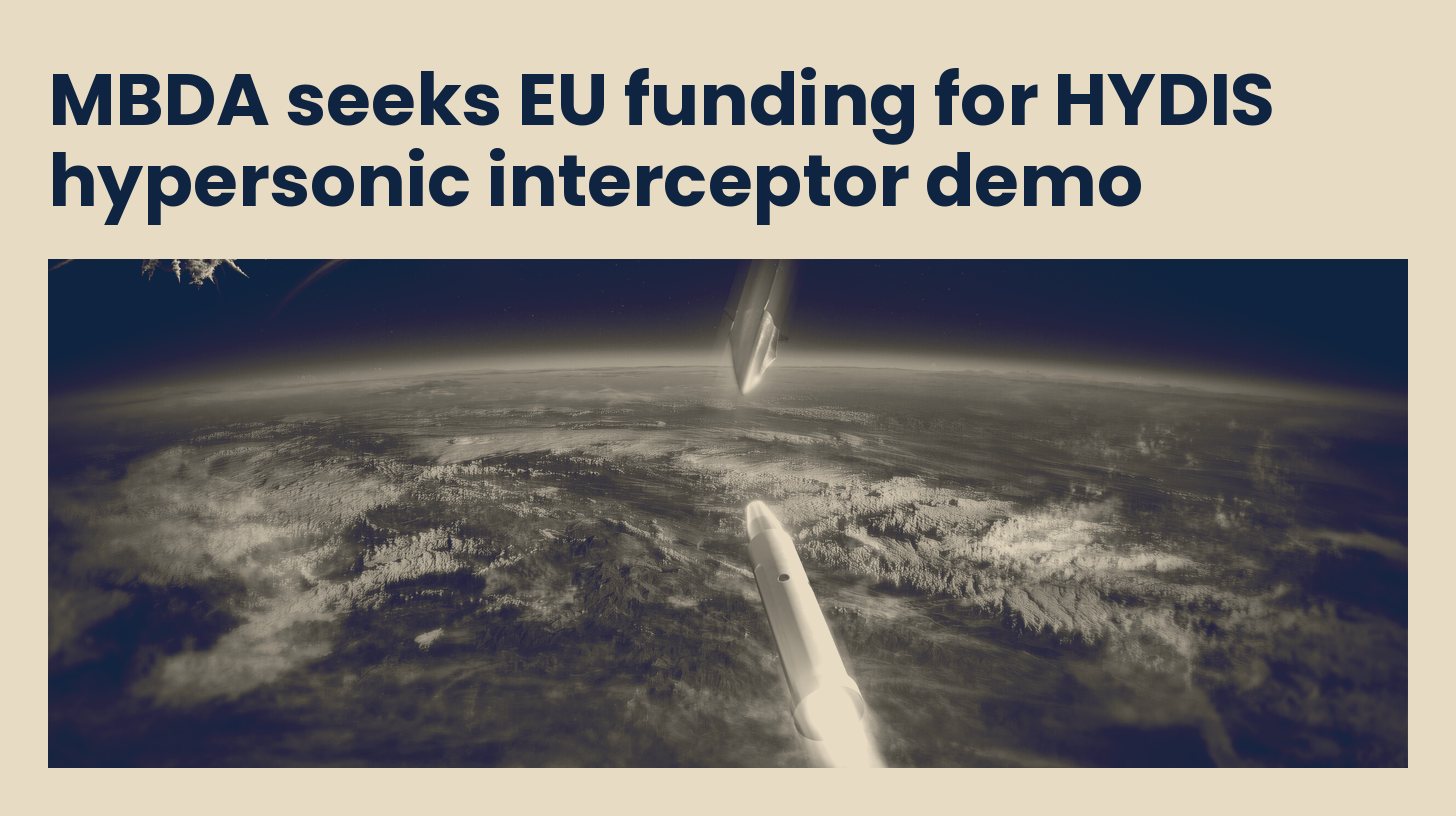
MBDA is leading a 36-partner European consortium seeking €100 million in EU funding for the second phase of Hydis, a hypersonic interceptor designed to counter both Chinese and Russian hypersonic glide vehicles and ballistic missiles. The program plans a full-systems demonstrator flight by end-2029 and production startup in the early 2030s.
What's happening
- MBDA's Hydis consortium is competing against Spain's Hydef program for €100 million in European Defence Funds for phase-two development, with a funding decision due at end-November 2026.
- Phase two will expand from 19 companies to 36 industrial and research partners across 17 countries, adding firms including Safran, Thales, Saab and Leonardo for sensors and data links.
- The consortium aims for a full-systems demonstrator flight by end-2029, with production starting in the first half of the 2030s.
- The four-stage interceptor is designed to intercept both hypersonic glide vehicles traveling at medium altitude and ballistic missiles in the upper atmosphere, using real-time AI trajectory prediction.
Why it matters
- Europe currently lacks indigenous capability to intercept hypersonic threats, leaving a critical gap against Chinese and Russian advanced weapons systems.
- A unified European interceptor reduces supply-chain complexity by stockpiling a single missile type against multiple threat classes, versus separate systems for ballistic and hypersonic defense.
- Expanding the consortium to 17 nations and 36 partners distributes both industrial capacity and political commitment across the European defense industrial base.
- AI-driven trajectory prediction at 5 kilometers-per-second encounter velocity represents a technology maturation milestone that will shape European air-defense architecture for decades.
Going deeper
- Phase one ran for three years until May 2027 and received €80 million in European funding plus €57 million from France, Italy, Germany and the Netherlands.
- Phase two runs from mid-2027 to mid-2029 and will include full-scale flight trials, aiming for technology readiness levels between 3 and 6 across all interceptor functions.
- France, Italy, Belgium, the Netherlands, Sweden and Poland will provide the largest financial contributions in phase two, while 11 member states combined will contribute €133 million in addition to EU funds.
- The Hydis design contrasts with the U.S. Glide Phase Interceptor, which only addresses hypersonic gliders while leaving ballistic missile defense to separate exoatmospheric interceptors like SM-3.
Financial impact
- European Commission and member states have committed €80 million in phase-one funding through May 2027, with €57 million from France, Italy, Germany and the Netherlands.
- Phase two seeks €100 million from European Defence Funds, with 11 member states committing €133 million in addition and industrial partners providing over €10 million combined, spanning mid-2027 to mid-2029.
- Production-phase capital expenditure timing is not disclosed, though production startup is planned for the first half of the 2030s.
- Program funding flows through government grants and industrial co-investment; revenue recognition will follow first production orders in the early 2030s once development completes.
The intrigue
- MBDA is competing head-to-head with Sistemas de Misiles' Hydef program for the same €100 million pot, with only one program to receive phase-two funding despite both having received initial development funding.
- Germany is dropping out as a partner country for phase two despite being a contributor in phase one, signaling potential shifts in national defense priorities or budget constraints.
- The consortium is developing fallback options should the European Commission select Hydef instead, though MBDA leadership expressed confidence in winning.
The fine print
- European Commission funding decision is due at end-November 2026; only one of two competing programs will receive phase-two European Defence Funds.
- Phase-two program maturity target is technology readiness levels 3 to 6 across all functions, with full-systems demonstrator readiness at end-2029 leaving limited margin for technical delays before production.
- System is designed for integration with European space-based early-warning capabilities JEWEL and Odin's Eye but must also perform acceptably with only long-range radar, adding design complexity.
- Encounter velocity reaches 5 kilometers per second, requiring unprecedented AI-driven real-time trajectory prediction; interceptor design feasibility depends entirely on this algorithmic capability.
Source: Defense News · Nov 5, 2026 · Drafted with Claude, reviewed by Industrial Base Alpha.