
Mentioned:PLTR Palantir USG Inc.
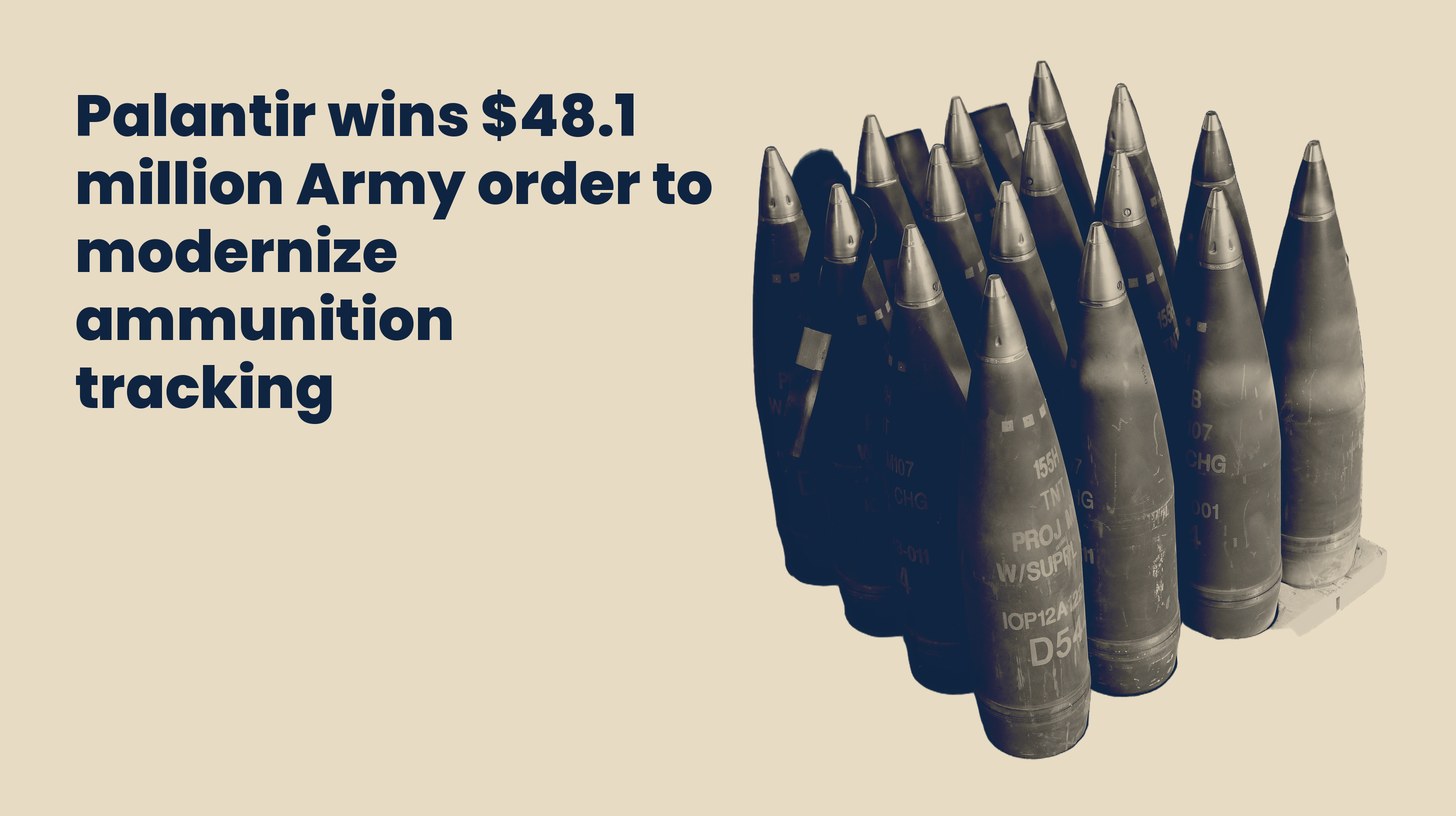
The U.S. Army has awarded Palantir USG a $48,094,071 firm-fixed-price delivery order for an enterprise ammunition management platform. The award replaces nine legacy systems and followed a competitive three-phase selection completed in six weeks.
What's happening
- The Army awarded Palantir USG Inc. a $48,094,071 firm-fixed-price delivery order for enterprise ammunition management software.
- The order sets a 12-month base period with up to five optional years for continued scaling and optimization.
- The new system replaces nine legacy Army ammunition platforms, including SAAS-Modernization and the Industrial Base Assessment Tool.
- The award followed a competitive three-phase selection process that the Army completed in six weeks.
Why it matters
- Consolidating nine separate systems into one platform is meant to give the Army a single authoritative view of ammunition assets across the full lifecycle.
- Faster, unified visibility into stockpiles supports planning and forecasting as munitions demand and production pressures increase.
- Retiring legacy platforms is intended to improve audit readiness for Army ammunition accounting.
Going deeper
- The platform will use commercial low-code, no-code technology to integrate data from disparate legacy systems.
- It is designed to support tactical users operating in disconnected or low-bandwidth environments.
- Vendors were scored in phase one on relevance, innovation, scalability and feasibility, then advanced to live demonstrations in phase two.
Financial impact
- The $48,094,071 figure is the firm-fixed-price delivery order value, not a contract ceiling, since five option years remain unexercised.
- Revenue recognition follows the 12-month base period of performance, with option-year revenue contingent on Army exercise, timing not disclosed.
- The article does not state which fiscal quarter Palantir will book the award or its effect on backlog.
The fine print
- The $48,094,071 total covers development, configuration and fielding of core capabilities during the base period only.
- The five optional years are not yet obligated funds and depend on future Army decisions.
- The article does not specify which legacy systems will be retired first or on what schedule.
Source: soldiersystems.net · Sep 24, 2026 · Drafted with Claude, reviewed by Industrial Base Alpha.