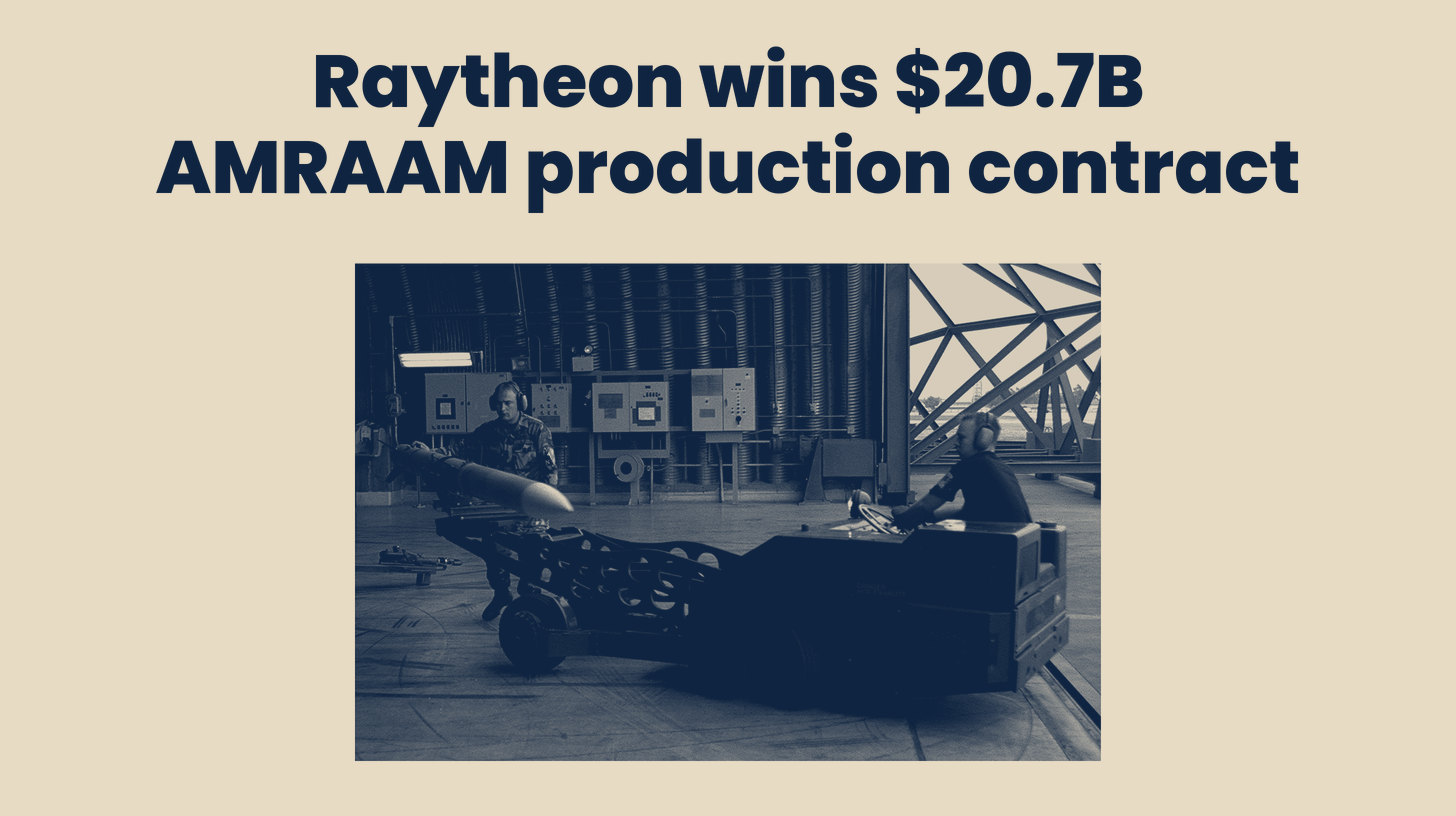
Raytheon won a five-year AMRAAM production contract with two option years and a $20.7B ceiling covering the Air Force, Navy and allied customers. The deal nearly doubles current production rates and surpasses the previous AMRAAM contract ceiling of $3.5B awarded in July 2025.
What's happening
- Raytheon received a $20.7B ceiling multi-year AMRAAM production contract announced September 28 under the Pentagon's Arsenal of Freedom initiative.
- The contract covers five years with two option years and applies to Air Force, Navy and allied procurement.
- Raytheon committed to reaching at least 1,900 AIM-120 missiles annually, nearly doubling current production output.
- The AIM-120 is now in its fifth generation and operates across 14 platforms in service with 44 nations.
Why it matters
- Scaling AMRAAM production to 1,900 missiles yearly from below 1,000 addresses documented Allied air defense gaps and surging demand from the Joint Force.
- The contract underpins supply chain resilience by requiring RTX to engage hundreds of small and mid-sized U.S. suppliers.
- Multi-year procurement authority enables Raytheon to plan capital investment and workforce expansion with demand certainty.
- AMRAAM is the primary interceptor for NASAMS ground-based air defense, making production rates critical to homeland defense modernization.
Going deeper
- RTX reached five separate production frameworks with the Pentagon in February, each setting long-term output goals for AMRAAM, Tomahawk and Standard Missile-6 before formal contracts followed.
- RTX nearly doubled combined AMRAAM and munitions output in 2025 relative to 2024, demonstrating capacity expansion already underway.
- The Pentagon credited Congress for granting multi-year procurement authority and signaled requests for additional authority to sustain production momentum.
Financial impact
- The $20.7B ceiling represents obligated and future revenue recognition over five years plus two option years; obligated amount at contract signing not disclosed.
- Revenue will be recognized upon delivery of missiles against Pentagon and allied customer orders, backlog to be built throughout the contract term.
- Raytheon must fund workforce and facility capital expenditure to reach 1,900-unit annual production, impacting capex and operating margins through the contract period.
- Contract award timing announced September 28, 2026, with revenue recognition spanning fiscal 2026 through 2031 and beyond under option years.
The intrigue
- Actual missile quantity purchased by the Pentagon and allies was not disclosed by either the Pentagon or RTX, leaving the obligated versus ceiling value split unclear.
- RTX is evaluating international co-production of AMRAAM, a step that could shift manufacturing footprint and supply chain resilience equations if pursued.
The fine print
- Contract carries a $20.7B ceiling value; obligated funding at award announcement not disclosed.
- Two option years included in contract structure but exercise at Pentagon discretion.
- Production goal of 1,900 AMRAAMs annually is an agreed target, not a guaranteed minimum purchase commitment per year.
Source: overtdefense.com · Oct 6, 2026 · Drafted with Claude, reviewed by Industrial Base Alpha.