Mentioned:Hanwha OceanHD Hyundai Heavy Industries$23B · Program/Policy
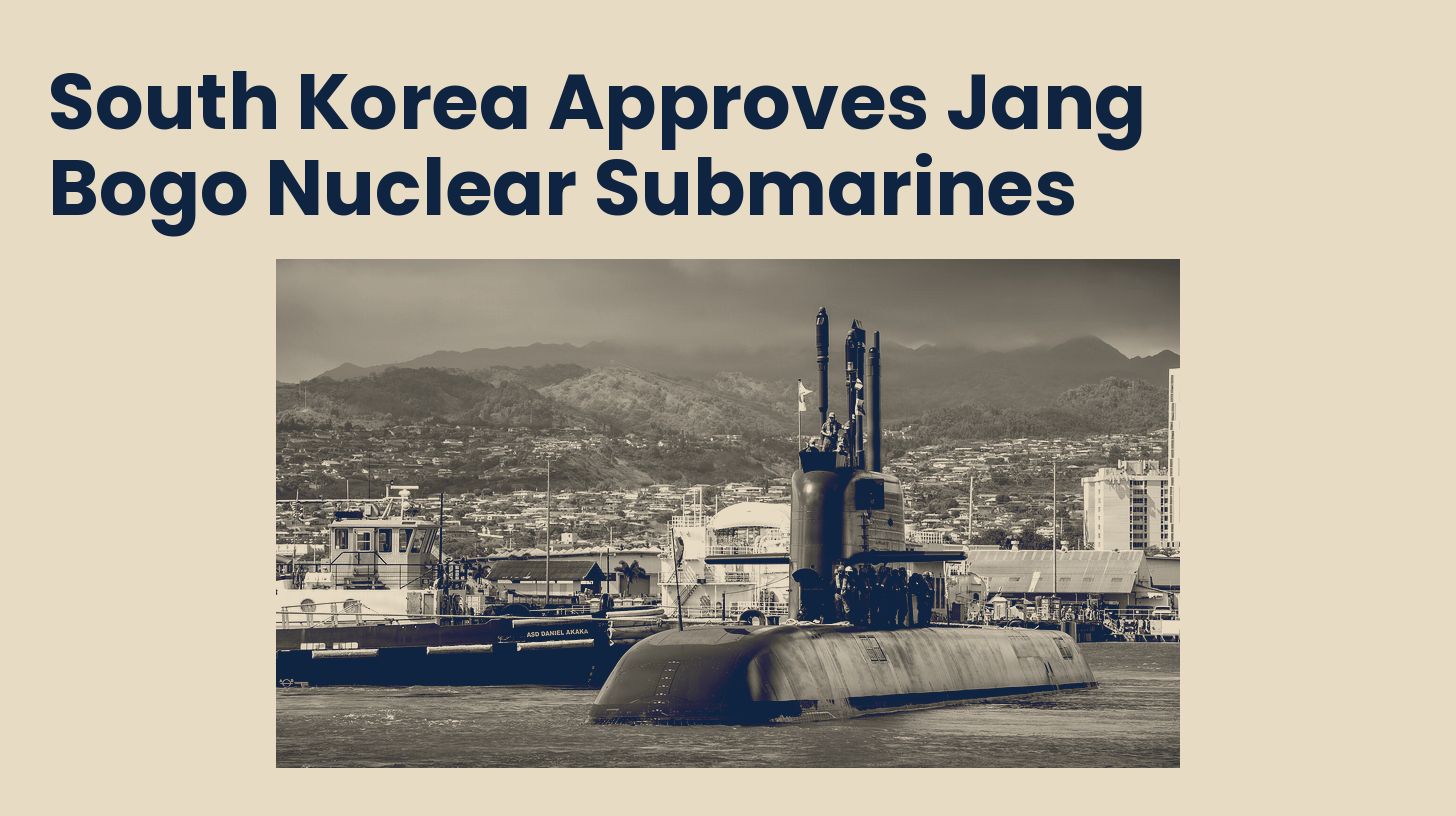
South Korea approved the Jang Bogo N nuclear submarine program on November 6, 2026, with a total estimated cost of 28.9 trillion won ($23 billion USD). The program will develop three nuclear-powered attack submarines displacing over 8,000 tons, with design work beginning in 2027 and the first launch targeted for approximately 2035.
What's happening
- DAPA approved the Jang Bogo N basic acquisition strategy on November 6, 2026, clearing the way for design work to commence in 2027 with an initial budget of 96.6 billion won.
- The program calls for developing three nuclear-powered submarines displacing more than 8,000 tons, compared to the current KSS-III Batch-II vessels at approximately 3,600 tons.
- A South Korean shipbuilder will be selected through competitive bidding in 2027, with Hanwha Ocean and HD Hyundai Heavy Industries expected as main contenders.
- Design work will take three to four years, followed by more than five years of construction, with the first submarine targeted for launch around 2035 and entry into service in the late 2030s or later.
Why it matters
- Nuclear propulsion eliminates the battery-recharging constraints of current diesel-electric submarines, enabling sustained underwater surveillance near North Korean naval bases without surfacing.
- The transition from 3,600-ton conventional submarines to 8,000-ton nuclear-powered vessels substantially extends underwater endurance and operational range, addressing ballistic missile submarine tracking requirements.
- The program represents South Korea's first acquisition of nuclear-powered submarines, expanding the nation's naval strike and surveillance capabilities in regional waters.
- Competitive selection between Hanwha Ocean and HD Hyundai will determine which South Korean shipbuilder develops critical nuclear propulsion manufacturing expertise and submarine production capacity.
Going deeper
- The Jang Bogo N, also designated KSS-III Batch-III, builds on the current Batch-II submarines, which feature ten vertical launch cells for ballistic missiles and lithium-ion batteries with fuel cell air-independent propulsion.
- Nuclear propulsion will enable the Jang Bogo N to maintain sustained speeds underwater and conduct extended patrols without periodically surfacing to recharge batteries, unlike current KSS-III variants.
- The program will incorporate a compact nuclear reactor, although technical specifications remain classified and subject to ongoing design definition during 2027-2030.
- The program depends on negotiations with the United States over supply of low-enriched uranium for military reactor fuel, as U.S. restrictions on nuclear material transfer could affect construction schedule.
Financial impact
- Total program cost is estimated at 28.9 trillion won, recognized as a capital defense acquisition program under South Korean defense budgeting beginning 2027.
- Initial design-phase budget of 96.6 billion won was approved for 2027, with subsequent construction costs spread across the 5+ year manufacturing period following design completion in 2030-2031.
- The selected shipbuilder will receive government-supplied strategic components including the nuclear reactor, affecting supply chain economics and profit margins on the contract relative to conventionally powered submarine production.
The intrigue
- U.S. nuclear material export approval represents a critical path item not yet secured, creating schedule risk if Washington delays low-enriched uranium supply agreements required for South Korean reactor operation.
- The choice between Hanwha Ocean, which recently launched the Seo Hui on November 3, 2026, and HD Hyundai Heavy Industries will concentrate South Korea's nuclear submarine manufacturing expertise at a single yard, creating industrial base dependency.
The fine print
- Total cost of 28.9 trillion won and the three-submarine quantity have not been officially confirmed by DAPA, pending formal design specifications and shipbuilder selection in 2027.
- The program timeline assumes design work starting 2027, shipbuilder selection during 2027, and contract award before year-end 2027; any delays in competitive bidding or U.S. approval processes could compress construction schedules.
- Final weapons configuration for the Jang Bogo N remains classified, although the current Batch-II design baseline includes ten vertical launch cells for ballistic missiles.
Source: armyrecognition.com · Nov 8, 2026 · Drafted with Claude, reviewed by Industrial Base Alpha.