Mentioned:ZiplineWalmartUber$1.5B · Fund Raise
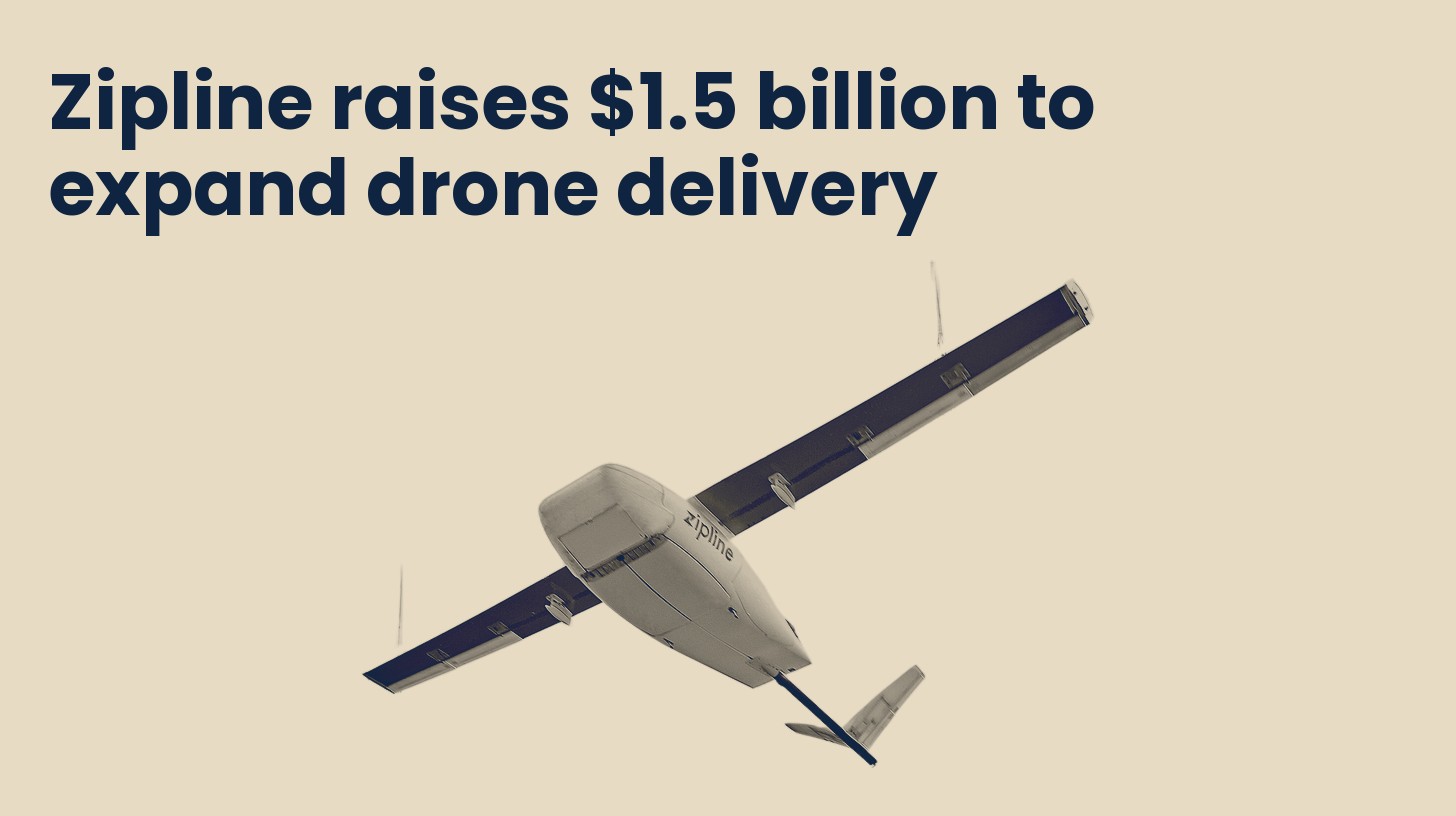
Drone delivery company Zipline raised $1.5 billion at a $21.5 billion valuation to expand U.S. operations nationwide. The round, led by Paradigm, WCM Investment Management, and Layer Global, includes strategic backing from Walmart and Uber.
What's happening
- Zipline closed $1.5B funding at $21.5B valuation, a 183% increase from $7.6B valuation in January 2026.
- Paradigm, WCM Investment Management, and Layer Global led round; Uber, Walmart, Fidelity, Tiger Global, J.P. Morgan, ARK Invest, and Salesforce Ventures also invested.
- Walmart and Zipline plan to launch 300 additional delivery sites under multiyear agreement, with expansion possible beyond those locations.
- Zipline and Uber aim to integrate drone delivery into Uber Eats and reach one million daily deliveries by end of 2029.
Why it matters
- Zipline has demonstrated 150 million commercial autonomous miles flown without a safety incident, signaling maturity of autonomous delivery logistics at commercial scale.
- Walmart and Uber partnerships provide established retail and restaurant customer access, generating order volume needed to sustain a national delivery network.
- Capital deployment supports manufacturing expansion, hiring, and infrastructure build-out to transition from regional to nationwide operations.
- Market validation shows restaurants using Zipline grew delivery revenue share from 10.8% to 34.9% between March and October 2026, with 26% increase in gross merchandise value.
Going deeper
- Zipline completed over one million deliveries in Dallas-Fort Worth during 2026, with median delivery time of 19 minutes from checkout.
- Company introduced noise-reduction technology for next-generation aircraft designed to carry heavier orders farther while flying higher and more quietly.
- Drone industry faces regulatory fragmentation: FAA approval does not resolve local zoning restrictions, environmental concerns, or community opposition.
Financial impact
- Zipline's cash position increases by $1.5B from capital raise; timing of cash inflow is November 2026.
- Capital directed toward manufacturing capacity, personnel hiring, and delivery infrastructure to support national expansion through 2029.
- At a private company pre-revenue scale, this round extends runway, increases ownership dilution, and signals path to profitability through Walmart and Uber volume commitments.
The intrigue
- Zipline's valuation tripled in nine months despite FAA certification being only one hurdle; local zoning restrictions and community opposition could fragment the national network rollout.
- One million daily deliveries by 2029 assumes flawless execution across manufacturing, regulatory approval in 50 states, and sustained demand from Walmart and Uber partnership.
The fine print
- Walmart agreement specifies 300 new sites with expansion possible; terms and timeline for rollout beyond those locations not disclosed.
- Uber Eats integration will begin in existing markets before expanding to new cities; specific markets and expansion schedule not disclosed.
- One million daily deliveries target is aspirational; achievement depends on demand generation, cost control, and resolution of local regulatory challenges highlighted by Amazon's Massachusetts withdrawal.
Source: DroneLife · Nov 5, 2026 · Drafted with Claude, reviewed by Industrial Base Alpha.