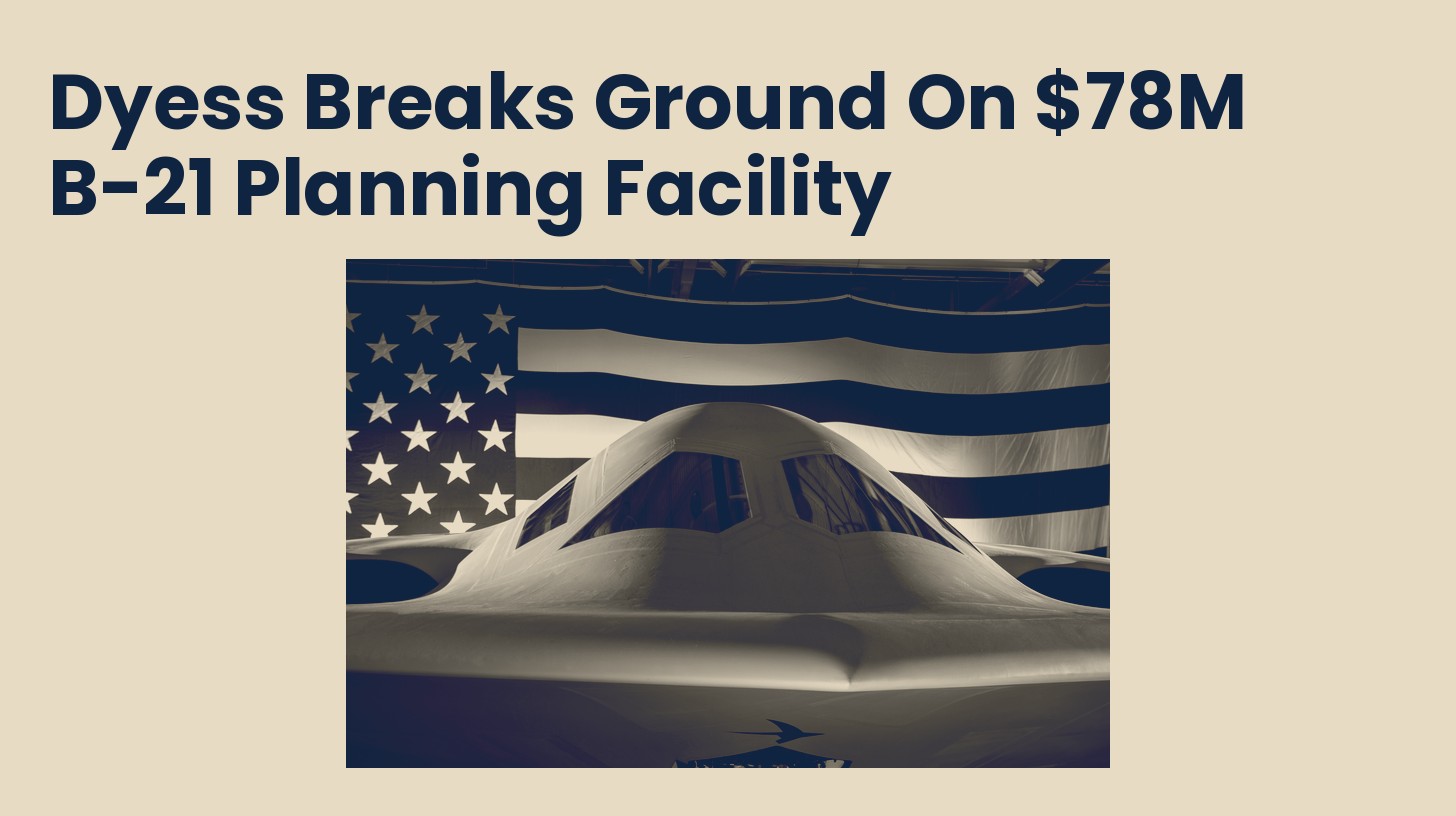
The U.S. Air Force has begun construction of a $78 million mission-planning facility at Dyess Air Force Base, Texas, supporting the installation's preparation to host the B-21 Raider stealth bomber. The 46,000-square-foot building is the first at Dyess designed exclusively for B-21 operations.
What's happening
- Air Force broke ground on a 46,000-square-foot mission-planning facility at Dyess Air Force Base on November 5, 2026.
- The $78 million facility will provide secure workspaces and communications infrastructure for planning and generating B-21 global strike missions.
- Dyess is becoming a B-21 Main Operating Base, joining Ellsworth Air Force Base in South Dakota and Whiteman Air Force Base in Missouri.
- The facility is part of a projected $1.6 billion modernization roadmap covering more than 24 construction and renovation projects over the next decade at Dyess.
Why it matters
- B-21 operations require protected facilities separate from aircraft hangars to handle sensitive mission planning and operational information.
- Dedicated ground infrastructure at a third main operating base increases U.S. bomber force operational capacity and geographic redundancy for sustained global strike presence.
- The facility establishes secure command layer infrastructure necessary to convert B-21 airframe capabilities into executable combat missions against defended airspace.
- Dyess modernization demonstrates Air Force commitment to transitioning from legacy B-1B and B-2 platforms toward a homogenized B-21 and modernized B-52J fleet.
Going deeper
- Col. Robert Sturgill Jr., 7th Bomb Wing commander, described the building as the future nerve center of the B-21 campus, emphasizing modern communications networks and security infrastructure.
- Air Force must balance extensive base construction workflows with ongoing operational readiness of active B-1B Lancer and C-130J Super Hercules squadrons at Dyess during multi-platform transition.
- Many B-21 performance characteristics remain undisclosed, limiting public assessments of range, payload, and survivability against emerging air defense systems.
Financial impact
- The $78 million facility represents obligated government capital spending on military construction (MILCON) in fiscal 2026, likely recognized as Air Force real property asset on the balance sheet.
- The facility cost is embedded within the broader $1.6 billion Dyess modernization roadmap, spread across multiple fiscal years as 24+ projects progress over the next decade.
- No completion date or commissioning schedule has been disclosed, deferring full operational impact recognition to future periods.
The fine print
- The announcement does not disclose detailed systems, construction completion date, or commissioning schedule for the facility.
- Aircraft delivery, personnel preparation, and supporting infrastructure remain separate requirements beyond this single building to establish full B-21 operational readiness at Dyess.
- The baseline $1.6 billion modernization roadmap is distinct from an overall $2 billion investment projection mentioned in reporting, suggesting secondary installation support costs during platform transition are not yet fully itemized.
Source: armyrecognition.com · Nov 8, 2026 · Drafted with Claude, reviewed by Industrial Base Alpha.