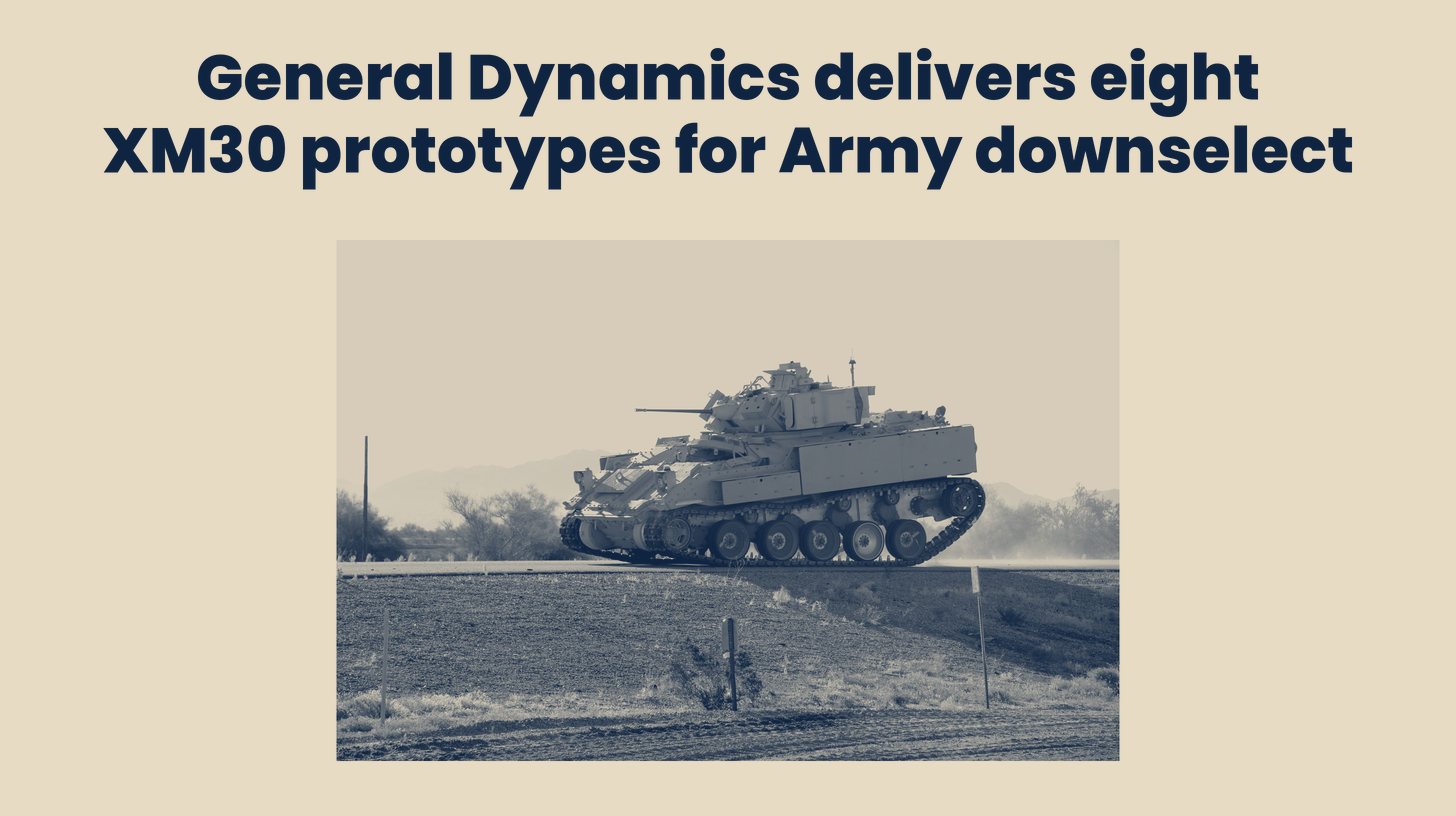
American Rheinmetall delivered its Lynx XM30 prototype to the U.S. Army, beginning operational evaluation by soldiers as part of a $764 million contract to develop a Bradley replacement. The vehicle competes against General Dynamics' Wolf XM30 design in an ongoing trial phase.
What's happening
- American Rheinmetall delivered the Lynx XM30 prototype after completing Army safety tests, moving into soldier-led evaluation and operational feedback.
- The vehicle features a hybrid-electric powertrain and uncrewed 50mm turret, providing more firepower than the Bradley's 25mm M242 Bushmaster.
- American Rheinmetall will deliver 7 additional prototypes by year-end as part of the Engineering and Manufacturing Development contract.
- Soldiers are driving the prototype hundreds of miles to identify design improvements before the Army selects a final contractor.
Why it matters
- The XM30 is designed with modular, open architecture allowing rapid software updates instead of requiring facility overhauls like the Bradley, reducing modernization timeline and geographic displacement.
- Soldier feedback during prototype evaluation directly shapes design decisions, accelerating refinement cycles for a production-ready combat vehicle.
- The dual-vendor development approach preserves competitive pressure and validates two separate technical solutions before committing to full production.
- Replacing the Bradley, which entered service in the 1980s, addresses modern combat environments with electronic warfare and drone threats evident in Ukraine.
Going deeper
- American Rheinmetall emphasized that both XM30 designs likely share similar physical architecture, so competitive differentiation hinges on powertrain, transmission and user interface operability.
- The Army selected both contractors in 2023 for the design phase, advancing to Engineering and Manufacturing Development after initial concept validation.
Financial impact
- The $764 million Engineering and Manufacturing Development contract funds prototype expansion and validation through 2026, recognized as revenue as deliverables are completed and accepted.
- Ceiling value of $764 million covers digital design through validation; obligated funds at contract award timing not disclosed.
- American Rheinmetall recognizes revenue as prototypes are delivered and tested, with 8 total vehicles scheduled by end of 2026.
The intrigue
- American Rheinmetall's competitive advantage rests on powertrain and user experience rather than architecture, a narrower differentiation surface than expected in a $764 million development race.
- The modular, open-architecture design philosophy means future upgrades could potentially be performed by operators or maintenance units rather than manufacturers, altering the support and sustainment revenue model compared to the Bradley.
The fine print
- The $764 million ceiling value is for Engineering and Manufacturing Development; the contract does not commit to production or a final platform selection.
- General Dynamics' Wolf XM30 is undergoing parallel evaluation, meaning the Army will conduct head-to-head testing before awarding a production contract.
Source: Defense News · Oct 13, 2026 · Drafted with Claude, reviewed by Industrial Base Alpha.