General Dynamics Land Systems is demonstrating two systems at the Association of the United States Army's annual meeting: the Wolf XM30 competing against American Rheinmetall's Lynx to replace the M2 Bradley, and PERCH 2.0, which integrates Switchblade 300 loitering munitions onto Abrams tanks and Stryker vehicles.
What's happening
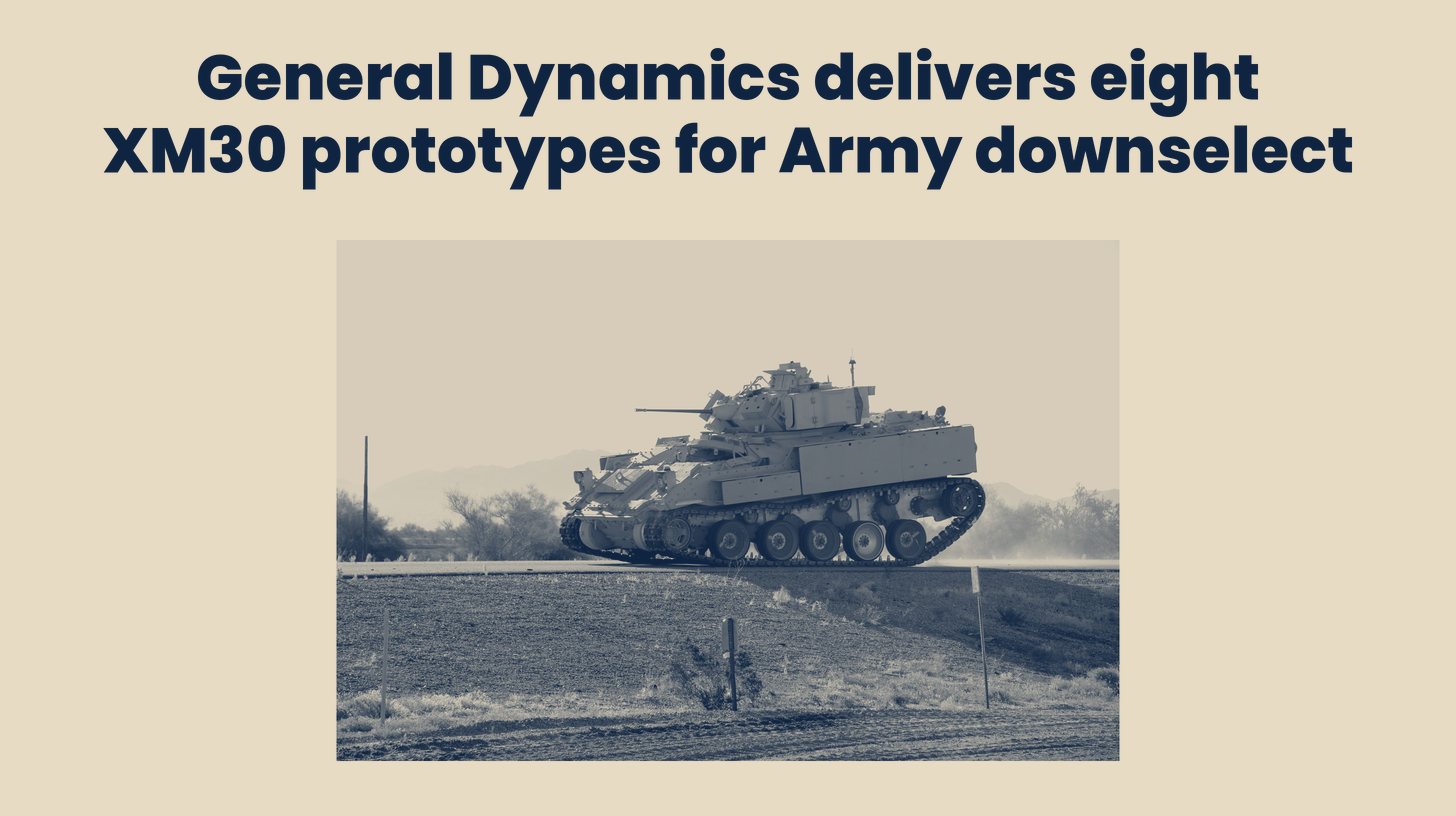
- General Dynamics delivered its first Wolf XM30 prototype to the Army in August, competing against American Rheinmetall's Lynx candidate in the XM30 program.
- PERCH 2.0 enables M1A2 Abrams and Stryker crews to launch Switchblade 300 loitering munitions while staying under armor, with 1 prototype delivered and 3 more in production.
- Thunder Horse soldiers at Fort Hood are testing the PERCH 2.0 prototype, building on feedback from earlier PERCH 1.0 field evaluation by 1st Cavalry Division.
- General Dynamics developed PERCH 1.0 in less than 4 months using internal research and development funding after the 2025 Ukraine discussions.
Why it matters
- The Bradley has reached weight and integration limits, making the XM30 competition critical to maintaining infantry fighting vehicle modernization and close-combat capability.
- PERCH 2.0 expands loitering munitions capacity onto the Army's most lethal armor platforms without requiring vehicle redesign, increasing distributed firepower on existing systems.
- The Army's evaluation approach shifts risk from procurement to experimentation, allowing operational feedback to shape whether the capability competes or moves to production.
Going deeper
- Wolf design prioritizes greater capacity than Bradley while improving fightability, lethality and survivability to accommodate future modular capabilities.
- PERCH 2.0 design incorporated 1st Cavalry Division feedback on loading procedures, crew space and tank loader display integration from the earlier PERCH 1.0 test.
- The Army initially experimented with Switchblade 600 before directing General Dynamics to focus on the smaller Switchblade 300 for crew-under-armor operations.
The fine print
- The Army will decide based on field testing whether to compete the PERCH 2.0 capability or procure it through the Abrams program office.
- General Dynamics funded PERCH 1.0 and early PERCH 2.0 development with its own money before the Army contracted for 3 additional prototypes under the Abrams program office.
Source: Defense News · Oct 13, 2026 · Drafted with Claude, reviewed by Industrial Base Alpha.