Mentioned:Antares$161M · Government Support
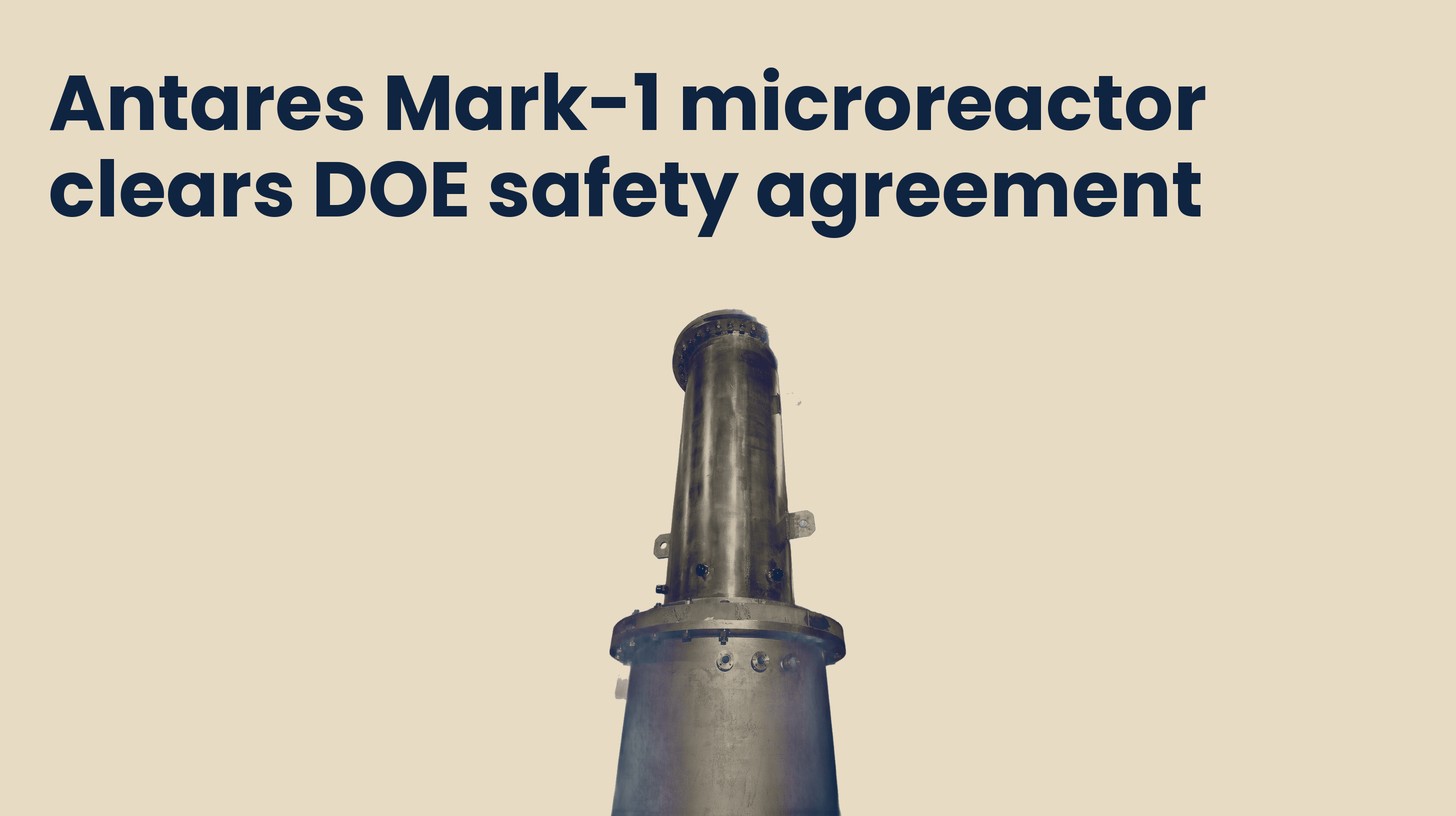
Antares has cleared the DOE's Nuclear Safety Design Agreement for its Mark-1 microreactor, enabling construction and testing at Idaho National Laboratory. The company simultaneously received a $161 million Space Force Strategic Breakthrough award to develop space-qualified reactors for orbital and terrestrial military applications.
What's happening
- Antares Mark-1 gained DOE approval of its Nuclear Safety Design Agreement, establishing formal safety standards and technical baseline for Idaho National Laboratory testing.
- The Space Force awarded Antares $161 million in September 2026 to develop space-qualified reactors for high-demand computing and directed-energy equipment in contested orbital zones.
- Mark-1 will run a six-month full-power testing campaign in 2027 using a nitrogen closed Brayton cycle system to generate electricity.
- The Army's Janus program plans to deploy operational Antares microreactors at Fort Bragg starting in 2028, with multiple units planned.
Why it matters
- The Mark-1 approval demonstrates Antares can move a new reactor design from safety review to demonstration within months, compressing development timelines for military nuclear power.
- Space Force plans depend on persistent orbital power for satellites supporting contested-zone operations; Antares microreactors offer a compact, portable alternative to traditional power systems.
- Successful 2027 testing will directly inform first military deliveries, establishing operational baseline data for Army deployments and reducing integration risk for both terrestrial and space platforms.
- Mark-1 serves as ground proof for the R1-S orbital design using passive heat pipes, reducing mechanical failure modes during long space voyages and supporting rapid space-qualified reactor deployment.
Going deeper
- Antares Mark-0 achieved self-sustaining fission in June 2026, the first privately developed non-light-water reactor to reach initial criticality in over 40 years.
- Mark-1 uses the same full-scale reactor core and TRISO fuel as Mark-0 but must prove sustained electrical generation reliability under operational loads.
- R1-S orbital variant relies on passive heat pipes instead of mechanical pumps, reducing spacecraft breakdowns during extended missions before ground evaluation and flight certification.
Financial impact
- The $161 million Space Force Strategic Breakthrough award funds R1-S orbital reactor development; timing and obligated versus ceiling value not disclosed.
- Antares will recognize revenue from Space Force and Army Janus program contracts as milestones are met through 2028 deployments; specific contract structure not disclosed.
- Successful Mark-1 testing in 2027 will generate operational data supporting subsequent production contracts and Army base installations, establishing revenue streams from repeat military deployments.
The intrigue
- Antares has achieved regulatory approval twice in twelve months (Mark-0 in June 2026, Mark-1 in October 2026), suggesting either exceptional execution or streamlined federal process that may face congressional or technical scrutiny.
- The shift from pure physics validation (Mark-0) to commercial electrical generation (Mark-1) within one year creates execution risk if sustained-load testing reveals unanticipated thermal or materials challenges.
The fine print
- DOE approval of the Nuclear Safety Design Agreement establishes baseline but does not constitute full operational licensing; additional approvals may be required before Fort Bragg deployment.
- Space Force $161 million award amount is stated; contract ceiling versus obligated funds and period of performance not disclosed.
- Mark-1 testing campaign planned for 2027; Janus program deployment start date of 2028 assumes successful completion and all regulatory clearances.
Source: interestingengineering.com · Oct 24, 2026 · Drafted with Claude, reviewed by Industrial Base Alpha.