Mentioned:No public companies identified
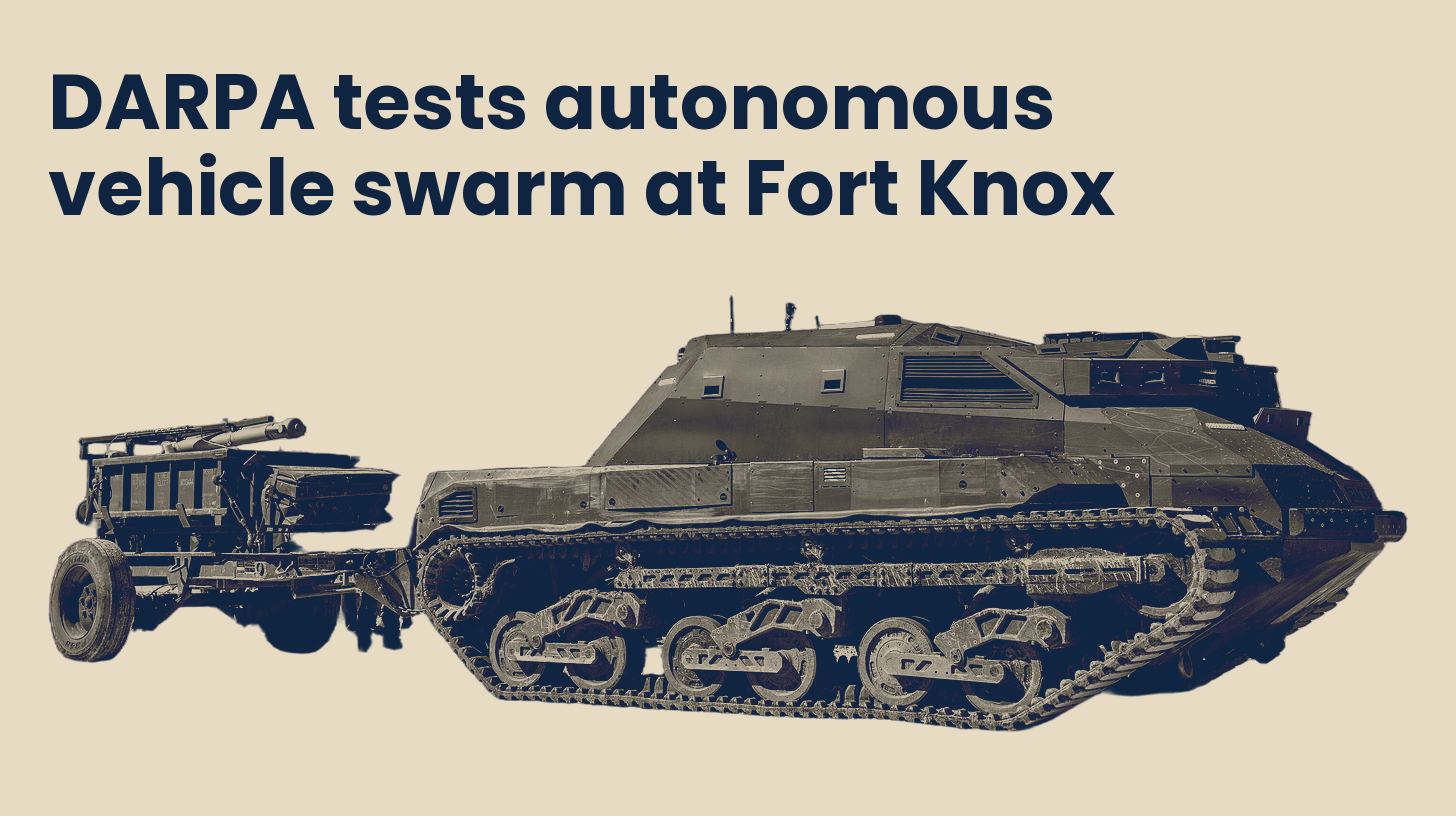
DARPA tested four autonomous unmanned ground vehicles at Fort Knox on October 15, linking satellite imagery to a simulated strike with human operator approval required. The demonstration marks the first end-to-end integration of the RACER program's autonomy software after five years of development.
What's happening
- Four autonomous unmanned ground vehicles executed coordinated movement from a satellite-imagery tip to a simulated strike on an enemy position approximately 275 meters away.
- The lead vehicle detected a target and stopped for human approval while two additional vehicles provided cover and a fourth advanced tactically.
- The test connected the entire chain from satellite intelligence to tactical ground engagement for the first time after earlier component and integration testing at performer sites.
- All mobility, movement and detections operated autonomously, but human operators retained approval authority over engagement decisions.
Why it matters
- The demonstration validates RACER's five-year software development cycle and advances Army operational capability for autonomous reconnaissance and strike beyond forward lines of troops.
- U.S. European Command requested the test to evaluate robotic assets for early warning of enemy forces, addressing a stated tactical gap in the European theater.
- Transition from component testing to integrated tactical demonstration opens pathways for soldier-feedback trials in December and anticipated broader Army deployment.
- The program integrates kinetic and non-kinetic payloads with human-in-the-loop detection protocols, establishing a model for autonomous ground vehicle employment.
Going deeper
- RACER launched in 2021 to develop software enabling off-road military vehicles to drive autonomously at speeds comparable to human operators.
- Earlier RACER field deployments included the U.S. Army's 36th Engineer Brigade pairing a Heavy Platform with an M58 mine-clearing line charge at Fort Hood in October 2025, and the 11th Armored Cavalry Regiment operating Fleet Vehicles based on the Polaris RZR for autonomous reconnaissance at the National Training Center in November 2025.
- The demonstration employed vehicles equipped with onboard sensors and drive-by-wire systems tasked by soldiers via satellite imagery rather than manual control.
- About two dozen visitors from military and government organizations observed the test at Fort Knox's St. Vith Range.
The intrigue
- DARPA must demonstrate that soldier feedback trials in December will generate actionable insights on autonomous vehicle employment, as the gap between laboratory integration and soldier acceptance remains unresolved.
The fine print
- Human operators retain full approval authority over engagement decisions; vehicles do not autonomously decide whether to strike.
- The program is adding kinetic and non-kinetic payloads to vehicles and working on human-in-the-loop detection of both close and deep targets, implying additional development cycles ahead of Army deployment.
Source: defence-blog.com · Oct 25, 2026 · Drafted with Claude, reviewed by Industrial Base Alpha.