Mentioned:GM DefenseFord MotorBC Customs$2.1B · Program/Policy
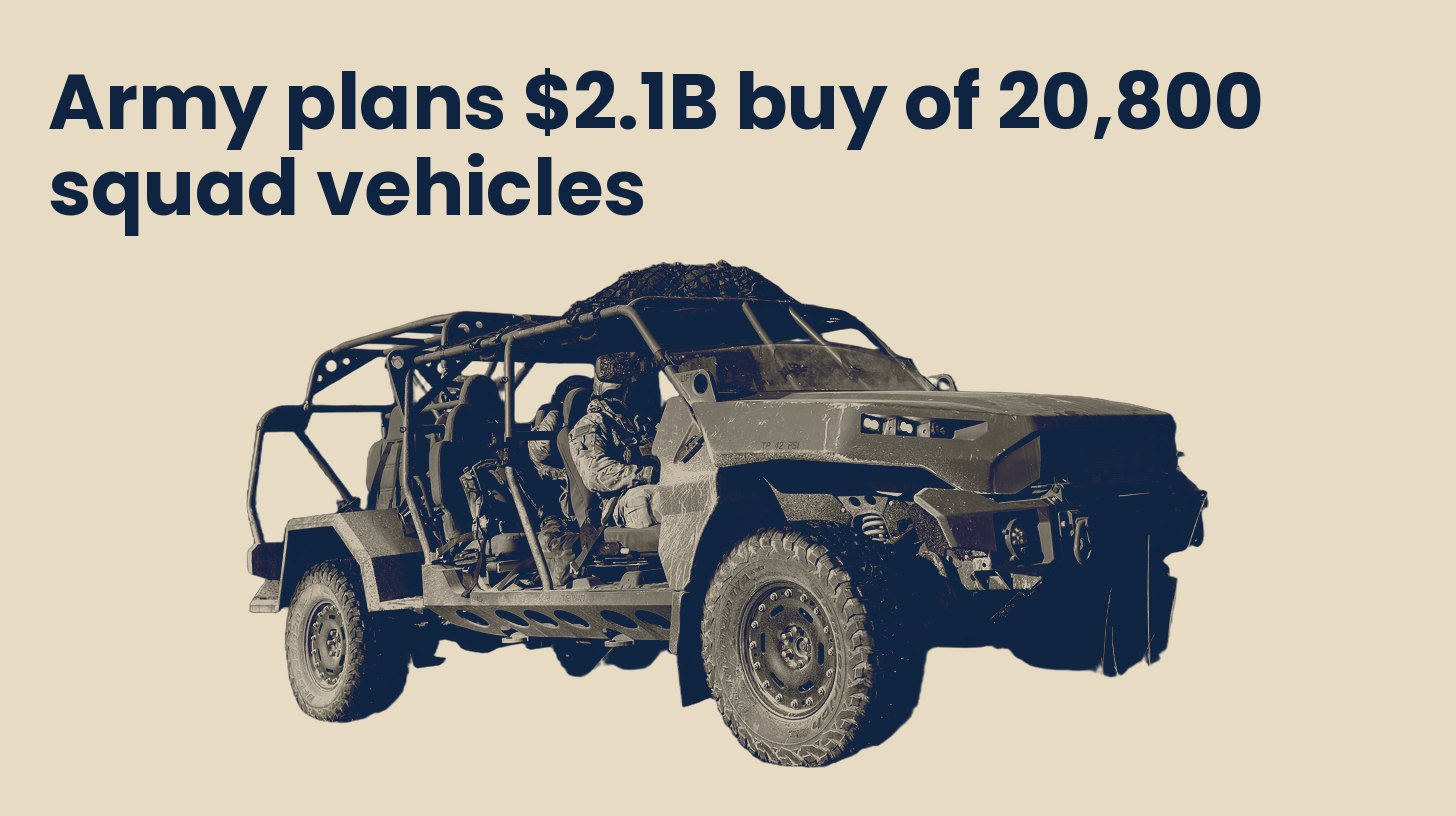
The Army is pursuing a July 2028 contract award for 20,800 Infantry Squad Vehicles, a $2.1 billion expansion that would nearly double the existing acquisition objective. Initial deliveries are targeted for Q4 FY2029, with production ramping to approximately 2,000 units annually.
What's happening
- Army market survey assesses vendor capacity to produce 9,003 ISV-9 models and 11,784 ISV-Utility variants under a 10-year contract.
- Current acquisition objective of 11,582 ISVs would rise to approximately 32,400 units if the 2028 award proceeds.
- GM Defense is in full-rate production on ISV-9 and ISV-U models; Ford Motor and BC Customs compete for the separate ISV-Heavy contract.
- Production schedule shows 106 vehicles in FY-28, then 2,119 in FY-29, and roughly 2,000 units annually thereafter through FY-38.
- Army requested $527 million in FY-27 to purchase 2,418 ISVs and is evaluating multiyear procurement strategies to reduce costs.
Why it matters
- Sustained 2,000-unit annual production rate establishes a stable industrial base for light tactical vehicle supply across Mobile Brigade Combat Teams.
- Multiyear procurement structure would lock in supplier commitments and reduce annual budget volatility compared to annual appropriations.
- Contract award represents sustained capital flow to automotive defense contractors and signals Army confidence in ISV operational performance.
- Army demand for semi-autonomous capability options creates new development pathway and potential margin uplift for winning vendor.
Going deeper
- Senate draft FY-27 defense policy bill includes multiyear procurement authority for ISVs, signaling congressional alignment with Army acquisition strategy.
- Army seeks unlimited rights to technical data, repair specifications and hardware to establish organic sustainment capability and reduce long-term logistics costs.
- Market survey asks vendors to estimate cost savings from multiyear procurement versus annual buys or priced-option contracts.
Financial impact
- GM Defense would recognize revenue over the 10-year contract period from FY-29 through FY-38, with initial deliveries in Q4 FY-29 and peak annual volumes of approximately 2,000 units.
- FY-27 appropriation of $527 million for 2,418 vehicles establishes baseline pricing; future-year obligations depend on contract award and congressional authorization.
- Multiyear procurement structure would accelerate cash flow recognition upfront compared to annual appropriations, improving working capital for the supplier.
- Timing not disclosed for cash flow impact of the $2.1 billion contract ceiling value or obligated funding tranches.
The intrigue
- Army demand for semi-autonomous ISV kits suggests operational pivot toward reduced-manning or remote-control capability, yet cost impact and timeline for autonomy integration remain undefined.
- Competitive ISV-Heavy contract outcome could influence overall ISV-9 and ISV-U procurement strategy and vendor consolidation.
The fine print
- Contract award expected July 2028; market survey is exploratory and does not commit vendors to terms or pricing.
- Army retains unlimited intellectual property rights for data, logistics support and repair specifications, limiting vendor long-term service revenue opportunities.
- Ceiling value is $2.1 billion; obligated funds in early fiscal years are likely lower pending contract finalization and congressional authorization.
- Prototype deliveries for ISV-Heavy competition targeted March before developmental testing; outcome could affect ISV product portfolio.
Source: insidedefense.com · Oct 27, 2026 · Drafted with Claude, reviewed by Industrial Base Alpha.