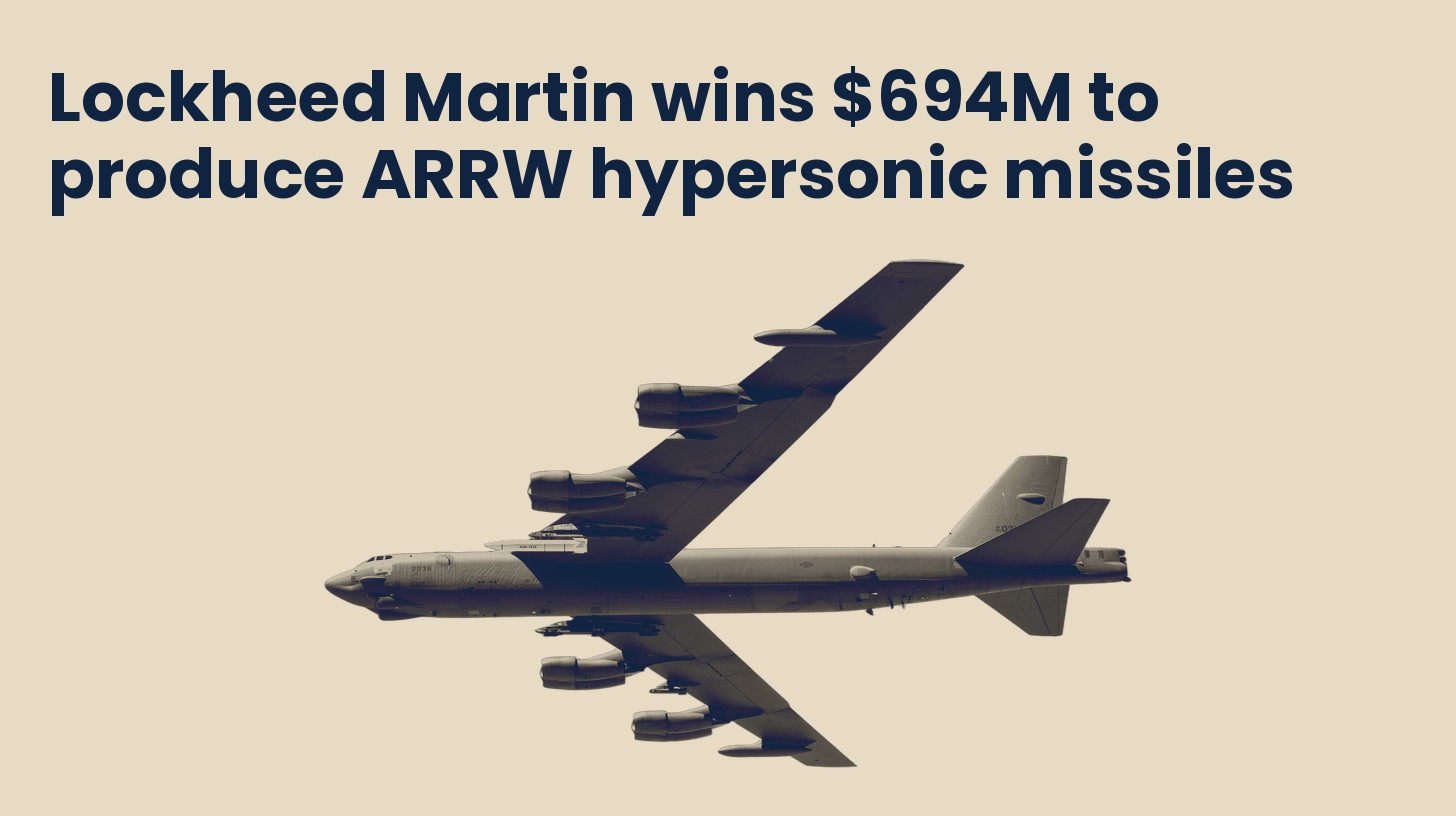
The U.S. Air Force awarded Lockheed Martin a $694 million contract on September 29, 2026, to begin production of the AGM-183A ARRW hypersonic missile. The award reverses the service's 2023 decision to nearly cancel the program and marks the transition from test to production for the air-launched weapon.
What's happening
- Lockheed Martin received a $694 million production contract under the Department of War's Enterprise-Wide Agile Acquisition Contract framework.
- The AGM-183A ARRW will be integrated on B-52H Stratofortress and B-1B Lancer bombers as the Air Force's first hypersonic weapon.
- The Air Force added a $345.7 million request in its FY2027 budget for the weapon's Increment 2 phase.
- The missile uses hypersonic glide vehicle technology derived from the DARPA Tactical Boost Glide program, reaching speeds up to Mach 15.
Why it matters
- Production capacity for a high-speed strike weapon addresses Air Force operational requirements against advanced air defense systems in contested environments.
- The program's reversal from near-cancellation signals sustained commitment to hypersonic capability in the bomber force.
- Fielding ARRW on both B-52H and B-1B platforms diversifies delivery options and distributes industrial risk across multiple airframes.
- The transition from prototyping to production establishes a serial production line for kinetic-kill hypersonic weapons.
Going deeper
- The AGM-183A glide vehicle launches from a solid-rocket motor booster to the upper atmosphere, then separates and glides to targets using kinetic energy alone.
- The Air Force did not disclose the number of missiles ordered or expected delivery dates, citing operational security concerns.
- A 2024 test from Guam involving a live AGM-183 launch at the Reagan Test Site in the Pacific was considered the program's final test event.
- The Director, Operational Test & Evaluation report noted in 2024 that the ARRW showed preliminary indications of becoming operationally lethal despite earlier test failures in 2022 and 2023.
Financial impact
- Lockheed Martin will recognize revenue from the $694 million contract over the period of performance; timing not disclosed.
- The $345.7 million FY2027 budget request for Increment 2 will flow into Lockheed Martin's backlog as work orders are issued.
The fine print
- The contract ceiling is $694 million; obligated funds and milestone-based payment terms were not disclosed.
- The Air Force withheld specifics on production quantities and delivery schedules for operational security reasons.
- Earlier test failures in December 2022 and March 2023 were attributed to sensor system failures and shroud ejection issues, not fundamental design flaws.
Source: theaviationist.com · Oct 27, 2026 · Drafted with Claude, reviewed by Industrial Base Alpha.