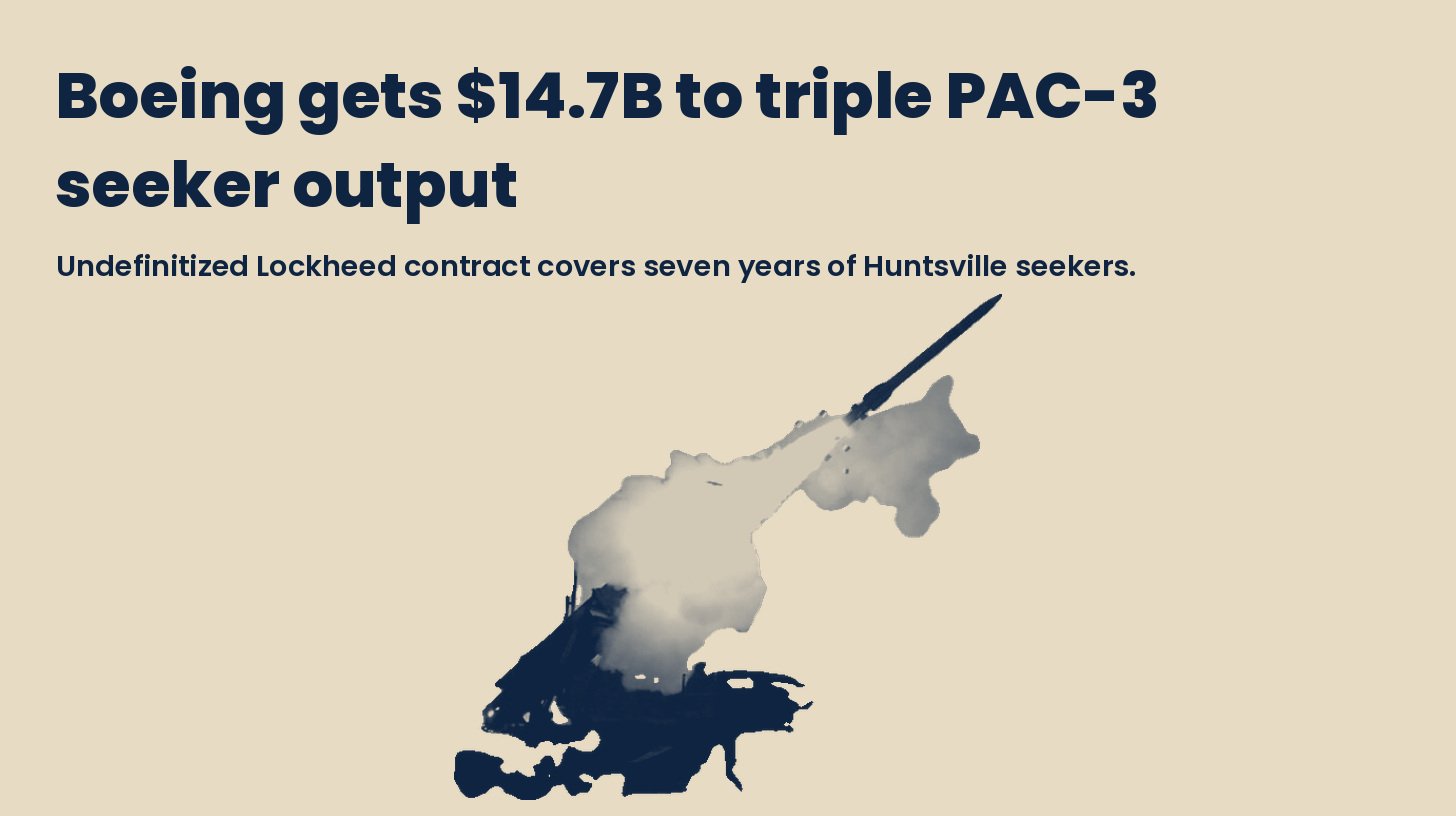
Boeing formalized a seven-year undefinitized contract worth $14.7 billion to triple production of PAC-3 Missile Segment Enhancement seekers at its Huntsville facility. The agreement aligns with Pentagon Acquisition Transformation Strategy and matches Lockheed Martin's push to increase annual PAC-3 interceptor production from approximately 600 to 2,000.
What's happening
- Boeing signed a seven-year undefinitized contract valued at $14.7 billion to triple PAC-3 MSE seeker production at Huntsville, Alabama.
- Work on seekers began immediately following an April framework deal announcement, with production spread across seven years.
- The agreement coordinates with Lockheed Martin's seven-year framework to surge PAC-3 interceptor production from 600 to 2,000 units annually.
Why it matters
- Tripling seeker output addresses U.S. and allied air defense capacity constraints as reliance on costly interceptors against advancing threats intensifies.
- Production surge at Boeing's Huntsville facility establishes critical manufacturing capacity for PAC-3 MSE components, supporting sustained program throughput.
- Coordinated production increases between Boeing seekers and Lockheed Martin all-up rounds eliminate manufacturing bottlenecks in the air defense supply chain.
Going deeper
- PAC-3 MSE seekers identify, track and eliminate ballistic missiles, hypersonic threats and hostile air platforms through direct body-to-body contact.
- The production expansion follows increased Pentagon scrutiny of interceptor costs relative to threat proliferation, particularly Iranian drone and missile activity.
Financial impact
- Revenue from the $14.7 billion contract will be recognized over seven years of performance; timing not disclosed for annual revenue recognition schedule.
- As an undefinitized contract, final pricing and definitization terms remain subject to negotiation, affecting gross margin and cost recognition timing.
- Boeing's backlog grows by $14.7 billion obligated value upon contract formalization, supporting long-term revenue visibility through fiscal 2033.
The intrigue
- Undefinitized contract structure defers cost and pricing certainty, creating potential margin variance depending on labor and material cost negotiations over seven years.
The fine print
- Contract is undefinitized, meaning final terms, pricing and definitization schedule require future agreement between Boeing and the Pentagon.
- Seven-year production period extends through 2033, subject to annual appropriations and program continuation decisions by Congress and DOD leadership.
Source: Defense News · Oct 6, 2026 · Drafted with Claude, reviewed by Industrial Base Alpha.