Mentioned:CesiumAstro$730M · Other
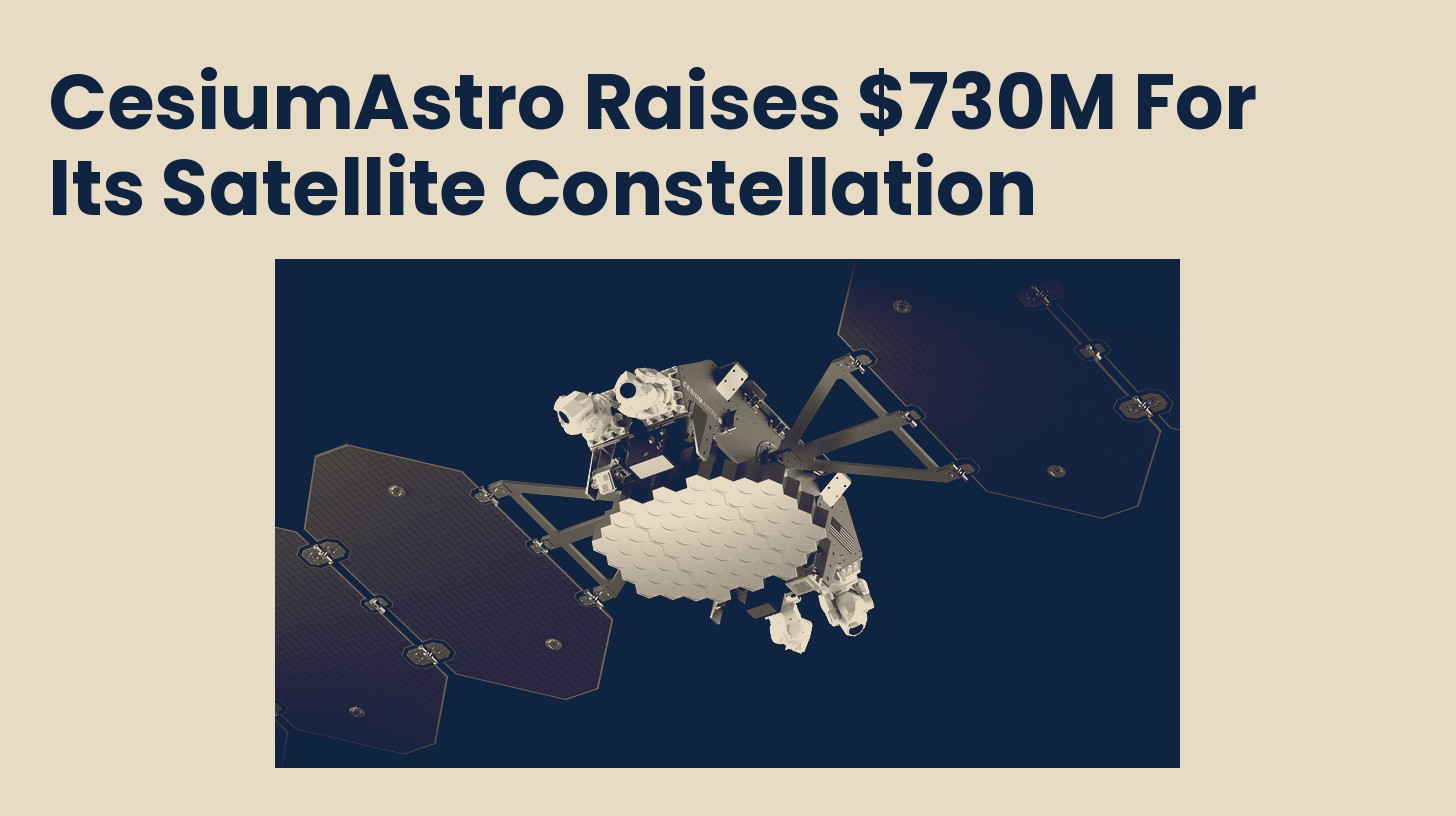
CesiumAstro closed a $730 million Series D led by Janus Henderson, valuing the Austin-based company above $4.5 billion. The capital funds development of Synchronicity, a 737-satellite constellation with AI-enabled edge compute and multi-band communications, along with $500 million in manufacturing expansion over five years.
What's happening
- CesiumAstro raised $730 million in Series D equity plus $100 million in debt from the Export-Import Bank and JPMorgan, bringing 2026 capital announced to $1.2 billion.
- The company plans Synchronicity as a 737-satellite constellation with AI-integrated network optimization, multi-beam multi-frequency architecture across Ku-, Ka-, and V-band, and edge compute for autonomous mission adaptation.
- CesiumAstro acquired Jariet Technologies (RF-SoC semiconductors), 1Aardvark (mission software and autonomous systems), and Vidrovr (AI) in the past 12 months to build vertical integration from silicon to operations.
- The company will invest $500 million over five years to expand its Austin headquarters with 270,000 square feet of advanced manufacturing space.
Why it matters
- Synchronicity positions CesiumAstro as a vertically integrated space infrastructure operator rather than a component supplier, controlling the full stack from custom silicon through spacecraft to ground terminals.
- AI-enabled edge compute and autonomous payload reconfiguration reduce dependence on terrestrial command links, critical for contested or remote military operations requiring resilience and dynamic resource allocation.
- Domestic manufacturing capacity expansion supports DoD supply chain diversification and reduces reliance on existing satellite operators for next-generation defense communications.
- 737-satellite scale enables global coverage with redundancy and multi-orbit deployment options, supporting both commercial and sovereign national security missions across multiple frequency bands.
Going deeper
- Element-1, CesiumAstro's first satellite, has completed on-orbit validation of core technologies before full constellation deployment begins.
- Vertically integrated design enables system-wide optimization impossible with independently sourced components, allowing payload software and processors to evolve post-launch as mission requirements change.
- Strategic acquisitions consolidated semiconductor design, autonomous mission software, and AI capabilities under one roof rather than through external partnerships, reducing supply chain complexity.
Financial impact
- Series D equity of $730 million plus $100 million debt from EXIM and JPMorgan increases CesiumAstro's capital base; timing not disclosed for revenue recognition or balance sheet booking.
- Manufacturing capex of $500 million over five years will appear on the cash flow statement as capital expenditure, typically recognized in the years incurred starting 2026 or 2027.
- As a private company, the raise extends runway and delays need for near-term exit or public offering, allowing focus on Synchronicity development and constellation deployment without immediate IPO pressure.
The intrigue
- CesiumAstro's vertical integration and AI-autonomous architecture compete directly with legacy satellite operators building similar constellations (Kuiper, OneWeb, Telesat), but with proprietary custom silicon and mission adaptation capabilities legacy players cannot replicate quickly.
- Timing of Synchronicity deployment and revenue generation from constellation operations remains undisclosed, leaving uncertainty around when the $1.2 billion in 2026 capital translates to commercial or defense contract wins.
The fine print
- Synchronicity is described as planned and designed; no launch date, orbital deployment schedule, or first-customer revenue timeline is specified in the announcement.
- The $500 million manufacturing investment spans five years, meaning capex will be distributed across multiple fiscal periods rather than concentrated in one year.
- EXIM debt of $100 million carries export credit terms and likely requires compliance with U.S. content and foreign policy restrictions typical of export-import bank financing.
Source: SpaceNews · Nov 5, 2026 · Drafted with Claude, reviewed by Industrial Base Alpha.