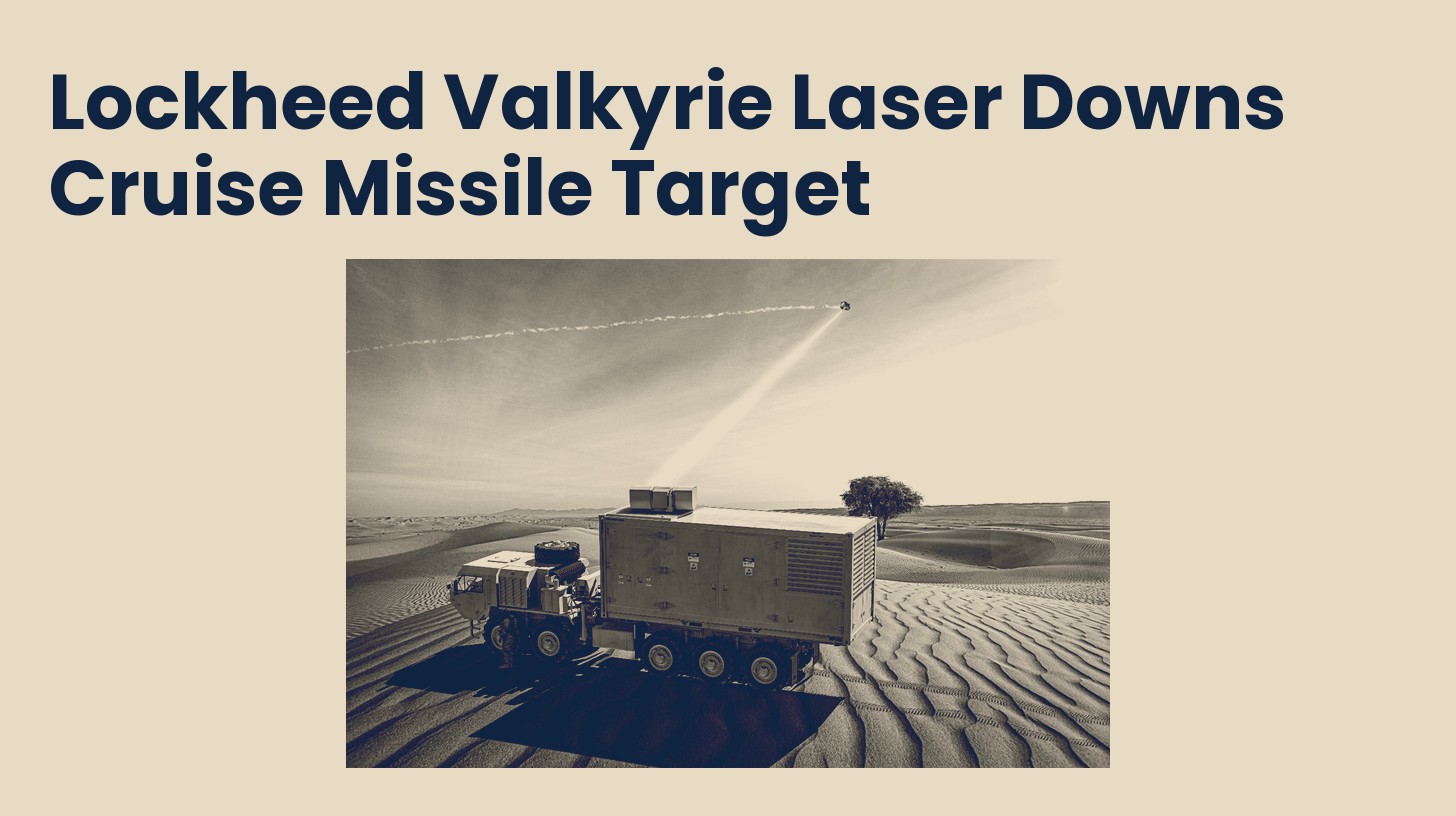
Lockheed Martin's 300-kilowatt Valkyrie laser has destroyed a surrogate cruise missile target for the first time with full kill chain integration, the company announced in November. The demonstration feeds into the Joint Laser Weapon System, a new Army-Navy program that awarded Lockheed and nLight $86 million initially with an $847 million ceiling.
What's happening
- Lockheed Martin destroyed a surrogate cruise missile target using its 300-kilowatt IFPC-HEL Valkyrie laser without track augmentation or beacons.
- The test demonstrated full kill chain integration, meaning the system acquired, tracked and engaged the target autonomously.
- The U.S. Army discontinued the IFPC-HEL program but transferred its technology to the Joint Laser Weapon System, a joint Army-Navy initiative.
- Lockheed Martin and nLight received an initial $86 million contract award with a $847 million ceiling value to develop cruise-missile-defeating lasers.
Why it matters
- Air defense capacity against cruise missiles and drones remains a production and deployment priority for the Army and Navy.
- The transition from IFPC-HEL to JLWS preserves investment in high-energy laser technology and accelerates multi-service integration.
- A 300-kilowatt laser capability represents one of the most powerful directed-energy systems the U.S. military has fielded, expanding the air defense arsenal beyond kinetic weapons.
- Joint service development reduces redundancy and aligns Army and Navy procurement, improving interoperability and industrial base efficiency.
Going deeper
- The Valkyrie test achieved engagement at meaningful distance and short engagement time, addressing previous concerns about laser effectiveness in real-world conditions.
- Secretary of War Pete Hegseth observed IFPC-HEL at White Sands Missile Range in June 2026 as part of a directed-energy weapons demonstration.
- The fiscal 2027 budget request explicitly cited lessons from IFPC-HEL to justify the JLWS program structure and requirements.
Financial impact
- Lockheed Martin will recognize revenue incrementally over the period of performance as development milestones are achieved, beginning with the $86 million obligated portion in fiscal 2027.
- The $847 million ceiling represents the total contract value available if all development phases and options are exercised; timing of ceiling realization depends on Navy and Army funding decisions.
- nLight, as a joint awardee, receives a portion of the initial $86 million but the split between contractors was not disclosed.
The intrigue
- The Army's decision to discontinue IFPC-HEL while simultaneously transferring its technology to JLWS suggests internal disagreement over fielding timelines or operational doctrine rather than technical failure.
- The absence of disclosed test location, date and engagement range raises questions about whether the demonstration was recent enough to influence the JLWS contract award or conducted earlier to justify the program shift.
The fine print
- The $847 million is a ceiling value; actual obligation depends on appropriations and program performance reviews by both Army and Navy.
- nLight's role and funding allocation were not disclosed; Lockheed Martin's percentage of the total award is unknown.
- The test used a surrogate target, not an operational cruise missile, limiting conclusions about real-world performance against full-scale threats.
Source: defence-blog.com · Nov 18, 2026 · Drafted with Claude, reviewed by Industrial Base Alpha.