Mentioned:Survice EngineeringMalloy Aeronautics
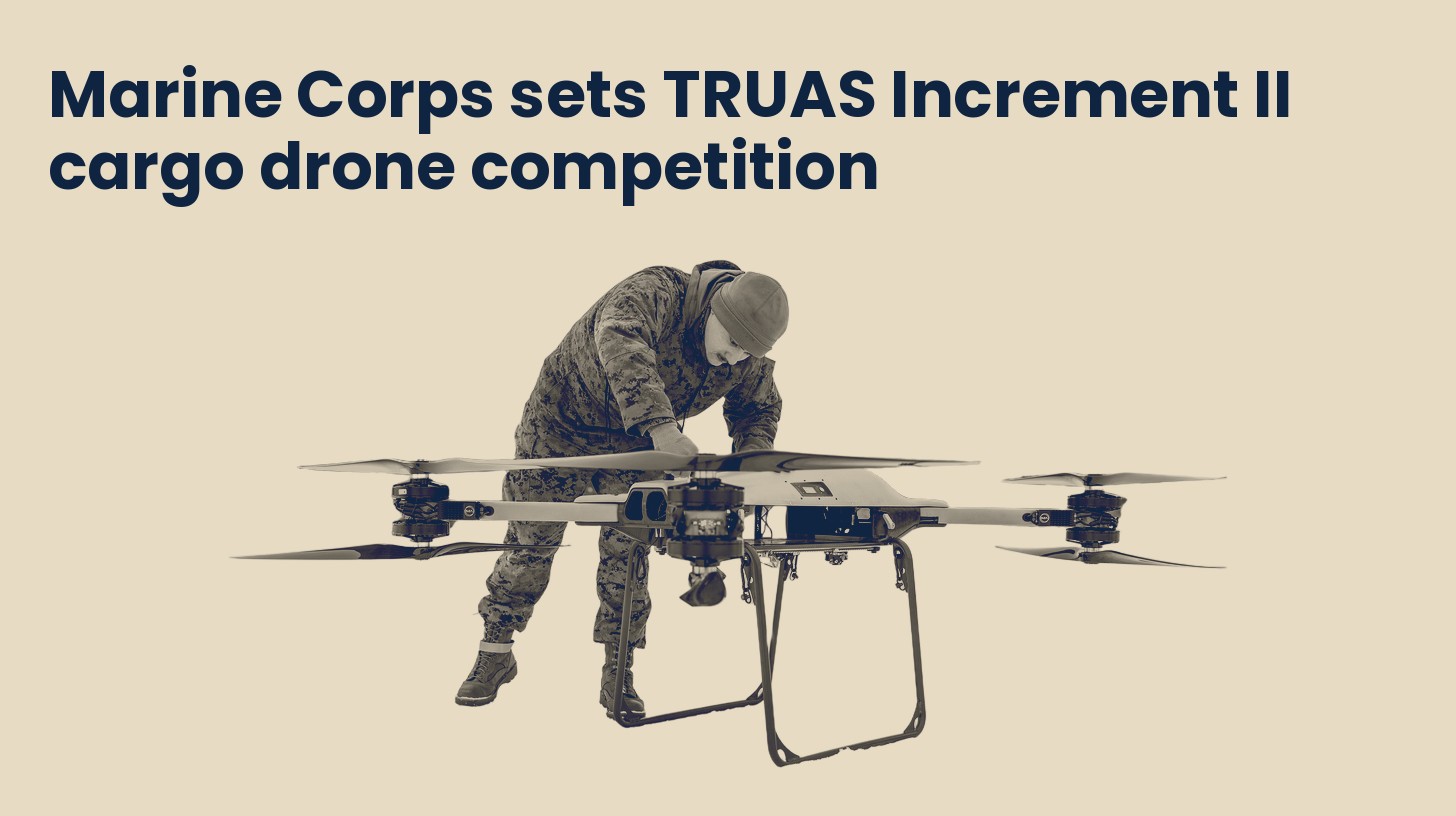
The U.S. Navy is hosting a competition for the Marine Corps' TRUAS Increment II cargo drone system in Huntsville from Jan. 25 to Feb. 5, 2027. Successful competitors must demonstrate the ability to carry 100 pounds 40 nautical miles and return without refueling, using heavy fuel or hybrid power systems.
What's happening
- The Navy will host a cargo drone demonstration for TRUAS Increment II in Huntsville, Alabama, from Jan. 25 to Feb. 5, 2027.
- Entrants must carry 100 pounds 40 nautical miles out and back without refueling, or carry 150 pounds 10 nautical miles out and back.
- Competing aircraft must run on heavy fuel like JP-5 or JP-8, or use hybrid fuel-battery systems, with a maximum gross takeoff weight preference of 350 pounds.
- Companies with applications due Nov. 30, 2026, must demonstrate up to five autonomous sorties with ground setup and flight preparation shown to Navy evaluators.
- Successful prototypes may receive other transaction prototype agreements and follow-on production contracts without further competition.
Why it matters
- Current TRV-150C drones can fly only 9 miles with a full 150-pound load, so Increment II targets a roughly 4-fold range increase to support distributed Marine operations.
- Heavy-fuel powerplants would let Marine units draw from existing JP-8 or diesel supply chains for vehicles and generators instead of depending on field-charged batteries.
- Marine officials planned to issue three to six TRUAS drones to every logistics battalion by 2028, making this competition critical to scaling organic aerial resupply across the force.
- The demonstration will compete multiple designs and select one or more for production, building competition and reducing dependence on the current single supplier, Survice Engineering.
Going deeper
- The current TRV-150C, designed by Malloy Aeronautics and sold in the United States by Survice Engineering, was procured at 21 units for $8.4 million in April 2023 and 31 more for $9.8 million in a later contract modification.
- The TRV-150C achieved initial operational capability on Oct. 27, 2023, with the 3rd Littoral Logistics Battalion at Marine Corps Base Hawaii and has completed field tests since October 2025.
- The U.S. Army evaluated the TRV-150 at Fort Stewart, Georgia, in February 2026, signaling potential cross-service demand.
- System requirements include single-operator control of up to four aircraft, natural-language voice commands, a 20-minute launch readiness window and mean time between failures of at least 30 flight hours with a 90-hour objective.
The fine print
- Participation is limited to U.S.-based, U.S.-owned companies using U.S. manufacturing and repair facilities, or firms compliant with 10 U.S.C. Section 4881 and the American Security Drone Act.
- The competition notice gives no dollar value for awards, planned procurement quantity or timeline for follow-on production decisions.
- Companies must pay their own demonstration costs, sign a cooperative research and development agreement before flying and join the Naval Aviation Systems Co-operative Research and Development effort.
- The government may award no agreements, one or several agreements, and successful prototypes are not automatically guaranteed production contracts.
Source: defence-blog.com · Nov 1, 2026 · Drafted with Claude, reviewed by Industrial Base Alpha.