Mentioned:No public companies identified
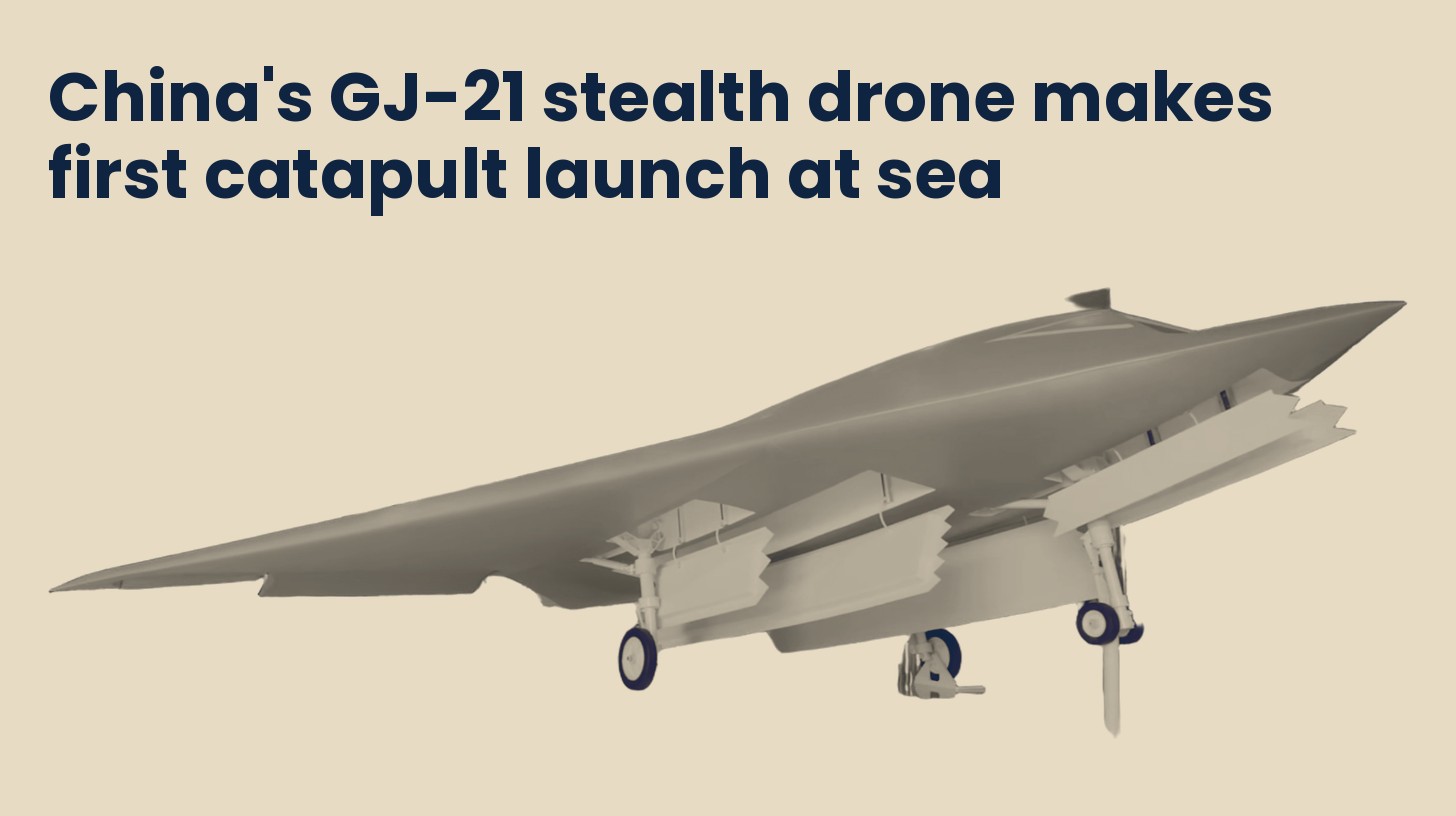
China's PLA Navy confirmed the GJ-21 stealth reconnaissance and strike drone completed its first electromagnetic catapult launch and arrested landing aboard the Type 076 Sichuan amphibious assault ship in October 2026 sea trials. The achievement establishes the first confirmed deployment of a heavy fixed-wing stealth UCAV from an amphibious assault ship.
What's happening
- The GJ-21, a navalized variant of the GJ-11 Sharp Sword introduced in 2019, conducted catapult launch and arrested recovery tests aboard the 50,000-tonne Type 076 Sichuan during late-October 2026 sea trials.
- The GJ-21 features naval modifications including reinforced landing gear, nose-gear launch bar for catapult engagement, and arresting hook for recovery, with both systems visible during April 2026 flight testing.
- The aircraft carries internally mounted precision-guided munitions, potentially including small guided glide bombs, for reconnaissance, surveillance, precision attack, and suppression of enemy air defenses missions.
- The Type 076 Sichuan, launched December 27, 2024, displaces approximately 50,000 tonnes and integrates full-length aviation deck, twin-island superstructure, two side-mounted aircraft elevators, and electromagnetic catapult with enclosed aviation hangar below flight deck.
Why it matters
- Successful UCAV carrier operations from an amphibious assault ship expand China's power projection capability, enabling long-range strike and ISR missions independent of dedicated aircraft carriers.
- Integration of heavy stealth drones with an amphibious platform carrying more than 1,000 marines and multiple landing craft creates a combined-arms capability that merges distributed strike with expeditionary warfare.
- The demonstrated catapult and recovery system on a 50,000-tonne vessel establishes operational procedures for carrier-grade electromagnetic aircraft launch and recovery (EMALS) systems outside traditional carrier platforms.
- Maximum launch weight, recovery speed, sortie-generation rates, and simultaneous operation parameters remain untested, leaving operational capacity and sustained combat tempo undefined for the broader force structure.
Going deeper
- The GJ-21 is a derivative of the GJ-11 Sharp Sword, first publicly displayed during the September 3, 2025 Beijing military parade, making this the first sea trial deployment only 13 months later.
- Naval modifications visible in April 2026 flight testing included reinforced landing gear and launch bar systems, suggesting multiple test phases preceded the October catapult and recovery demonstrations aboard Sichuan.
- Chinese military assessments compare the GJ-21's combat radius to that of the J-20 and J-35 fighter aircraft, but maximum takeoff weight, combat radius, flight endurance, fuel capacity, and weapons payload remain undisclosed.
- The Type 076 Sichuan is the first of its class, with hull assembly beginning October 2023 and launch occurring 14 months later, reflecting sustained production momentum for large-deck amphibious warfare vessels.
The intrigue
- No photographs or video footage had been publicly released as of report writing, leaving the claim unconfirmed by independent visual evidence despite official PLA Navy announcement.
The fine print
- Flight tests validate operational integration of EMALS and recovery systems but do not establish maximum launch weight, recovery speed, sortie-generation rates, or simultaneous operation capacity.
- The GJ-21's tailless flying-wing configuration, S-shaped engine intake duct, and internal weapons bays are designed for stealth preservation, but radar cross-section estimates and detection range against allied systems remain undisclosed.
Source: armyrecognition.com · Oct 30, 2026 · Drafted with Claude, reviewed by Industrial Base Alpha.