Mentioned:The Aerospace Corporation
The Space Force is actively exploring operations in very low-Earth orbit between 150 and 350 kilometers altitude as an emerging area of military interest, with multiple R&D initiatives underway to understand how to operate satellites in conditions previously avoided by the space community.
What's happening
- Space Force deputy chief science officer Gillian Bussey characterized VLEO as an emerging area of interest with a place in future military architecture, though no decisions on launch timing have been made.
- Western companies and defense agencies are funding research and demonstrations including drag-reducing satellite designs, high-power solar arrays, atomic-oxygen-resistant materials, and air-breathing electric propulsion systems.
- China's state aerospace industry plans to launch a remote sensing constellation to VLEO by 2030 and has established an industrial alliance to coordinate standards and research in the region.
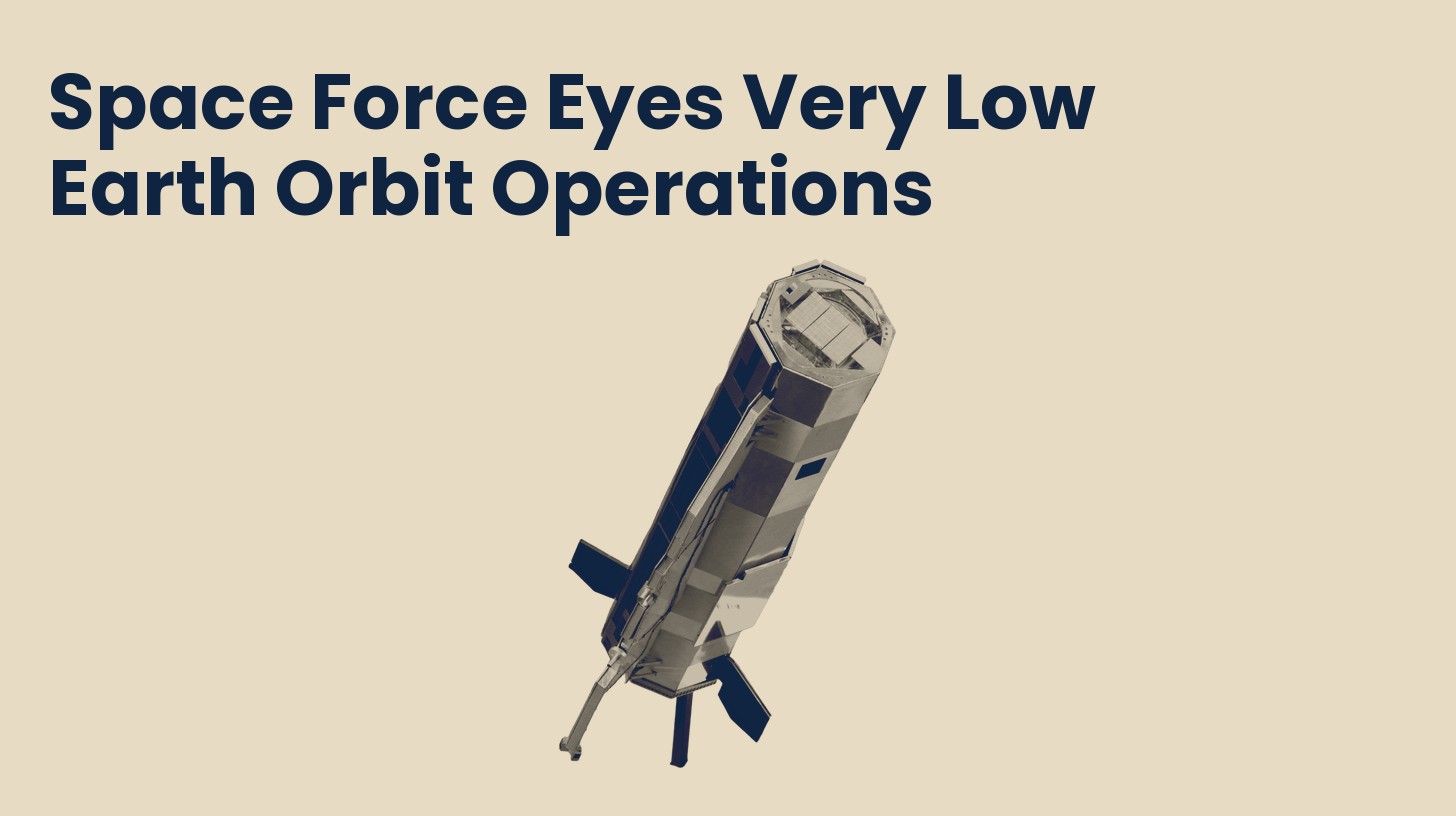
- The Aerospace Corporation launched Disksat in late 2025 to demonstrate a flat satellite design optimized for very low-Earth orbit operations.
Why it matters
- VLEO operations would provide faster communications, more precise positioning, and higher-resolution imagery while the self-cleaning debris environment poses lower collision hazards than current low-Earth orbit constellations.
- VLEO satellites could augment missile warning, tracking, and defense capabilities under the Pentagon's Golden Dome program and reduce vulnerability to nuclear detonation effects in low-Earth orbit.
- The atmospheric environment at VLEO altitudes naturally absorbs radiation and causes debris to de-orbit within weeks, potentially reducing satellite complexity and cost compared to conventional designs.
- Near-term military applications include rapid reconstitution capabilities, allowing the Space Force to demonstrate tactical responsiveness by ordering and launching replacement payloads on short notice.
Going deeper
- VLEO operations present significant technical challenges including atomic oxygen corrosion, extreme atmospheric drag requiring novel propulsion solutions, and difficulty tracking satellites at lower altitudes.
- Bussey indicated the Space Force needs to better understand cost and capability trade-offs between altitude, satellite numbers, and mission requirements before operationalizing VLEO constellations.
- Congressional and White House inquiries over the past year have generated increased discussion within the Space Force about incorporating VLEO into broader military space architecture.
The intrigue
- The Space Force must balance interest in VLEO capabilities against uncertainty about optimal altitudes within the 150-350 km band for different mission sets and the long-term cost of maintaining proliferated constellations in drag-heavy environments.
Source: airandspaceforces.com · Nov 6, 2026 · Drafted with Claude, reviewed by Industrial Base Alpha.