
Mentioned:RTX Raytheon TechnologiesLMT Lockheed MartinBA BoeingGD General Dynamics$44.5B · Program/Policy
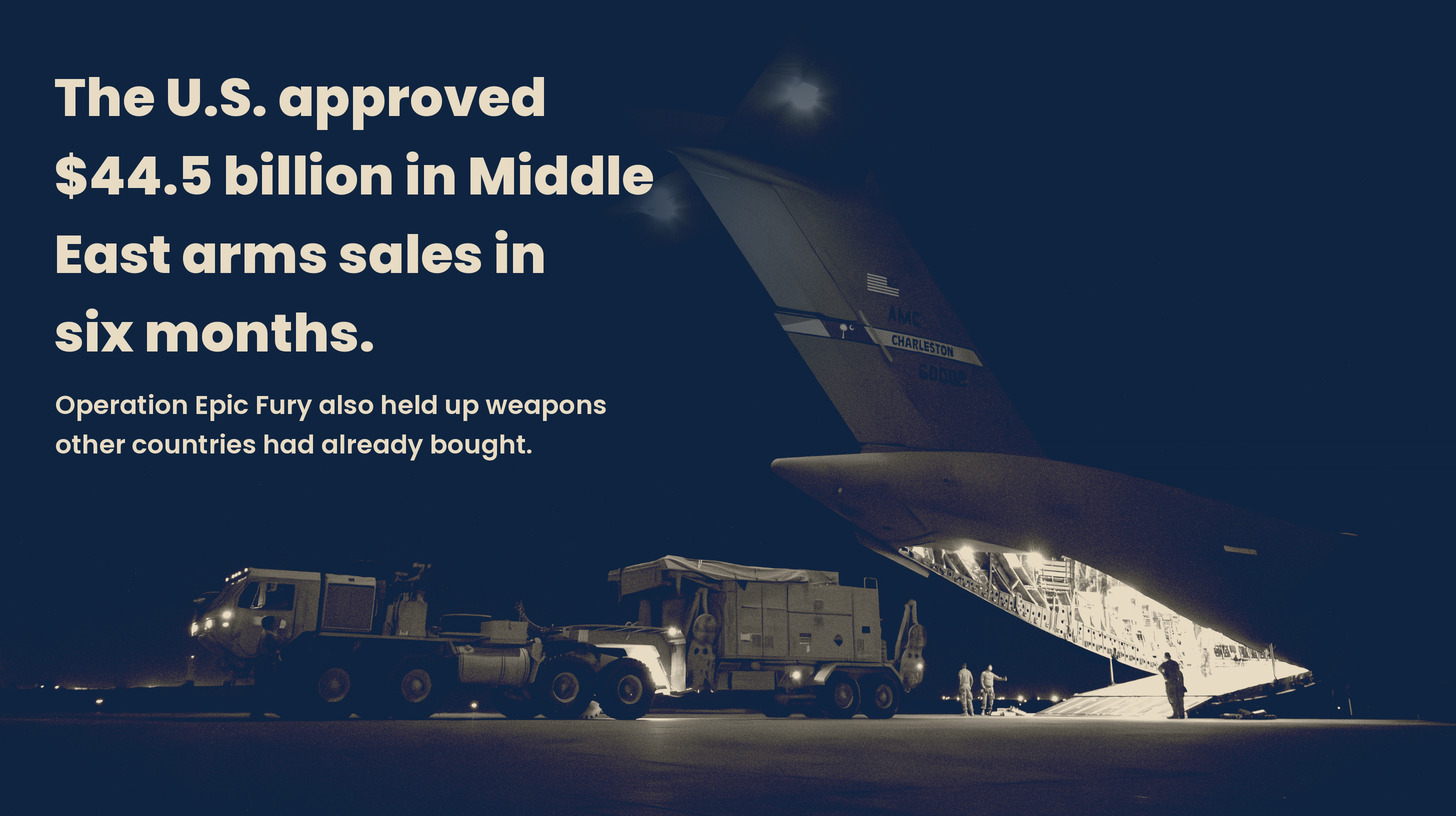
The U.S. State Department approved $44.51 billion in arms sales to six Middle Eastern allies in the first half of 2026, with $25.32 billion expedited through emergency authorities under the Arms Export Control Act. Concurrent Operation Epic Fury requirements forced Washington to delay or postpone equipment already purchased by other countries, revealing production bottlenecks in the domestic defense industrial base.
What's happening
- State Department approved $44.51 billion in proposed sales across six Middle Eastern countries in H1 2026: Saudi Arabia $12 billion, Kuwait $10.74 billion, UAE $8.61 billion, Israel $7.81 billion, Qatar $5 billion, Jordan $350 million.
- Secretary of State Marco Rubio issued three emergency determinations under the Arms Export Control Act, accounting for $25.32 billion and bypassing standard congressional review.
- Sales included Patriot Advanced Capability-3 interceptors, F-15 and F-16 aircraft, THAAD radars, AMRAAM missiles, Apache attack helicopters, and 10,000 APKWS II precision-guided rounds.
- Operation Epic Fury demands caused the State Department to hold or postpone equipment already contracted by unidentified allied and partner nations, without disclosing affected countries, withheld items or delay duration.
Why it matters
- Delivery delays on existing allied commitments expose inability of U.S. defense contractors to simultaneously fulfill Operation Epic Fury requirements and pre-existing foreign military sales obligations.
- The reliance on three emergency determinations for more than half the proposed sales reflects pressure on critical production lines for air-defense missiles, radars and precision munitions.
- Withheld or postponed deliveries to unnamed allies creates political friction and may erode confidence in U.S. supply reliability at a time when deterrence depends on credible defense commitments.
- The State Department's conclusion of no adverse impact on U.S. defense readiness, despite unspecified delays to allied equipment, signals confidence in domestic inventory but masks actual production rate constraints.
Going deeper
- Patriot missile interceptors dominated regional sales, with Saudi Arabia purchasing $9 billion in PAC-3 Missile Segment Enhancement systems and Qatar buying $4.01 billion in Patriot replenishment.
- Air-and-missile defense systems featured prominently: Kuwait's $8 billion radar package, UAE's $4.5 billion long-range discrimination radar, and multiple THAAD system components reflect the operational demands of Operation Epic Fury.
- The composition of sales prioritized missile defense, counter-drone equipment, precision weapons and aircraft sustainment, reflecting the role of ballistic missiles, drones and sustained air operations in the ongoing conflict.
Financial impact
- The $44.51 billion in proposed sales will flow to contractors including Raytheon, Lockheed Martin, Boeing and General Dynamics through foreign military sales contracts over a multi-year performance period; timing not disclosed.
- Revenue recognition for emergency sales approved in H1 2026 will depend on contract execution dates and delivery schedules; the $19.19 billion in non-emergency sales follows standard congressional notification timelines.
- Delays to earlier-purchased equipment for unidentified allies may accelerate cash receipts for Operation Epic Fury deliveries but create deferred revenue and schedule compression risks for affected contractors.
The intrigue
- The State Department withheld the identities of delayed allied nations and the specific equipment postponed, masking the industrial base trade-offs made to prioritize Operation Epic Fury and preventing analysis of which allied relationships bear the supply chain cost.
- The use of three emergency determinations to bypass congressional review for $25.32 billion in sales raises questions about the durability of future emergency authorities if regional demand continues to compete with domestic or allied commitments.
The fine print
- The State Department's Bureau of Political-Military Affairs concluded the full $44.51 billion sales package would have no adverse impact on U.S. defense readiness, but provided no public analysis of how production constraints will be resolved.
- The Lead Inspector General report to Congress listed the $44.51 billion total with a note that the figure may differ slightly from emergency and non-emergency subtotals due to rounding.
- The duration and scope of delays to earlier-purchased allied equipment remain undisclosed, preventing assessment of whether postponements will affect future allied procurement decisions or regional deterrence posture.
Source: defence-industry.eu · Sep 28, 2026 · Drafted with Claude, reviewed by Industrial Base Alpha.