Mentioned:U.S. Air Force$12.6B · Program/Policy
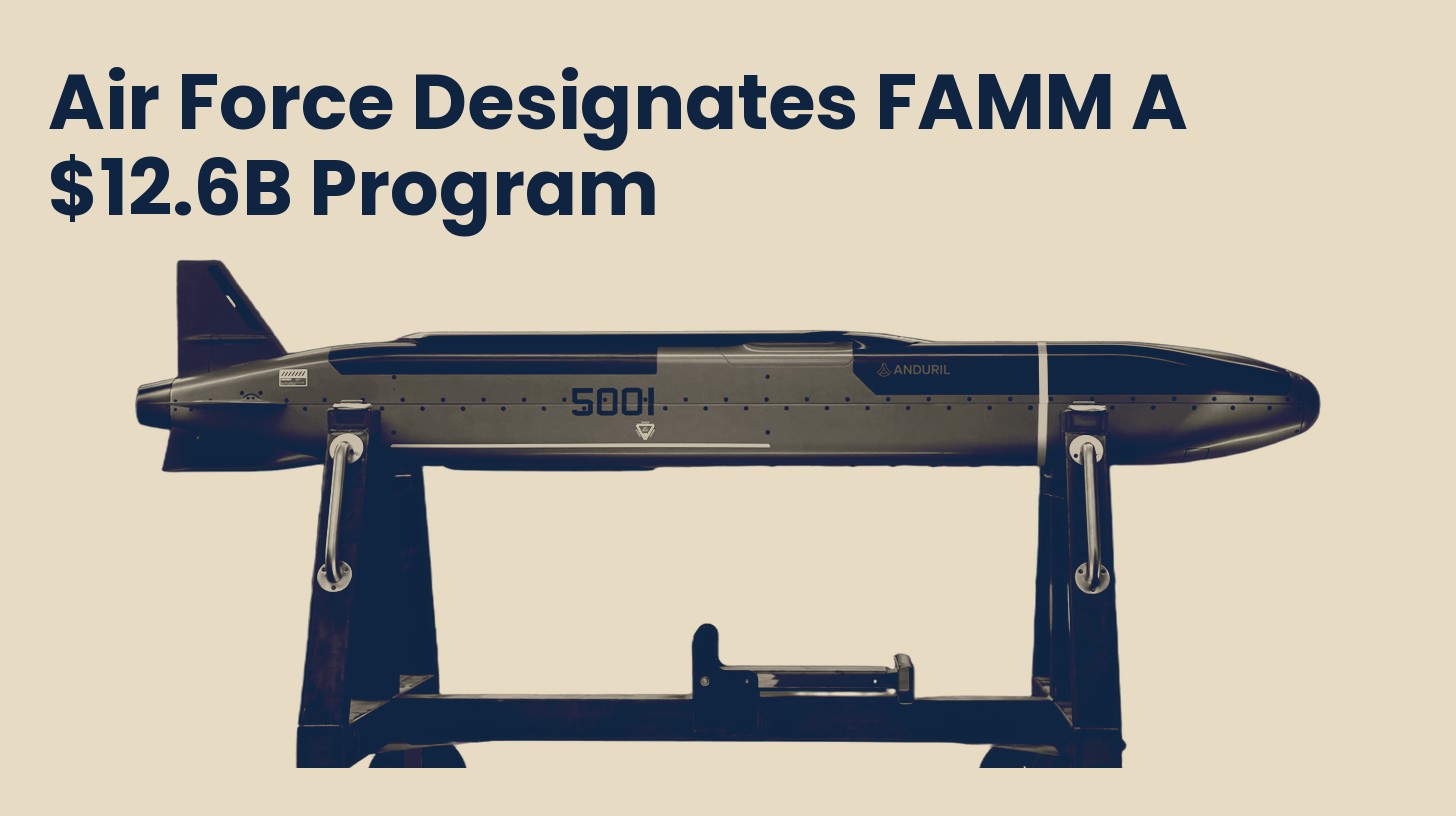
The Air Force has designated FAMM (Family of Affordable Mass Missiles) as an official program of record, committing $12.6 billion over five years to acquire 28,000 palletized cruise missiles. The program enables C-17s and C-130s to deliver mass fires by airdropping containerized munitions at roughly one-tenth the cost of legacy standoff missiles.
What's happening
- Air Force commits $12.6 billion over five years to procure 28,000 FAMM-Palletized cruise missiles costing approximately $450,000 each.
- FAMM weapons deploy from standard airdrop pallets aboard C-17s and C-130s, with missiles self-deploying via parachute and engine ignition after release.
- Program evolved from Air Force Research Laboratory experiments called Rapid Dragon, which began in 2019, and was renamed Dragon Cart before becoming official program of record in April.
- 2027 budget request includes $355 million for procurement of 1,000 FAMM weapons, with additional years following the five-year plan trajectory.
Why it matters
- Enables mobility air forces to deliver precision firepower, blurring the operational distinction between transport and combat aircraft and expanding effective strike capacity.
- Unit cost of approximately $450,000 versus $1.5 million to $2.6 million for JASSM equivalents reduces per-round munitions expense by 82 to 70 percent.
- Lead time measured in months rather than the two years required for JASSM production accelerates munitions availability and reduces supply-chain vulnerability.
- 28,000-unit procurement over five years sustains industrial capacity for affordable cruise-missile production across three companies under multiyear framework agreements.
Going deeper
- FAMM evolved from the Franklin initiative, which originally targeted $100,000-per-round cost, illustrating the program's focus on affordability over advanced capabilities.
- Operational precedent exists: strike aircraft consumed approximately 1,100 JASSMs during Operation Epic Fury from an estimated inventory of 4,400, indicating sustained demand for standoff munitions.
- Program requires cultural shift within Air Mobility Command, as cargo aircraft traditionally operated separately from strike forces and now assume direct combat roles.
- Palletized munitions employ networked, modular design enabling coordinated deployment and targeting from containerized platforms.
Financial impact
- Obligated value of $355 million for fiscal 2027 procurement of 1,000 missiles; total program ceiling of $12.6 billion over five years implies annual commitment of approximately $2.52 billion.
- Revenue recognition spans the five-year period of performance, with procurement phased according to annual budget appropriations and delivery schedules.
- Unit economics of $450,000 per missile establish gross margin baseline assuming efficient production ramp across three awarded contractors.
- Multiyear framework agreements with three companies distribute production, with timing of revenue dependent on option exercise and delivery acceptance.
The intrigue
- Three companies hold framework agreements for FAMM production and development, but the record does not identify the vendors or their respective production allocations.
- FAMM-Lugged variant for fighter aircraft and FAMM-Palletized variant for airlift represent parallel development tracks with potentially different production ramps and unit economics.
The fine print
- Ceiling value of $12.6 billion is a five-year projection; annual appropriations and option exercise remain subject to Congressional approval and budget cycles.
- 28,000-unit procurement plan assumes sustained production across three contractors; actual procurement may vary based on operational requirements and fiscal constraints.
- Lead time stated as months assumes production capacity is available; detailed delivery schedules and production timelines are not disclosed.
Source: airandspaceforces.com · Nov 9, 2026 · Drafted with Claude, reviewed by Industrial Base Alpha.