Mentioned:RTX Raytheon TechnologiesLHX L3Harris TechnologiesGD General DynamicsB&P Littleford$22.9B · Contract Award
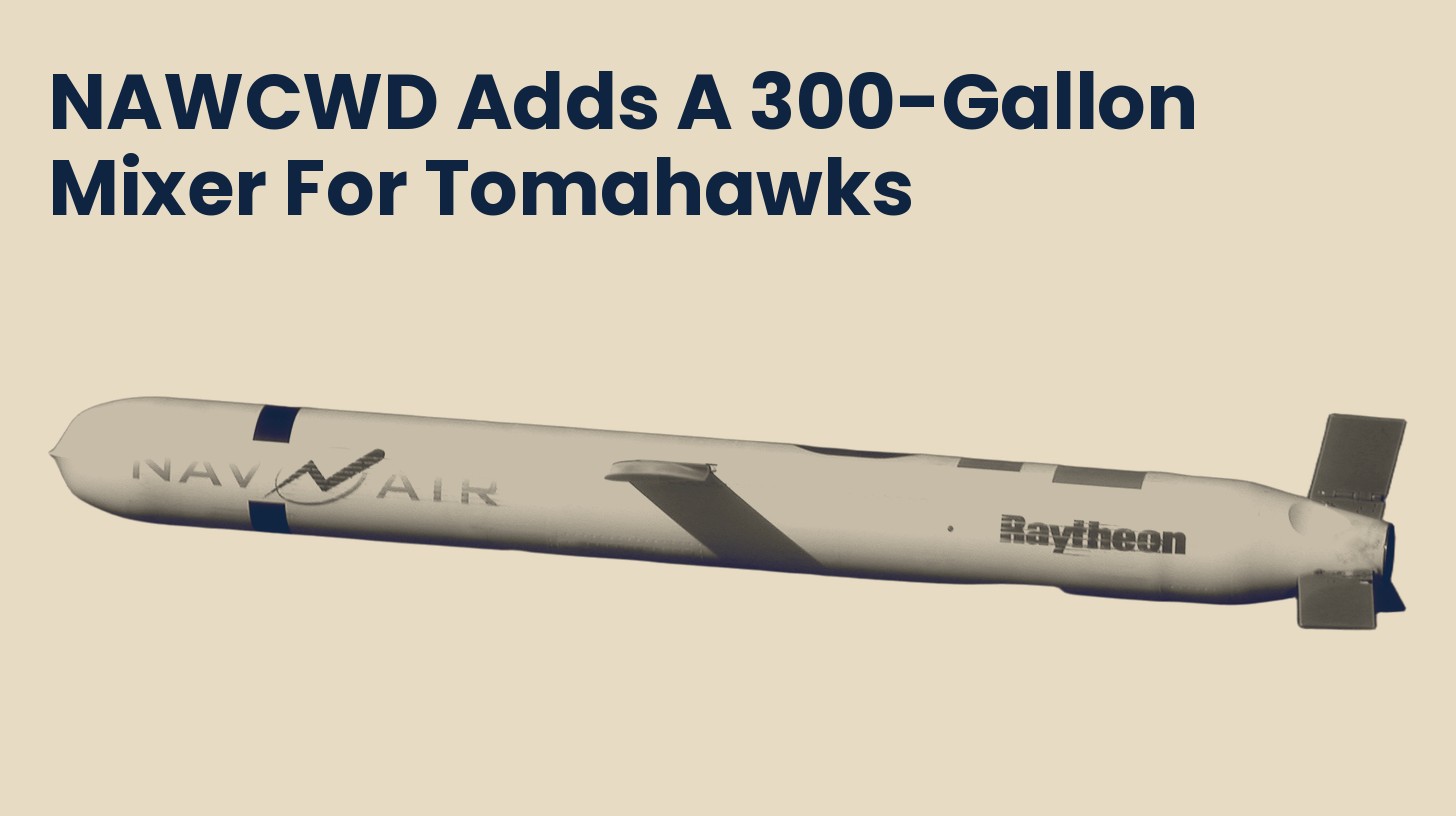
Naval Air Warfare Center Weapons Division activated a new 300-gallon mixer on November 9, 2026, to boost Tomahawk warhead production capacity at its China Lake facility. The expansion supports the Navy's $22.9 billion August 2026 contract with Raytheon to accelerate Tomahawk missile production.
What's happening
- NAWCWD commissioned a new 300-gallon mixer in the rebuilt Motor Assembly Compound at China Lake, expected to reach full production rate around June 2027.
- The facility filled 7 first-article Tomahawk warheads in fall 2026 using a legacy 150-gallon mixer, clearing the path for China Lake to become a second production source alongside L3Harris.
- The new mixer reduces the time to move explosive materials from half a mile between buildings to 15 minutes, accelerating throughput in the casting process.
- NAWCWD signed a multiyear public-private partnership with L3Harris in September 2026 to manufacture missile components, with the Navy lab producing a portion of Tomahawk warheads under the arrangement.
Why it matters
- Raytheon's $22.9 billion contract requires faster production than current warhead supply can support; NAWCWD's second production line ensures continuous on-time missile deliveries to the fleet.
- Dual-sourcing warhead production reduces single-point failure risk and builds surge capacity for peer or near-peer adversary deterrence, a stated Navy priority.
- The facility addresses a critical supply chain bottleneck: key materials take up to 1 year to arrive, requiring NAWCWD to purchase long-lead items in advance to meet accelerated multiyear schedules.
- NAWCWD's dispersed plant layout enables simultaneous casting and curing processes, delivering higher throughput than traditional sequential production workflows.
Going deeper
- The energetics team spent much of 2026 updating the Tomahawk warhead specification and the approved supplier list after the demonstration build revealed the need for a major specification revision.
- NAWCWD is bringing on more than a dozen new hires who will train under experienced technicians for approximately 1 year on safety, quality and procedures before independent work.
- The Motor Assembly Compound replaced energetics facilities destroyed in July 2019 earthquakes; rebuilding began in April 2022 and finished in November 2026.
- General Dynamics Ordnance and Tactical Systems machines warhead cases; L3Harris currently loads them with explosives; NAWCWD now joins as a third participant in the production chain.
Financial impact
- The $22.9 billion Navy contract to Raytheon in August 2026 flows revenue to the prime contractor over the multiyear period of performance; timing of NAWCWD warhead revenue recognition not disclosed.
- NAWCWD purchased long-lead materials ahead of the multiyear contract to reduce schedule risk, increasing operating cash outflows in 2026 and early 2027 before production revenue offsets.
- The facility expansion represents capex investment by Navy through NAWCWD; the new 300-gallon mixer and Motor Assembly Compound are government-owned infrastructure, no direct capex burden on contractors.
The intrigue
- NAWCWD's energetics team undertook the majority of warhead development and specification work alongside day jobs with minimal added staff, raising questions about sustainability as production scales and new hires complete their 1-year training cycle.
- The Navy's acquisition system is designed for fixed multiyear schedules; accelerating production on a shorter clock creates friction in material procurement and supplier onboarding, both acknowledged as harder than warhead loading.
The fine print
- The new 300-gallon mixer is expected to reach production rate around June 2027; warhead delivery timing depends on mixer commissioning and first-article approval completion.
- Every future Tomahawk warhead producer, Navy or industry, must build to the updated specification and source from the Navy-approved supplier list.
- The L3Harris public-private partnership signed in September 2026 is multiyear but specific funding, obligated amounts and term length not disclosed.
Source: seapowermagazine.org · Nov 10, 2026 · Drafted with Claude, reviewed by Industrial Base Alpha.