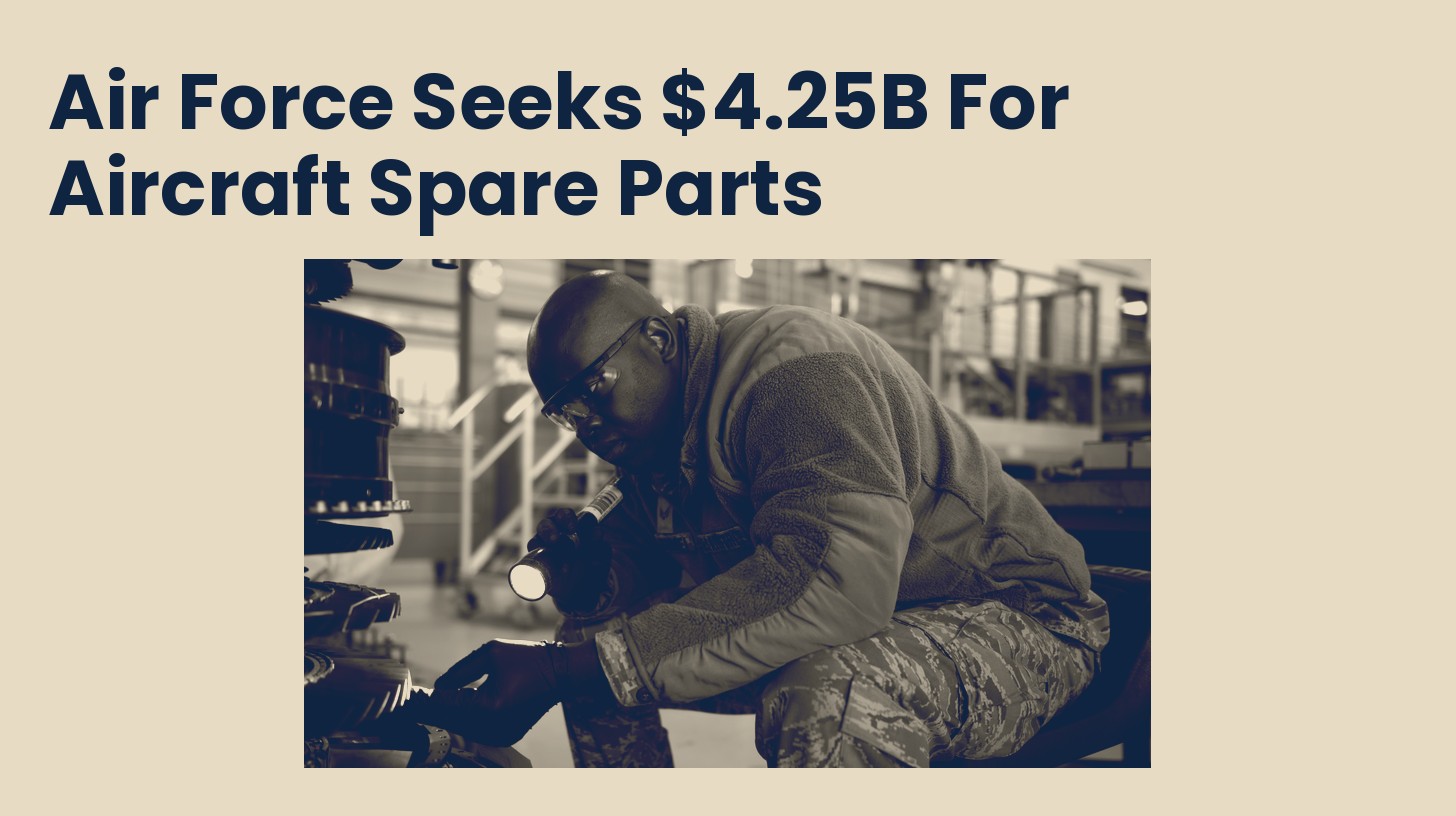
The U.S. Air Force is requesting $4.25 billion in direct appropriations for fiscal 2027 to rebuild critical aircraft spare parts inventory. Only 8 of 24 measured aircraft fleets currently meet supply readiness standards, with the service estimating 18 to 36 months for new parts to arrive and 3 to 5 years to fully recover the supply chain.
What's happening
- Air Force seeks $4.25 billion in FY2027 direct appropriations for the Consolidated Sustainment Activity Group supply division, which manages 70,000 Air Force-unique parts.
- B-2 stealth bomber receives $895.7 million, B-52 $424.7 million, and B-1B $59.9 million in the allocation, with fighter engines accounting for $847.4 million combined for F100 and F110 variants.
- 16 of 24 tracked aircraft fleets miss Total Non Mission Capable for Supply standards, with 5 fleets undershooting by more than 10 percent.
- 36 planned engine maintenance inductions for KC-135 tanker and B-52 could not proceed in fiscal 2024 and 2025 because required parts were unavailable.
Why it matters
- Supply shortages directly ground aircraft and force reliance on parts cannibalization, unsustainably burdening maintenance crews and degrading fleet availability and operational readiness.
- The supply division has operated at unit cost ratio 1.23 in fiscal 2026, meaning it purchases more parts than it sells to rebuild stock, requiring sustained investment to address 20 years of compounding readiness deficits.
- New parts require 18 to 36 months to arrive due to lengthened production lead times and shrunk supply chains since fiscal 2020, making current inventory crisis unresponsive to near-term demand.
- Current model relies on flying units paying for parts from operations and maintenance budgets; direct appropriations avoid forcing units to absorb higher internal costs across five-year planning windows.
Going deeper
- Supply division revenue rises from $6.55 billion in fiscal 2026 to $10.76 billion in fiscal 2027, and year-end cash balance reaches $6.58 billion with the infusion.
- Air Force has raised customer prices 13.4 percent in fiscal 2025, with budgeted increases of 5.78 percent in fiscal 2026 and 4.54 percent in fiscal 2027 to partially fund recovery.
- C-135 family including KC-135 tanker receives $396.9 million, while newer KC-46 tanker receives $109.5 million, reflecting older platforms' greater parts demand.
- F-22 and F-35 receive no appropriations in this exhibit because both rely heavily on contractor logistics support rather than Air Force depot operations.
Financial impact
- Air Force Working Capital Fund receives $4.44 billion in direct appropriations for FY2027, compared with $142.7 million in FY2026, marking structural shift from self-sustaining model to congressional funding.
- Supply division revenue increases $4.21 billion year-over-year from FY2026 to FY2027, recognized through parts sales to flying units over the fiscal year.
- Year-end cash balance improves to $6.58 billion in FY2027, providing liquidity buffer for extended procurement lead times of 18 to 36 months before parts inventory reaches shelves.
- Congress cut $500 million from supply division cash in fiscal 2026, reducing available capital for parts procurement and contributing to current shortfall.
The intrigue
- Air Force estimates full supply chain recovery requires 3 to 5 years of sustained investment, but request covers less than one-third of the $14 billion shortfall estimated by Air Force Materiel Command leadership, leaving future funding gap unaddressed.
- Supply division maintains above-1.0 unit cost ratio through fiscal 2027 by purchasing more parts than selling, a strategy that transfers cost burden to flying units and raises questions about sustainability when direct appropriations end.
The fine print
- Appropriation limited to Non-Contract Maintenance Platforms; F-22 and F-35 excluded because both rely on contractor-managed logistics support contracts.
- Budget estimates assume 18 to 36 month delivery timelines for newly procured parts due to extended supplier lead times; actual inventory recovery depends on industrial base capacity.
- Two prior fiscal years received zero direct appropriations for aircraft spare parts, creating accumulated deficit that single-year $4.25 billion request only partially addresses.
Source: defence-blog.com · Nov 6, 2026 · Drafted with Claude, reviewed by Industrial Base Alpha.