Mentioned:Bedrock Robotics$600M · Series C
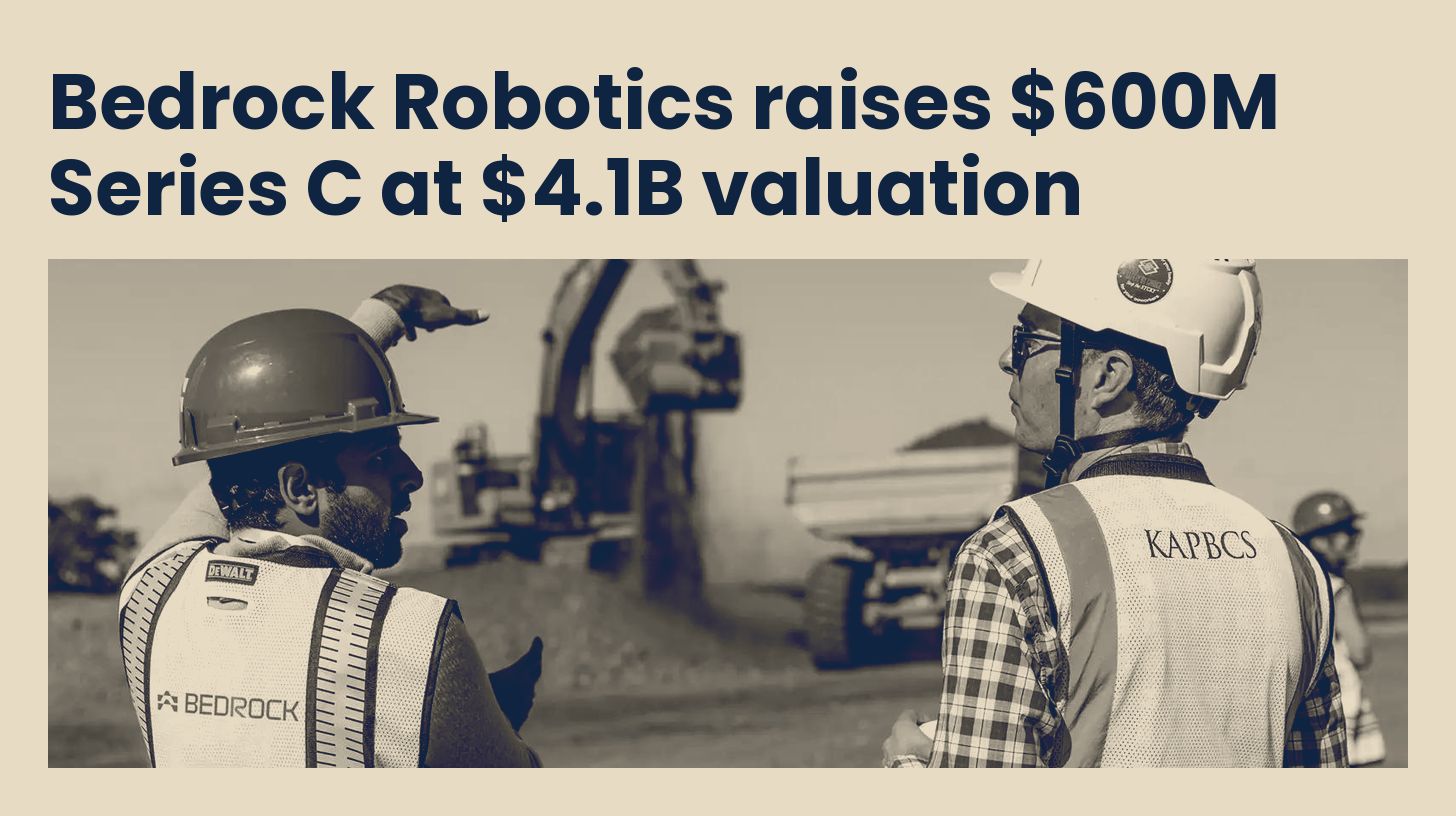
Bedrock Robotics closed a $600M Series C funding round at a $4.1B post-money valuation, co-led by CapitalG and Emergence Capital. The two-year-old startup is scaling commercial deployment of autonomous excavators to address a critical shortage of skilled operators in construction.
What's happening
- Bedrock Robotics raised $600M in Series C funding co-led by CapitalG and Emergence Capital, valuing the company at $4.1B post-money.
- Autonomous excavators equipped with Bedrock's self-driving retrofit kit are now operating commercially at three active job sites: a Nevada water treatment facility, a Texas earthwork site run by Champion Site Prep, and a 1.2 million-cubic-yard Zachry Construction project.
- The company has raised nearly $1B total since its founding in 2024 by Waymo and robotics veterans including CEO Boris Sofman.
- New investors USIT, Bessemer Venture Partners, and Temasek joined existing backers including Nvidia, 8VC, Georgian, and Valor Equity Partners.
Why it matters
- Construction faces acute labor shortages with more than 40% of construction workers approaching retirement age over the next five years, per the Associated Builders and Contractors.
- Excavator operation requires five or more years of training to master, making autonomous solutions critical for maintaining project capacity as the skilled workforce shrinks.
- Bedrock's commercial deployment at active sites demonstrates the technology can integrate into existing job workflows, reducing program risk for contractor adoption.
- Autonomous equipment addresses a structural supply-chain constraint in construction labor that cannot be solved through traditional hiring or training timelines.
Going deeper
- Bedrock's retrofit approach allows installation on existing excavation equipment, lowering capital requirements for contractors compared to purchasing purpose-built autonomous machines.
- CEO Sofman previously led Waymo's autonomous truck program before its shutdown, bringing proven autonomy expertise to construction equipment where labor shortages are less publicized but equally severe.
- The company recently hired Amy Jones Satrom from Amazon, Nuro, and Uber as VP of operations and Lando Juarez from Uber's autonomous mobility business as general counsel to scale field deployment and legal operations.
Financial impact
- Series C adds $600M to Bedrock's cash balance, supporting working capital for field deployment teams and customer support infrastructure; timing is Q4 2026.
- The $4.1B post-money valuation implies an $3.5B pre-money valuation, showing investor confidence in commercial traction after proving autonomous excavators on active job sites.
- Revenue recognition will depend on deployment model: if retrofits are capital sales to contractors, revenue recognition follows delivery; if Bedrock maintains ownership with usage fees, revenue recognizes over contract term.
- Haydon, Arizona-based general contractor, has signed on as a new partner to deploy Bedrock-equipped machines across manufacturing, water and wastewater, data center, and healthcare projects, signaling potential backlog growth.
The intrigue
- Bedrock is backed by Nvidia, raising questions about whether autonomous excavators will drive demand for Nvidia's AI chips in field deployment or whether Nvidia is positioning itself upstream in construction automation value chains.
- The company has achieved $1B in cumulative funding in just two years without apparent government R&D support or defense contracts, contrasting with autonomy startups that rely on DoD contracts for validation and runway.
The fine print
- Commercial deployment is limited to three known job sites as of October 2026; scale-up success remains unproven at dozens or hundreds of concurrent deployments.
- Operating autonomous heavy equipment on active construction sites involves regulatory, insurance, and liability questions that may constrain deployment velocity depending on state and local construction safety requirements.
Source: TechCrunch · Oct 26, 2026 · Drafted with Claude, reviewed by Industrial Base Alpha.