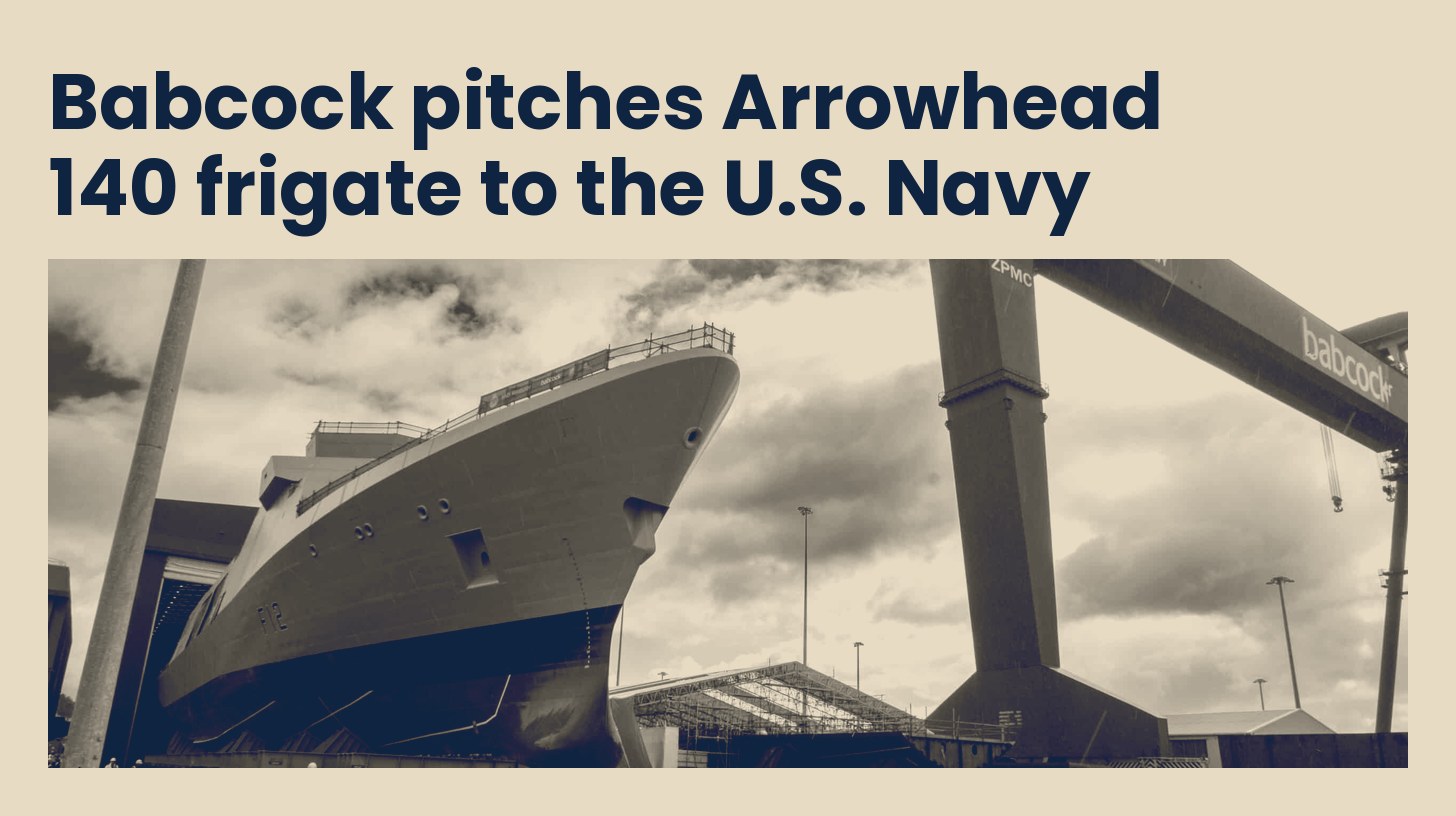
Babcock confirmed interest in offering the Arrowhead 140 frigate design for a U.S. Navy surface-combatant requirement following Washington's August 2026 policy shift permitting limited foreign warship construction. The company is exploring a partnership with Huntington Ingalls Industries for domestic assembly.
What's happening
- Babcock confirmed October 25, 2026, its interest in competing for a U.S. Navy surface-combatant requirement with the Arrowhead 140, the design foundation for the British Royal Navy's Type 31 frigate.
- Babcock is exploring a potential partnership with Huntington Ingalls Industries for domestic assembly of the frigate in American shipyards.
- The initiative places the Arrowhead 140 in competition with Japanese Mogami-class, South Korean Chungnam-class, and Turkish Istanbul-class frigate alternatives.
- An expression of interest is expected before October 31, 2026, but no formal bid, construction site, or contract has been confirmed.
Why it matters
- The Constellation-class frigate program was reduced to two vessels in December 2025, creating urgency for the Navy to evaluate alternative designs for rapid production.
- Trump's August 13, 2026, memorandum permits foreign suppliers to construct the first two vessels overseas if they establish a new U.S. shipyard or acquire majority equity in an existing facility; subsequent ships must be built domestically.
- Washington requested $1.85 billion to evaluate foreign construction and potentially finance initial procurement, signaling a significant shift in domestic shipbuilding capacity planning.
- The Secretary of War must submit a surface-combatant acquisition plan by November 12, 2026, establishing the timeline for the Navy's evaluation process.
Going deeper
- The Arrowhead 140 design originated from Denmark's Iver Huitfeldt-class and was selected in September 2019 for the British Type 31 program under a £1.25 billion construction contract, averaging £250 million per ship.
- The Type 31 displaces 5,700 tonnes, measures 138.7 meters in length, and accommodates a crew of 110 to 115 sailors with intended armament including one Bofors 57 mm gun, two Bofors 40 mm mounts, Sea Ceptor missiles, and Naval Strike Missiles.
- Unlike the Type 26, the Type 31 lacks integrated electric propulsion and dedicated acoustic-quieting arrangements, limiting its suitability for passive submarine detection without further modifications.
- Congressional restrictions remain: the House FY2027 defense authorization proposal prohibits foreign-built warships, while the Senate Armed Services Committee permits up to two foreign-built auxiliary vessels but maintains restrictions on combatants.
The fine print
- Babcock's eligibility for overseas construction depends on the company establishing a new U.S. shipyard or acquiring majority equity in an existing facility under the five industrial conditions set by Trump's August 13, 2026, memorandum.
- Overseas construction requires a national-security exception under 10 U.S.C. 8679 and congressional notification 30 days before contract award.
- The Type 31 has not entered operational service, and its baseline equipment lacks the shipborne sonar required for sustained anti-submarine operations.
- Modifications to mature foreign designs require senior administration approval before proceeding.
Source: armyrecognition.com · Oct 26, 2026 · Drafted with Claude, reviewed by Industrial Base Alpha.