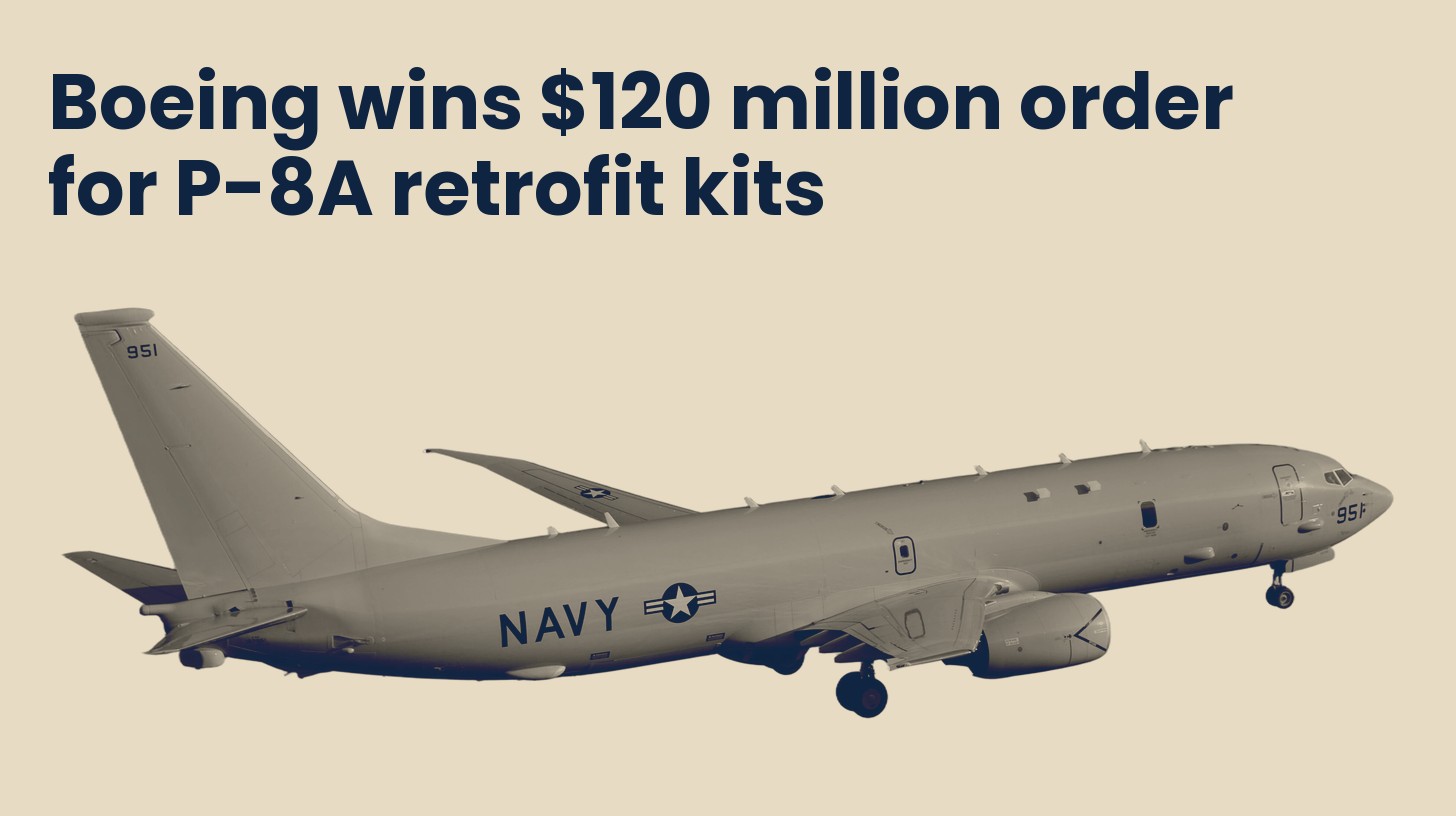
The U.S. Navy awarded Boeing $119.7 million to produce nine P-8A Increment 3 Block 2 retrofit kits, seven for the Navy and two for Australia, and to install four kits on U.S. Navy aircraft in Jacksonville, Florida. The modification exercises options under a June order worth $121.2 million for 18 kits total and is part of a $3 billion-plus Navy upgrade program across approximately 130 P-8As.
What's happening
- Boeing produces 9 Increment 3 Block 2 retrofit kits and installs 4 kits on U.S. Navy P-8As in Jacksonville, with delivery by May 2030.
- The Navy obligated $110.2 million in fiscal 2027 aircraft procurement funds and Australia obligated $9.5 million in cooperative partner funds at award.
- This modification follows a June 2026 order worth $121.2 million for 18 kits and 7 installations, totaling 18 kits and 7 U.S. Navy installations in less than 5 months.
- Work is distributed across three locations: Jacksonville 79.6%, St. Louis 10.9%, Mesa, Arizona 9.5%.
Why it matters
- Increment 3 Block 2 is the largest upgrade the P-8A has received since service entry, adding new combat systems, sensors, satellite communications and anti-submarine warfare capability across ~130 aircraft.
- The Navy declared initial operational capability for the configuration on April 24, 2026, enabling fleet conversion at scale, with the first upgraded aircraft rolled out June 2025.
- Australia is the only international P-8A operator committed to this upgrade, strengthening naval interoperability and demonstrating allied modernization parity.
- Production acceleration through back-to-back orders signals the Navy's priority to upgrade maritime patrol capacity within its modernization timeline.
Going deeper
- A-kits carry structural and electrical changes; B-kits contain mission equipment. The Navy furnishes B-kits separately, allowing Boeing to focus kit production while Navy sources advanced systems.
- The upgrade includes a new combat systems suite with higher-security computing architecture, wideband satellite communications, track management, and Multi-Static Active Coherent Enhanced processing for sonobuoy detection.
- Fleet conversion began March 2024 when the Navy delivered the first P-8A for Increment 3 Block 2 modification; Australian induction began October 2025.
- Boeing Defence Australia will modify remaining Australian aircraft at RAAF Base Edinburgh after Jacksonville work completes the first two conversions.
Financial impact
- Income statement: Boeing recognizes revenue over the performance period (through May 2030) as kits are produced and installations completed; the contract is cost-plus-fixed-fee, typically a lower-margin structure.
- Obligated funds of $119.7 million (all $110.2 million Navy and $9.5 million Australian funds) flow to Boeing upon award in fiscal 2027, providing immediate backlog certainty.
- The modification adds to Boeing's P-8A modification and installation backlog, building on the June 2026 order and an April 2026 $11.95 million single-kit installation contract.
- Revenue recognition timing aligns with monthly production and installation milestones through May 2030, though specific monthly or quarterly breakdowns are not disclosed.
The intrigue
- The contract separates A-kit production from B-kit installation but does not specify when or where Australian kits will be installed after delivery, leaving Australian operational availability timing unclear.
- The Navy has not disclosed whether Increment 3 Block 2 changes the AN/APS-154 Advanced Airborne Sensor radar on some P-8As, a potentially significant capability gap in the technical description.
The fine print
- This modification was not competed; it exercises options under existing basic ordering agreement N0001926G1002.
- All $119.7 million in obligated funds are locked at award in fiscal 2027; no contingent or option-year amounts are mentioned.
- Australian participation is funded through a cooperative program separate from Navy procurement, with Australia paying $9.5 million of the $119.7 million total.
- Work completion is set for May 2030; no interim milestones or payment schedules are disclosed.
Source: defence-blog.com · Nov 5, 2026 · Drafted with Claude, reviewed by Industrial Base Alpha.