Mentioned:Covenant IndustriesKongsberg
Denmark has ordered Covenant Industries' Anthem ground-launched cruise missiles, with production launching at a new Leipzig plant in 2027. The order gives Denmark its first land-based deep-strike capability and signals NATO demand for low-cost precision weapons.
What's happening
- Denmark Ministry of Defense signed contracts for Anthem cruise missiles on October 22, 2026, though quantities and prices remain undisclosed for security reasons.
- Covenant Industries opened a 10,000-square-meter Leipzig facility in October 2026 to establish European production, with manufacturing starting in 2027.
- Production schedule targets 1,000 missiles in 2027 and 5,000 in 2028 from the Leipzig line, with over 95 percent of components sourced within Europe.
- Germany's defense ministry is in talks with Covenant regarding the Anthem system to address its long-range strike capability gap.
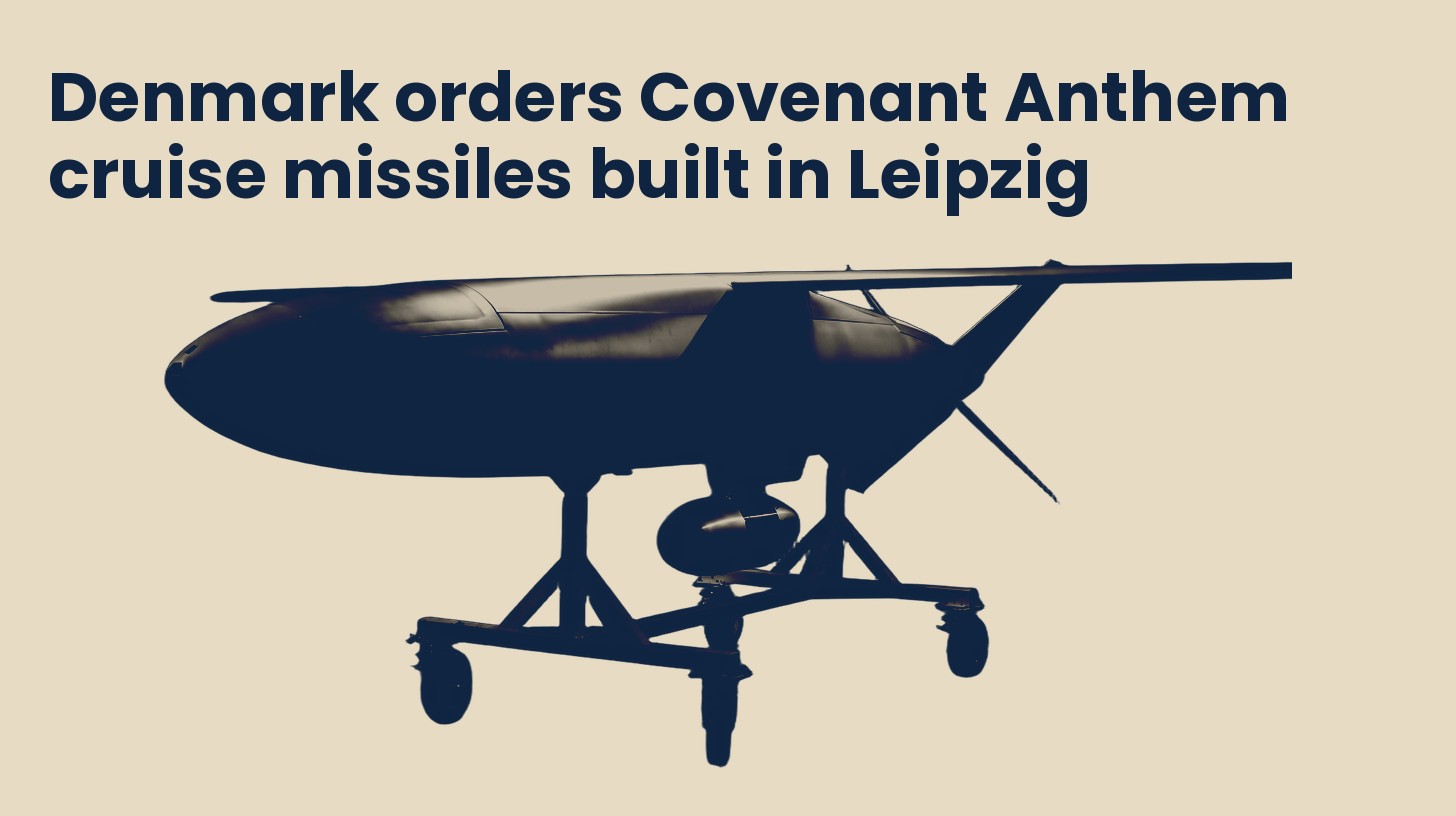
- The Anthem is a jet-powered cruise missile with over 1,000 km range, a 200 kg warhead, and unit cost under $1 million, compared to several million dollars for comparable systems.
Why it matters
- Denmark gains its first land-based precision strike capability, expanding NATO's collective deterrence posture against long-range threats.
- Low-cost production at scale addresses NATO demand for affordable munitions that can be used in mass quantities, shifting procurement away from single-million-dollar systems.
- A European manufacturing footprint reduces supply chain vulnerability and establishes Covenant as a credible supplier to allied defense ministries.
- German interest signals potential for multi-national orders that could sustain higher production rates and lower unit costs across NATO allies.
Going deeper
- Anthem first flew in August 2025 and has undergone more than 200 tests, including flight tests with U.S. forces, though it remains untested in combat.
- Denmark traditionally purchases proven, production-ready systems, making Anthem a departure toward newer technology backed by demonstrated testing.
- Covenant recruited Andreas Marlow, a retired German Army lieutenant general and former deputy commander, as an adviser to support Bundeswehr evaluation.
Financial impact
- Contract revenue recognition will begin in 2027 when Leipzig production starts, with obligated delivery volumes of 1,000 units year one and 5,000 in 2028.
- Unit pricing under $1 million per missile supports gross margin expansion compared to higher-cost legacy systems, pending disclosed production cost structure.
- Capital expenditure for the 10,000-square-meter Leipzig facility was incurred by October 2026; timing of revenue impact and capex recovery depends on final contract terms not disclosed.
The intrigue
- German procurement decision remains unconfirmed despite ministry talks and lieutenant general Freuding's stated need for low-cost cruise missiles, with Flamingo from Ukrainian Fire Point also under evaluation.
- Denmark's decision to field a system with no combat history represents a strategic shift and potential test case for NATO adoption of lower-cost precision munitions.
The fine print
- Quantities, pricing and delivery dates for the Denmark contract remain undisclosed for security reasons, limiting visibility into total contract value and cash flow timing.
- German evaluation status is preliminary and carries no confirmation of order; any Bundeswehr procurement would require separate announcement and funding.
- Warhead integration occurs at customer locations rather than in Leipzig, affecting the scope and capital requirements of the European manufacturing footprint.
Source: defence-blog.com · Oct 23, 2026 · Drafted with Claude, reviewed by Industrial Base Alpha.