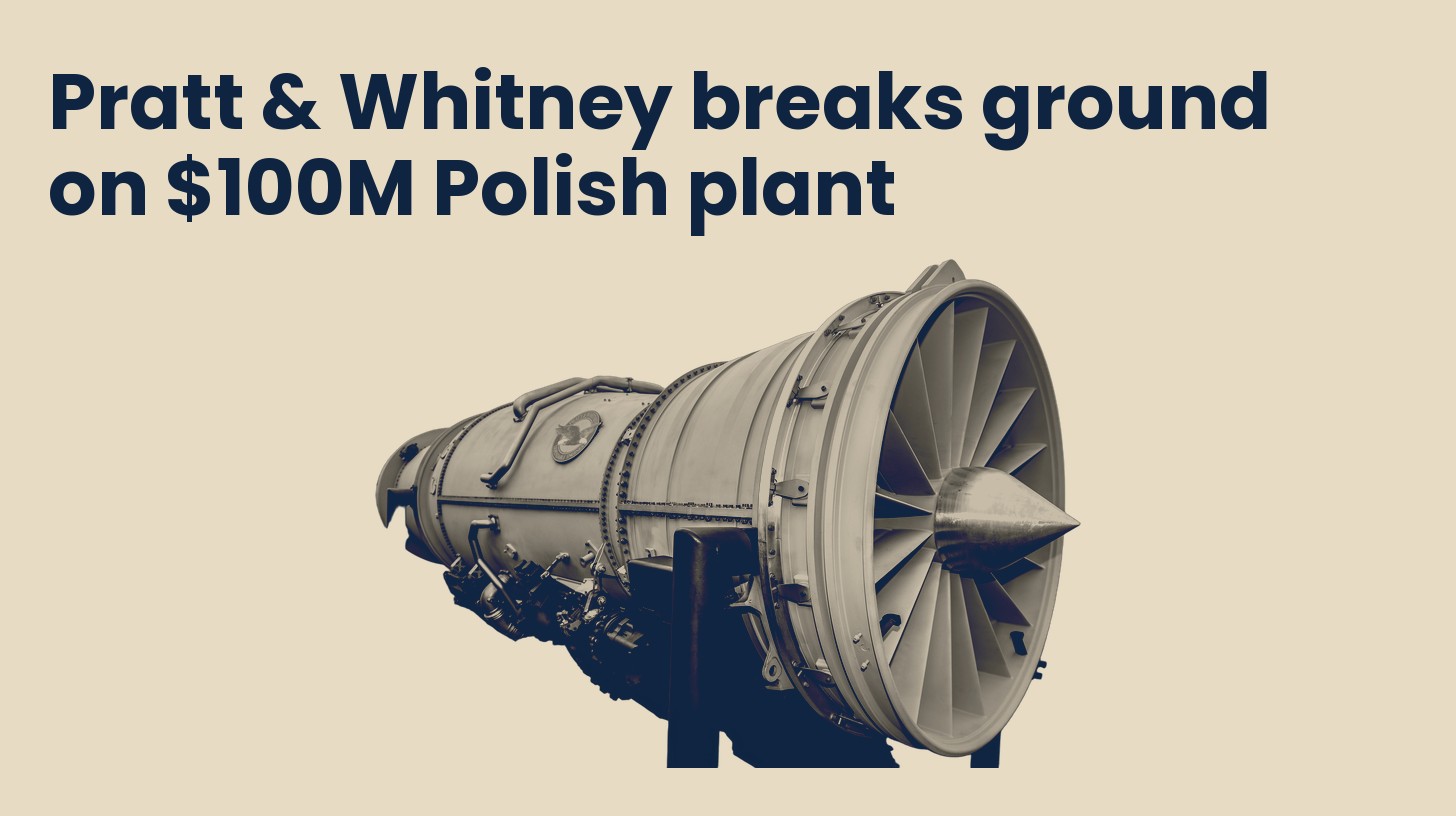
Pratt & Whitney is investing $100 million to expand rotating engine component production at its Rzeszów, Poland facility, expected to open in 2028. The investment complements a $200 million Georgia facility expansion to jointly increase output of critical engine parts by 30%.
What's happening
- Pratt & Whitney is building a $100 million facility in Rzeszów to manufacture critical rotating engine components including compressors and turbine disks for F-35, F135 and F100 military engines.
- The facility is expected operational in 2028 and will create more than 120 jobs, adding rotating-component manufacturing to existing GTF fan drive gear and F135 part production.
- A parallel $200 million investment at Columbus Forge in Georgia for a seventh isothermal forging press will become operational by 2028, together lifting output of rotating compressors and turbine disks by 30%.
Why it matters
- The dual investments address production capacity constraints for F-35 engine components, supporting sustained military engine demand across multiple platforms and reducing single-site risk.
- Poland hosts Pratt & Whitney's largest industrial footprint outside the United States with 9,500 RTX employees, making the expansion a strategic commitment to allied defense manufacturing.
- Rotating components are critical path items in engine assembly; the 30% capacity increase directly enables higher F-35 production rates and commercial engine output.
Going deeper
- Rzeszów currently produces GTF fan drive gear systems, F100 static structures and F135 parts, plus engine families serving helicopters, business jets and general aviation including PT6, PW200, PW500/600 and PW800.
- The two projects operate at separate stages of engine manufacturing, with Georgia handling forging and Poland adding rotating-component machining and assembly to diversify production geography.
Financial impact
- The $100 million Poland investment represents internal capital allocation by RTX, recognized as capex on the balance sheet and depreciated over the facility's useful life starting 2028.
- Revenue recognition timing depends on F-35 and F135 engine contract performance periods; higher throughput will increase operating cash flow from defense contracts recognized quarterly or as milestones are achieved starting 2028.
The fine print
- The facility is expected operational by 2028, meaning capital deployment extends over the next two years with revenue impact delayed until production ramps.
- Output increases of 30% assume both Poland and Georgia projects reach full operational capacity simultaneously; delays to either site would compress the combined benefit.
Source: defence-industry.eu · Oct 23, 2026 · Drafted with Claude, reviewed by Industrial Base Alpha.