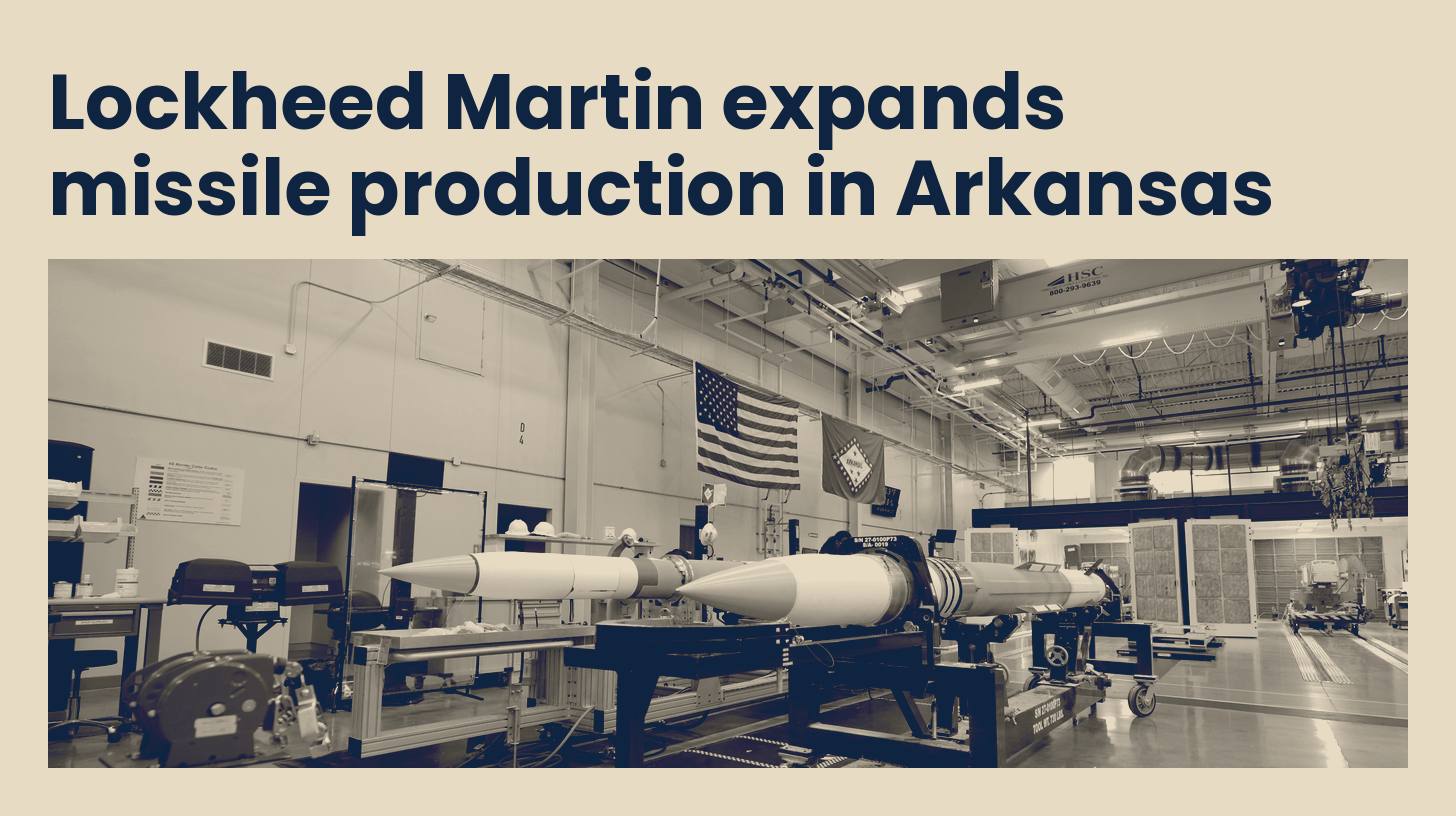
Lockheed Martin is investing $420 million to expand missile production capacity at its Camden, Arkansas facility for PAC-3, THAAD, and Precision Strike Missile programs. The investment is expected to create 650 new full-time jobs over five years.
What's happening
- Lockheed Martin is committing $420 million in internal capital to expand the 2.2 million square-foot Camden Operations facility in Arkansas.
- The expansion will increase production capacity for three air defense and strike systems: PAC-3, THAAD, and Precision Strike Missile programs.
- The investment is expected to add 650 full-time jobs over the next five years at the Camden facility.
Why it matters
- PAC-3 and THAAD are critical air defense systems for the U.S. military and allied partners, and production capacity constraints have been identified as a supply chain risk.
- Expanding production in an established facility reduces time to increase output compared to building new capacity elsewhere.
- Adding 650 jobs signals Lockheed Martin's confidence in sustained demand for air defense and precision strike systems across multiple programs.
Financial impact
- The $420 million capital expenditure will appear on the cash flow statement as capital expenditure in 2026 and subsequent years as the expansion phases in.
- Revenue recognition for PAC-3, THAAD, and Precision Strike Missile programs will accelerate in 2027 and beyond as new production capacity comes online, supporting backlog conversion.
- Operating margins on these programs may initially compress during ramp-up but should improve as the facility reaches steady-state production rates.
The fine print
- The expansion timeline and job creation are expected over five years, indicating a phased implementation rather than immediate full deployment of capital.
- Demand assumptions underlying the investment depend on sustained military procurement and allied customer orders for these three systems.
Source: Defense Daily · Nov 3, 2026 · Drafted with Claude, reviewed by Industrial Base Alpha.