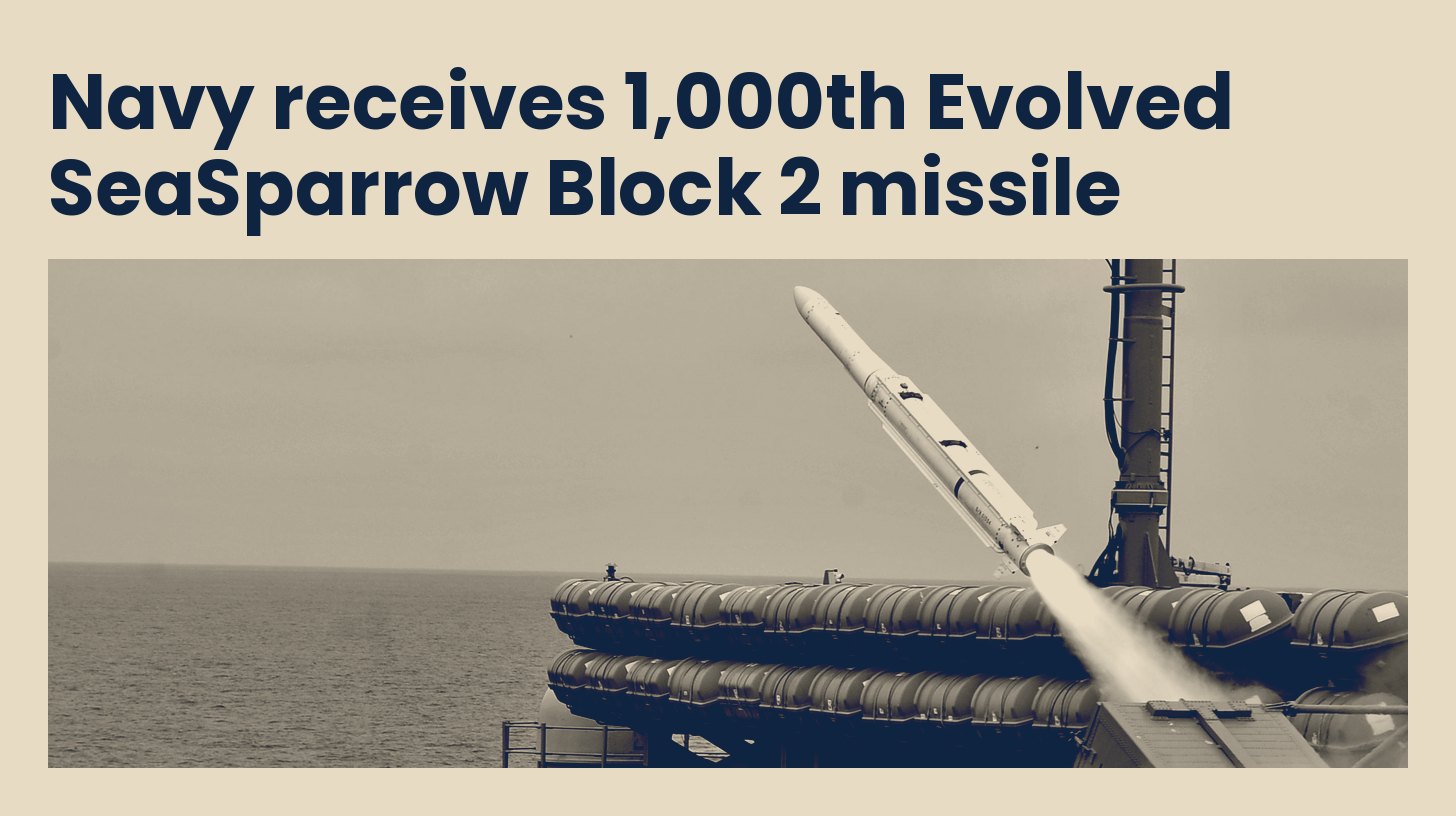
Raytheon has delivered the 1,000th Evolved SeaSparrow Missile Block 2 to the 12-nation NATO consortium, reaching the milestone after doubling production in 16 months from 500 units in June 2025. The Navy awarded Raytheon an $833 million contract modification in April for additional missiles and launch canisters across all consortium nations, with delivery due by September 2030.
What's happening
- Raytheon delivered the 1,000th ESSM Block 2 in late October 2026, up from 500 units in June 2025, representing a production doubling in 16 months.
- The Navy awarded Raytheon an $833 million contract modification in April 2026 for additional Block 2 missiles and launch canisters for all 12 consortium members.
- The April 2026 contract modification is due for completion by September 2030 and is funded mainly with fiscal 2026 appropriations.
- Raytheon manufactures the missiles in Tucson, Arizona, with suppliers across Canada, Australia and Europe.
Why it matters
- The production acceleration demonstrates sustained allied demand for ship-defense interceptors against evolving air and missile threats across 12 NATO nations.
- The ESSM Block 2's active radar seeker enables independent target acquisition in final flight seconds, reducing the launching ship's radar burden during dense combat scenarios.
- Four missiles fit in a single Mk 41 vertical launch cell, multiplying combat loadout capacity on destroyers and frigates across NATO and allied fleets.
- The NATO SEASPARROW Consortium's 58-year operational model pools development, production and sustainment costs across members, reducing individual burden.
Going deeper
- The Block 2 variant, in service since 2020, added active radar guidance over earlier Block 1 versions, enabling the missile to lock and track independently or accept ship-provided guidance.
- The ESSM has a stated range of approximately 50 kilometers and a maximum speed above Mach 4, positioning it as a close-in defensive layer complementing longer-range Standard missiles.
- Japan is building Block 2 missiles under license through Mitsubishi Electric using kits supplied by Raytheon, extending the platform's reach outside NATO.
Financial impact
- The $833 million contract modification will be recognized as revenue over the fiscal 2026 through September 2030 performance period, with obligated funds primarily from fiscal 2026 appropriations.
- The September 2024 production contract of $525 million with options valued at approximately $2.2 billion total establishes baseline production economics for the Block 2 line through FY2030.
- RTX (parent of Raytheon) will record the April 2026 modification as a contract asset, recognizing revenue as missiles and canisters are delivered and accepted by consortium members.
The intrigue
- The Navy requested Next Significant Variant concepts in August 2026 for a successor missile that must fit the same 10-inch diameter and remain available to all 12 consortium nations, but has not disclosed the formal solicitation timeline or whether it will replace or complement Block 2.
- The record does not disclose how many of the 1,000 delivered missiles went to the U.S. Navy versus allied navies, or the current production rate post-doubling.
The fine print
- The $833 million April 2026 contract modification covers Block 2 missiles and launch canisters for all 12 consortium members, with obligated funds primarily from fiscal 2026, not full appropriations for the September 2030 completion date.
- The September 2024 contract of $525 million included options that could raise total value to approximately $2.2 billion, establishing the production baseline prior to the April 2026 modification.
Source: defence-blog.com · Nov 2, 2026 · Drafted with Claude, reviewed by Industrial Base Alpha.