Mentioned:Garden Reach Shipbuilders and EngineersGoa Shipyard$5.7B · Contract Award
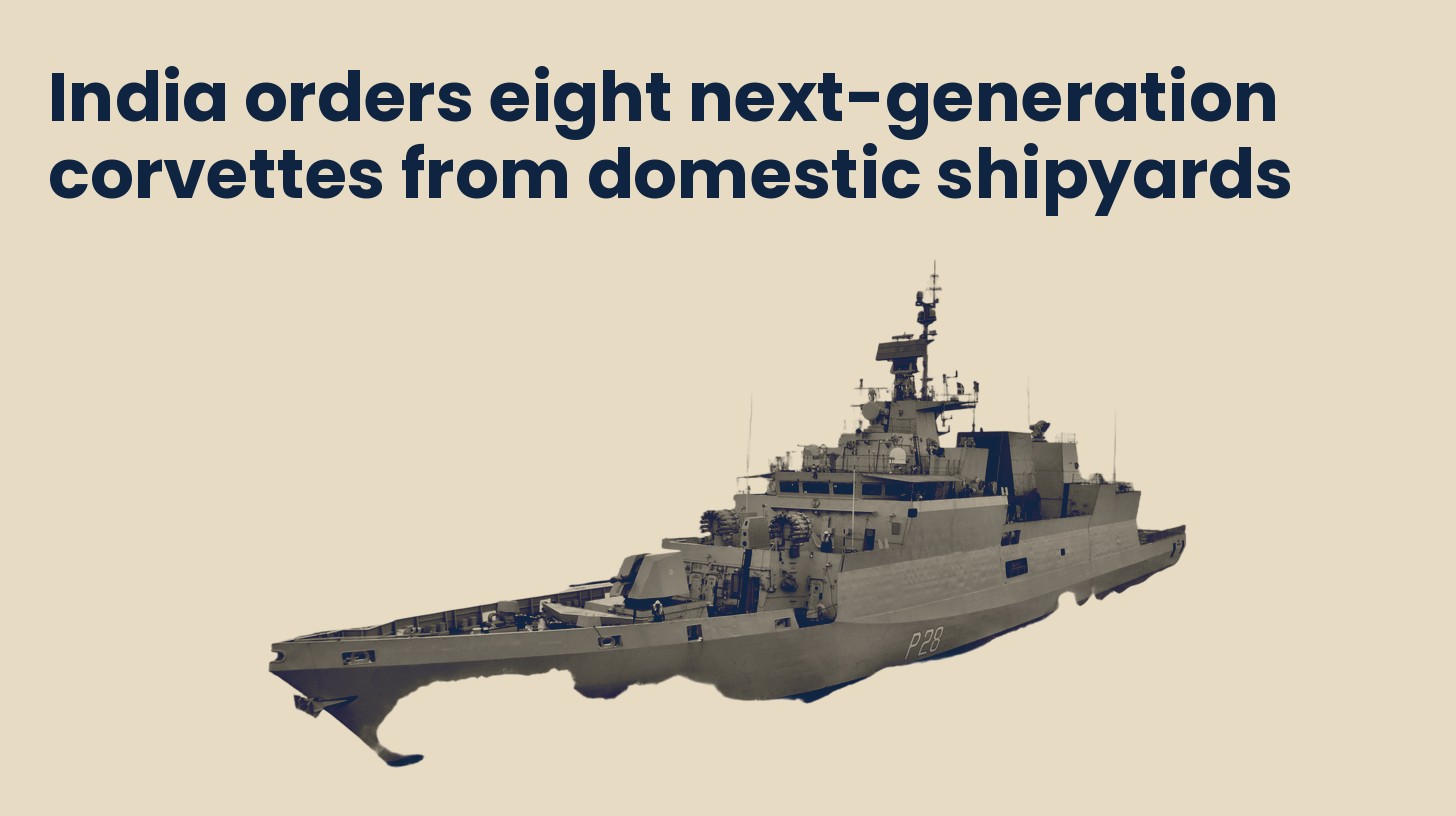
India awarded an $5.7 billion contract to build eight next-generation corvettes with domestic shipyards, the first warship class designed by the Indian Navy and built entirely in-country. The corvettes will replace aging single-role vessels and support India's goal to field 200-plus ships by 2035.
What's happening
- Garden Reach Shipbuilders will build 5 corvettes and Goa Shipyard will build 3 of the 8-ship class under the $5.7 billion contract.
- Each 127-meter corvette will carry medium-range anti-ship missiles, surface-to-air missiles and 324 mm torpedo tubes, with a maximum speed of 26 knots.
- The project represents the first Indian Navy-designed warship class built in state-owned domestic shipyards, ending reliance on foreign designs for this vessel type.
- Corvettes will conduct anti-submarine, anti-surface and coastal defense operations across India's 11,000+ km coastline and maritime trade routes.
Why it matters
- The contract consolidates indigenous warship design and construction capability across two major Indian shipyards, reducing future dependence on foreign designs and technology transfer.
- Corvette production provides sustained work for state-owned yards and demonstrates capacity to execute modern combat-vessel programs ahead of India's 200-ship fleet target by 2035.
- These vessels address India's maritime security priorities as 90% of its trade moves by sea and geopolitical competition with China intensifies in the Indo-Pacific.
- The program sits within a broader $20+ billion modernization effort including 6 German submarines, 26 French Rafale Marine aircraft and expansion of carrier aviation.
Going deeper
- The corvettes feature high-speed stealth design and multi-domain weapons integration, signaling India's advancement in combat-vessel architecture and sensor fusion.
- India currently operates 145 ships and submarines; adding 8 corvettes and 6 submarines moves it partway toward the 200-ship goal announced by the Chief of Naval Staff in February.
- Parallel programs with Germany (submarines with air-independent propulsion) and France (Rafale Marine carrier fighters) indicate India's strategy to blend indigenous capability with select allied technology partnerships.
Financial impact
- Garden Reach Shipbuilders will recognize $3.5625 billion in revenue (5 ships of $712.5 million each) and Goa Shipyard will recognize $2.1375 billion (3 ships of $712.5 million each) over the period of performance; timing not disclosed.
- The contract does not obligate full $5.7 billion immediately; the article does not specify obligated funds versus ceiling value or payment schedule phasing.
- Revenue recognition will likely follow construction milestones or ship deliveries; exact schedule and progress-billing terms not disclosed.
The intrigue
- The split build between two shipyards raises questions about production coordination, quality assurance and whether parallel construction reduces schedule risk or introduces cost growth.
- India's push for indigenous design and construction could signal domestic industry confidence, but scalability to higher production rates for the 200-ship fleet remains unproven.
The fine print
- Article states the corvettes will 'gradually replace' aging single-role vessels but does not specify retirement timelines or in-service dates for the 8-ship class.
- Specific delivery dates, milestone payments and performance specifications are not disclosed; contract details remain with the Ministry of Defense.
Source: Defense News · Nov 3, 2026 · Drafted with Claude, reviewed by Industrial Base Alpha.