Mentioned:Griffon Aerospace
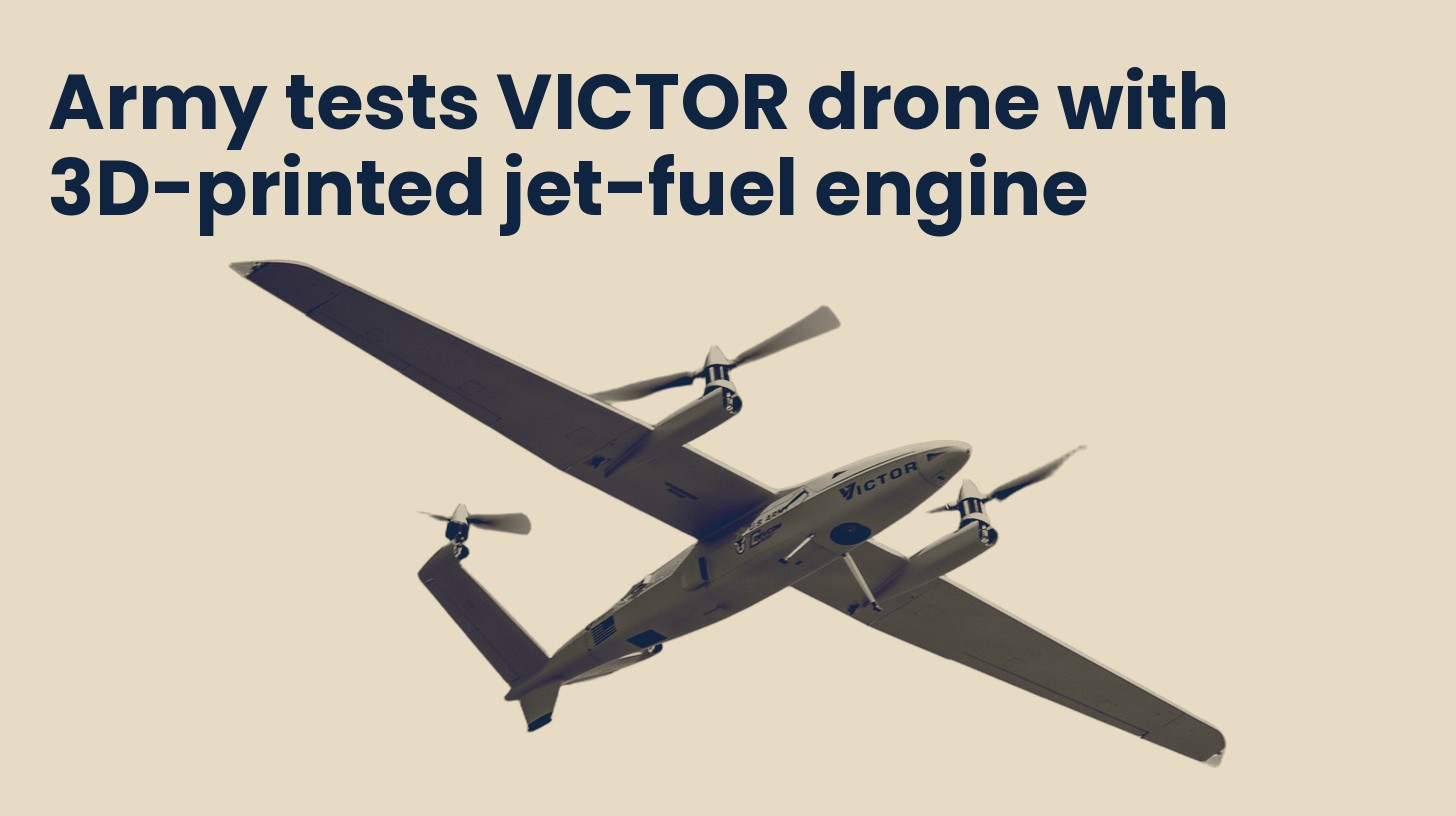
The U.S. Army completed flight testing of VICTOR, a mid-sized unmanned aircraft powered by a 3D-printed rotary engine that burns jet fuel to drive a 400-volt hybrid-electric system. The multiyear research program now transitions to military partners and industry for further development.
What's happening
- VICTOR, a Group 3 VTOL drone weighing up to 600 kilograms, flew successfully with a 3D-printed rotary engine burning heavy kerosene-based jet fuel in Huntsville, Alabama.
- The rotary engine powers a generator in a series-hybrid system that drives electric motors rather than turning propellers directly, producing a 400-volt motor-generator output.
- The multiyear program involved more than 30 universities, more than 13 federal laboratories and more than 20 companies, generating hundreds of scientific papers and dozens of patents.
- The Army will transition VICTOR and a follow-on swarm concept called PULSAR to military partners for testing, with Griffon Aerospace continuing refinement for broader use.
Why it matters
- Heavy-fuel engines eliminate the need for separate gasoline supply in field units, allowing drones to use the same kerosene-based jet fuel as Army vehicles and helicopters.
- The series-hybrid architecture extends endurance and range compared to conventional small-drone engines, enabling mid-sized drones to operate beyond line of sight and reduce soldier risk.
- 3D metal printing enabled rapid redesign of engine components and produced an air-cooled design that eliminates liquid coolant, reducing propulsion-system size and weight.
- The PULSAR swarm concept could provide logistics, strike and reconnaissance capabilities using multiple VICTOR aircraft, expanding tactical options for ground commanders.
Going deeper
- Getting small engines to burn heavy fuel efficiently is difficult because kerosene does not vaporize as easily as gasoline, requiring custom combustion chemistry and fuel-spray design.
- Researchers used computer modeling of fuel flow to redesign the rotary engine from scratch, improving vaporization while reducing leaks of compressed air and fuel vapor.
- A rotary engine with a spinning triangular rotor instead of pistons makes the design compact and smooth-running, a geometry well-suited to advanced manufacturing methods.
- Griffon Aerospace's Valiant, a similar hybrid-electric VTOL drone with heavy-fuel engine, was a finalist in the Army's cancelled Future Tactical Uncrewed Aircraft System competition to replace the RQ-7 Shadow.
The fine print
- The Army did not disclose the flight date, duration or specific performance metrics such as altitude, speed or endurance reached during testing.
- VICTOR is classified as a Group 3 unmanned aircraft, covering drones weighing up to about 600 kilograms flying below 18,000 feet, larger than squad-level quadcopters but well below Reaper-class systems.
Source: defence-blog.com · Nov 2, 2026 · Drafted with Claude, reviewed by Industrial Base Alpha.