Mentioned:Dassault AviationHindustan Aeronautics Limited$7.5B · Program/Policy
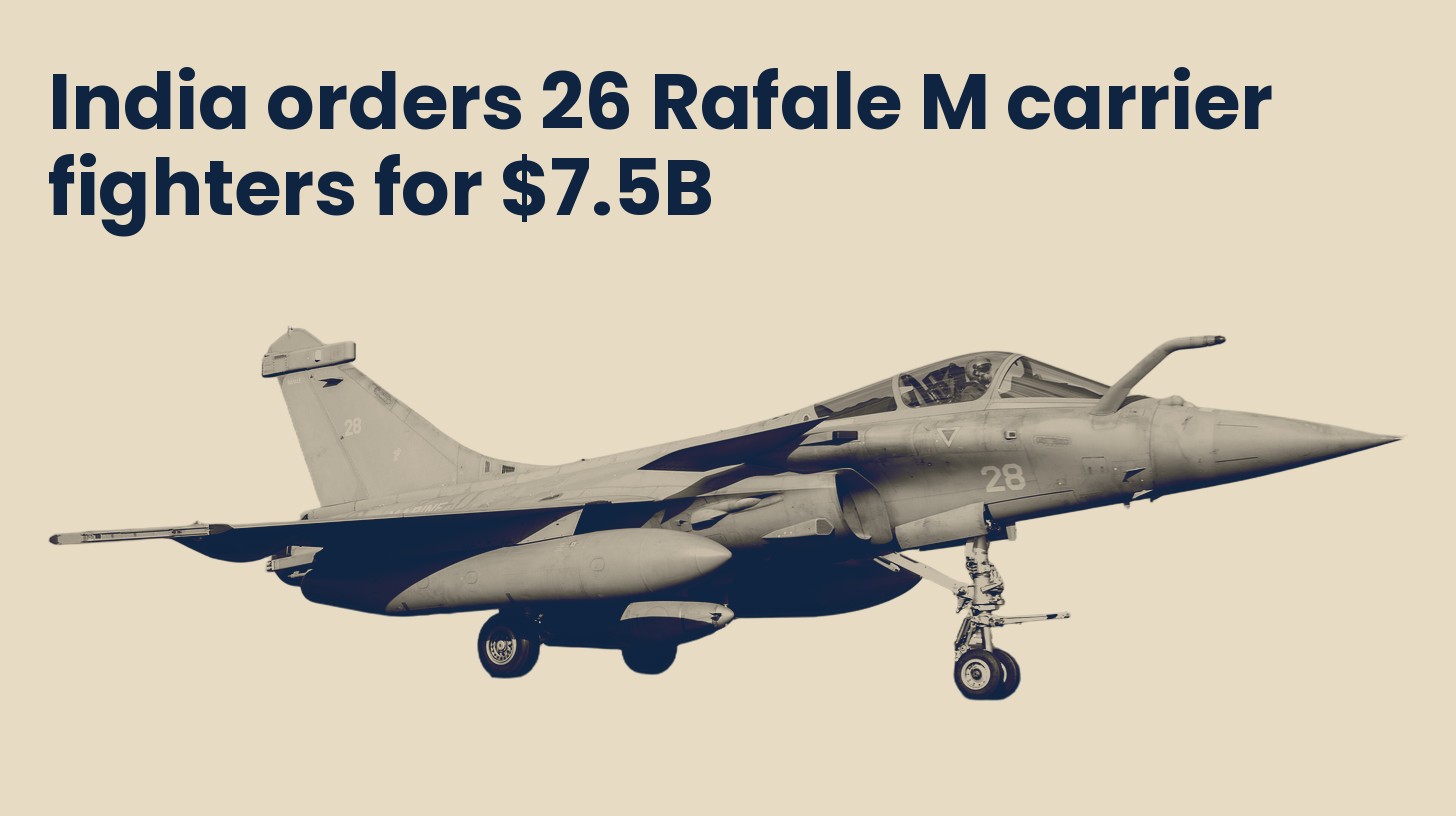
The Rafale M achieved its maiden arrested landing and takeoff from INS Vikrant on October 29, 2026, completing a critical carrier-compatibility milestone. India's $7.5 billion order for 26 aircraft represents an interim bridge to its indigenous TEDBF while addressing carrier air wing gaps left by delays in domestic fighter development.
What's happening
- Rafale M completed first successful arrested landing and takeoff from INS Vikrant on October 29, 2026, on its maiden carrier attempt.
- India ordered 26 Rafale M aircraft under an April 2025 intergovernmental agreement with France: 22 single-seat fighters and 4 twin-seat shore-based trainers.
- First deliveries are expected by end-2028 or early-2029, with full delivery by 2030.
- Aircraft underwent carrier-compatibility testing at the Shore-Based Test Facility in Goa beginning October 22, 2026.
Why it matters
- Rafale M provides interim carrier-based fighter capacity while India's indigenous Twin Engine Deck Based Fighter remains in development, addressing operational gaps in the Indian Navy's carrier air wing.
- The order sustains carrier strike capability across two carriers, INS Vikrant and INS Vikramaditya, currently dependent on aging Russian MiG-29K/KUB fleet.
- Rafale commonality with Indian Air Force's land-based Rafale fleet simplifies pilot training, maintenance and logistics across both services.
- Delays in domestic LCA Navy program and General Electric F404 engine deliveries made imported interim capacity essential for maintaining naval readiness.
Going deeper
- Rafale M required structural modifications for carrier operations, including reinforced landing gear, arrestor hook, launch bar and wingtip modifications to fit INS Vikrant's elevators.
- India selected Rafale M in July 2023 after rejecting LCA Navy Mk1 for insufficient power and single-engine limitation.
- Shore-Based Test Facility trials in Goa preceded the carrier trials, consistent with historical carrier-compatibility testing protocols for naval fighters.
- Twin-seat variants exist only as shore-based trainers; no twin-seat carrier-capable Rafale M configuration is available.
Financial impact
- Contract value of $7.5 billion (approximately 63,000 crore rupees) will be recognized as revenue on Dassault's books over delivery period 2028-2030.
- Ceiling value is $7.5 billion for 26 aircraft; obligated funds and milestone payment schedule not disclosed.
- Revenue recognition will accelerate from end-2028 as deliveries commence, with full contract completion by 2030.
The intrigue
- TEDBF program delays have raised questions about whether India will need additional imported fighters beyond the 26 Rafales to maintain full carrier air wing strength.
- Reliance on U.S. General Electric F404 engines for the domestic LCA program has created strategic vulnerability and friction between the Indian Air Force and Hindustan Aeronautics Limited.
The fine print
- This carrier trial marks technical qualification work but does not indicate imminent operational deployment; routine qualification precedes service entry.
- Exact scope of Goa trials and details on specific wingtip modifications not independently confirmed.
- Whether the aircraft tested was the first India-specific airframe or a French test aircraft remains undisclosed.
Source: theaviationist.com · Oct 31, 2026 · Drafted with Claude, reviewed by Industrial Base Alpha.