Mentioned:Bell Textron$115M · Contract Award
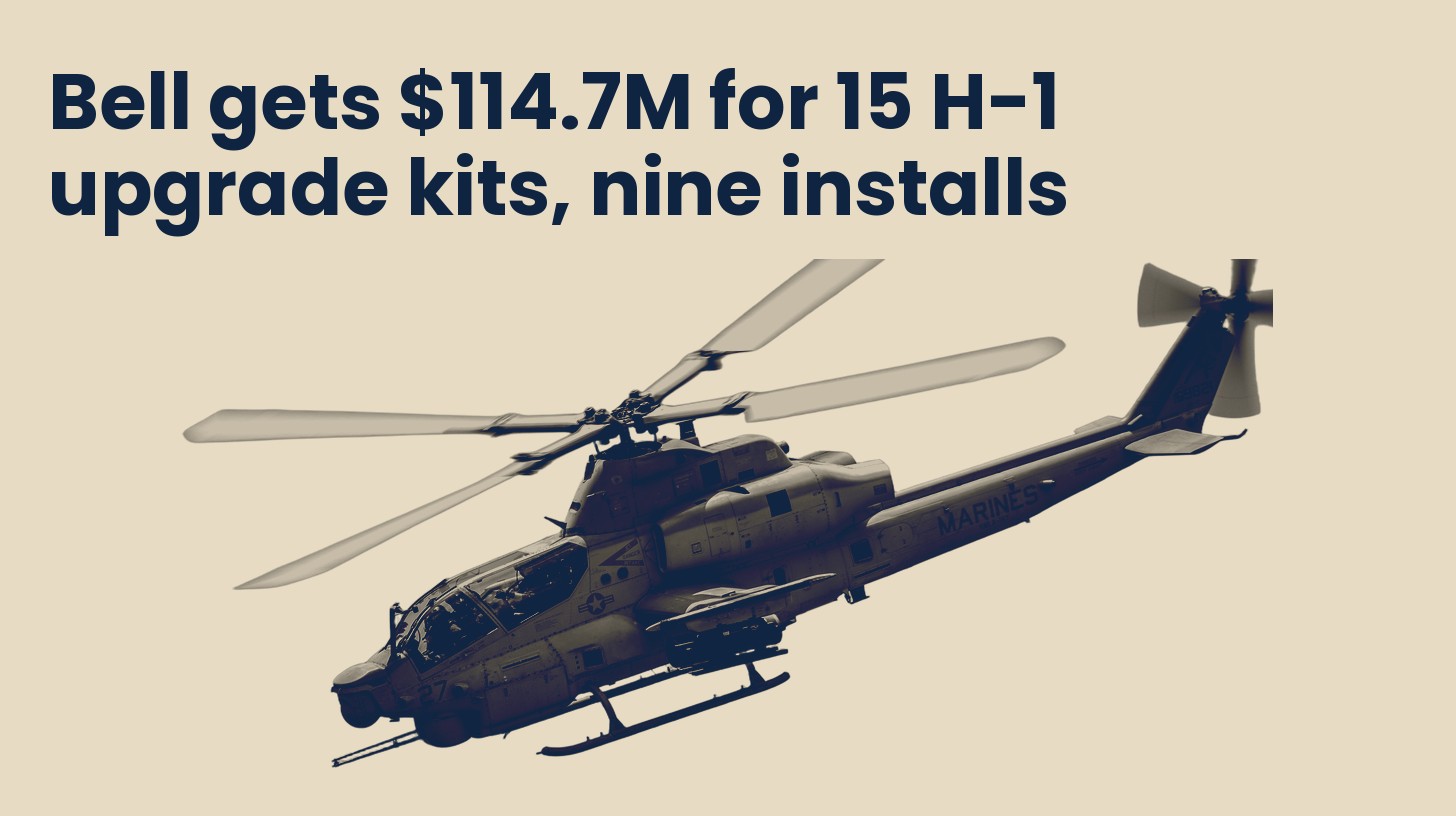
The U.S. Navy exercised a $114.7 million option with Bell Textron to upgrade 15 Marine Corps H-1 attack and utility helicopters under Phase III of the SPINE program. The work adds electrical generating capacity and structural reinforcement to support new sensors, electronic warfare systems and long-range munitions.
What's happening
- Bell will deliver 15 A-kits, four mission kits and nine aircraft installations, along with long-lead components, labor and spares, with work due by June 2028.
- The contract covers modifications to AH-1Z Viper and UH-1Y Venom helicopters, which share 85 percent of their components and are no longer in U.S. production.
- Naval Air Systems Command awarded the sole-source modification using fiscal 2027 Navy aircraft procurement funds, with all $114.7 million obligated at award.
- Bell's Fort Worth site will perform 38.1 percent of the work, Amarillo 28.7 percent, with remaining effort spread across suppliers in Arizona, Michigan, Oklahoma, California and six other states.
Why it matters
- Electrical power has constrained H-1 operations as new sensors, data links, electronic warfare gear and drone launchers add weight and power demand to 1990s-2000s airframes designed with limited capacity.
- The upgrade maintains fleet capability for Marine Corps operations across two aircraft types with high component commonality, extending the service life of about 349 total H-1s without requiring new procurement.
- SPINE enables integration of long-range munitions and air-launched effects that Marine Light Attack Helicopter Squadron 169 has already begun testing in exercises.
Going deeper
- Bell completed two prototype aircraft, one AH-1Z and one UH-1Y, in March 2026 after 19 months of work at its Amarillo Assembly Center, then sent them to Naval Air Station Patuxent River, Maryland for final configuration testing.
- In July 2026, the Navy awarded Bell $33.6 million to produce Phase III hardware under a base-plus-three-option contract covering upgrades to up to 49 aircraft (21 UH-1Ys and 28 AH-1Zs) with potential total value of about $300 million.
- U.S. domestic H-1 production ended in 2020 for the Viper and 2022 for the Venom, making structural and power modifications the primary path to extend fleet capability into the 2030s.
Financial impact
- Bell will recognize revenue over the performance period ending June 2028 under fixed-price-incentive, firm-fixed-price and cost-plus-fixed-fee pricing arrangements; all $114.7 million obligated at award in fiscal 2027.
- The $114.7 million option exercise aligns with the earlier July 2026 award of $33.6 million and supports the broader base contract's estimated $300 million potential value across up to 49 aircraft modifications.
The fine print
- The contract announcement does not specify which aircraft receive the nine installations or whether they are Vipers or Venoms, nor does it disclose what equipment the four mission kits contain.
- A-kits provide permanent structural, wiring, mount and power distribution provisions built into each airframe, while mission kits are equipment fitted on top of those provisions.
- Bell has not published the specific electrical generating capacity the upgrade adds, and the Marine Corps has not disclosed which particular weapons or air-launched effects will be integrated once modifications are complete.
Source: defence-blog.com · Oct 31, 2026 · Drafted with Claude, reviewed by Industrial Base Alpha.