Mentioned:RheinmetallMercedes-BenzArmoured Car Systems$970M · Contract Award
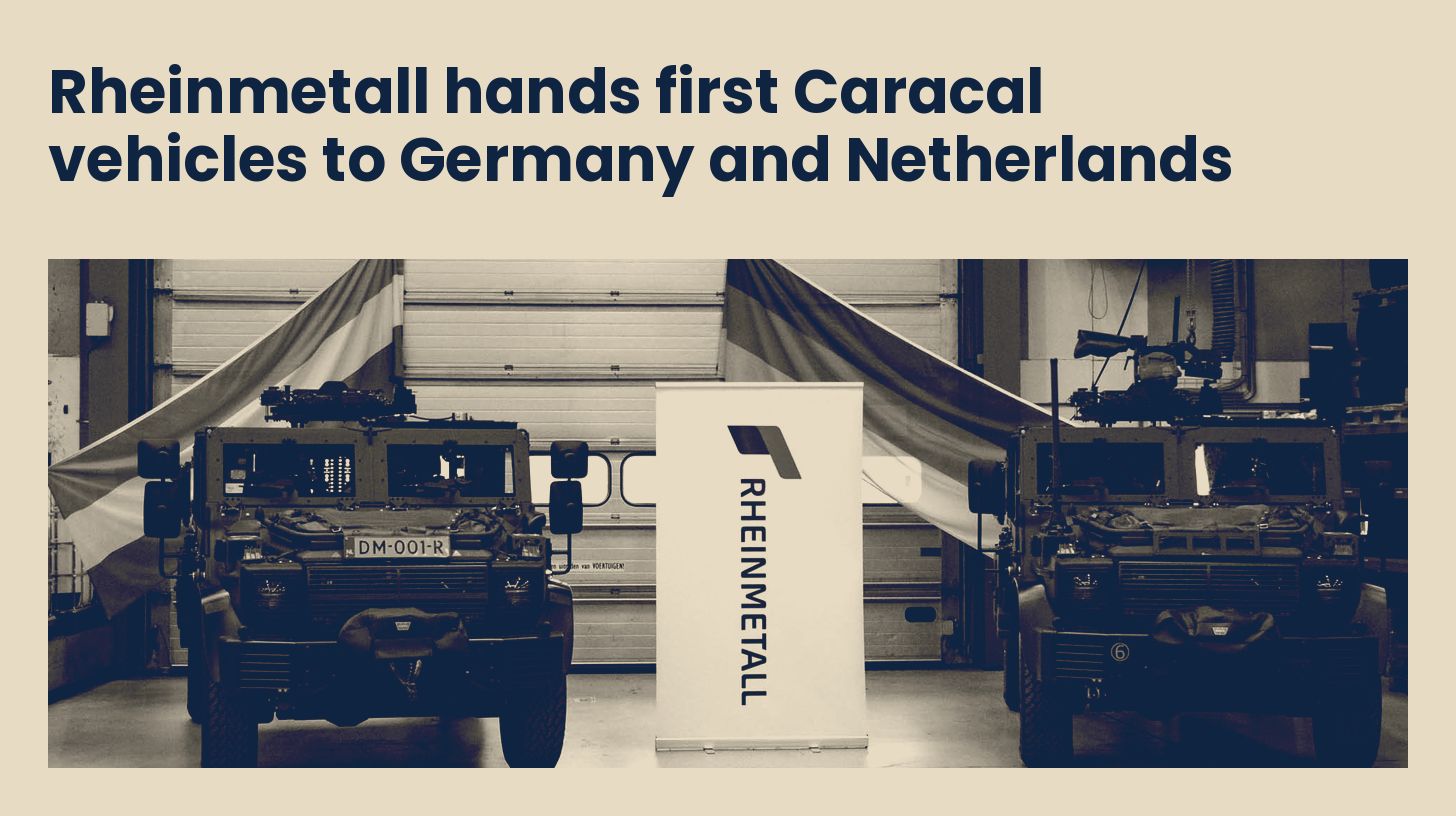
Germany and the Netherlands received their first Caracal air assault vehicles at Rheinmetall Defence Nederland's Ede plant on October 29. The lightweight 4x4s will equip the Dutch 11th Air Assault Brigade and Germany's Rapid Forces Division under a firm order for 1,508 vehicles worth €870 million.
What's happening
- Germany and Netherlands took delivery of initial Caracal vehicles on October 29 at Rheinmetall's Ede facility under a firm order for 1,508 units.
- The G-Class-based 4x4 vehicles will arm the Dutch 11th Air Assault Brigade and Germany's Rapid Forces Division, which have operated as an integrated formation since 2014.
- Rheinmetall developed the Caracal with Mercedes-Benz and Armoured Car Systems, with ACS building the body and Rheinmetall's Ede plant performing final assembly and system installation.
- Both nations are procuring technically identical vehicles to enable interoperability in maintenance, repair and resupply across the combined force.
Why it matters
- The Caracal addresses a critical gap in light air-assault mobility for NATO airborne forces, with each 4.9-ton vehicle fitting inside two-helicopter loads or underslung on CH-47F or CH-53K platforms.
- Joint procurement standardizes training, logistics and spare parts across the Dutch-German integrated brigade, reducing duplication and accelerating interoperability maturity.
- Germany is funding its Caracal share from its 2022 special rearmament fund, signaling sustained capital commitment to modernizing airborne and rapid-reaction capabilities.
- The firm order for 1,508 vehicles secures production at Rheinmetall's Ede plant and validates the modular platform for future variants, including a 6x6 version unveiled in June 2026.
Going deeper
- Germany and Netherlands signed a framework contract with Rheinmetall in July 2023 for up to 3,058 vehicles worth up to €1.9 billion, covering 2,054 units for Germany and 1,004 for the Netherlands.
- The Caracal platform is designed for multiple configurations including troop transport, ambulance and supply versions, allowing economies of scale across variants.
- Rheinmetall revealed a larger 6x6 variant at Eurosatory Paris in June 2026, offering an additional 3.3-ton payload capacity compared to 1.2 tons on the 4x4, with hopes for both nations to order through the same framework.
Financial impact
- The firm order for 1,508 Caracals worth €870 million will be recognized as revenue by Rheinmetall over the period of performance as vehicles are delivered, with timing not disclosed.
- Germany is funding its procurement share from the special defense fund established in 2022, a dedicated cash allocation already approved for armed forces modernization.
- The framework contract ceiling of €1.9 billion creates future revenue optionality if Germany and the Netherlands exercise options for additional vehicles or the 6x6 variant through existing contractual authority.
The fine print
- The Dutch Defense Ministry did not disclose the quantity delivered in the first batch or the schedule for remaining vehicles.
- The framework contract allows for up to 3,058 total vehicles, but only 1,508 have been placed as a firm order, leaving 1,550 units subject to future purchasing decisions.
- The article notes the Caracal should not be confused with the Airbus H225M Caracal helicopter, which the Netherlands will procure separately from 2030.
Source: defence-blog.com · Oct 31, 2026 · Drafted with Claude, reviewed by Industrial Base Alpha.