Mentioned:Dulo$130M · Seed
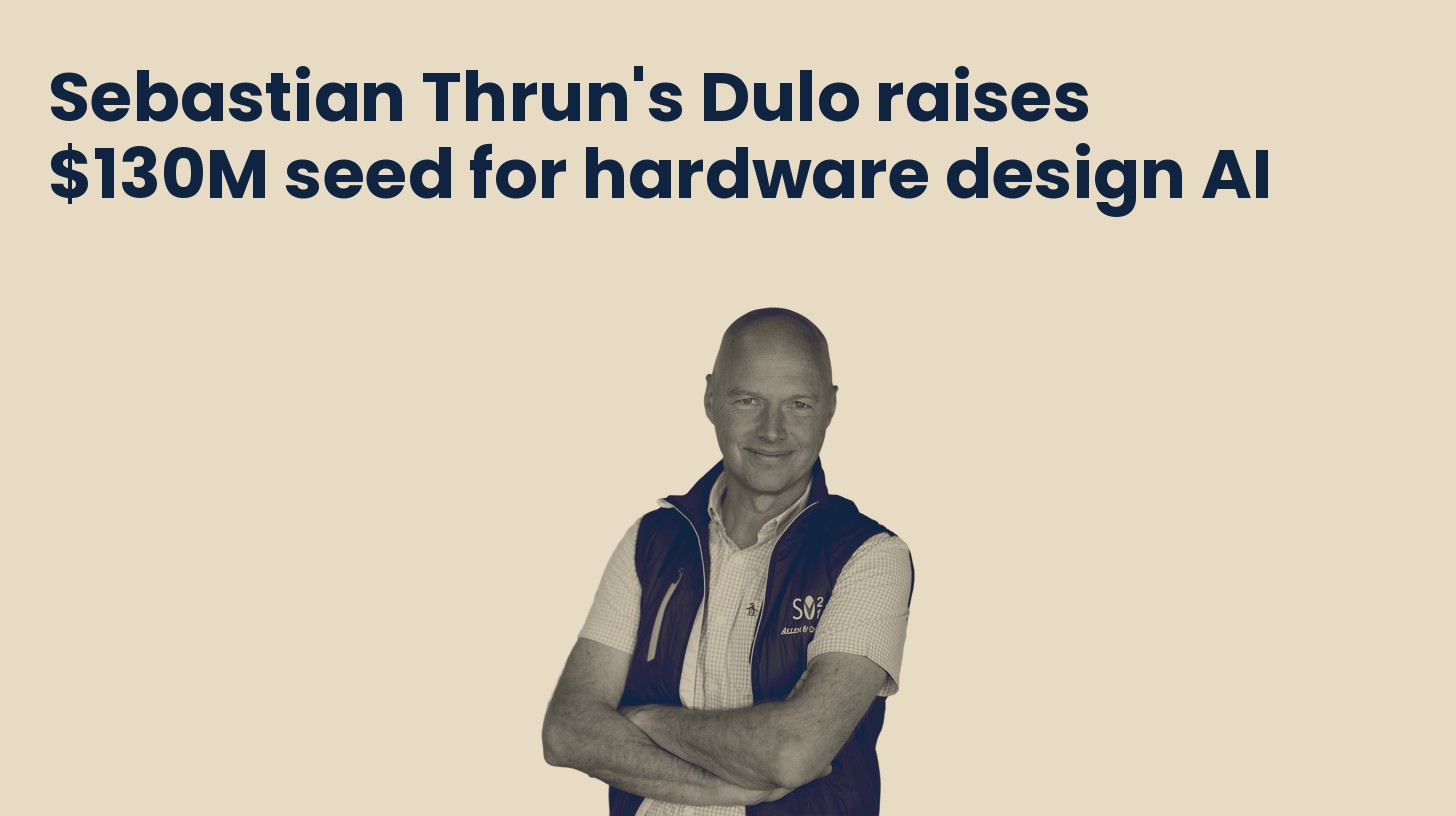
Dulo raised $130 million in seed funding to develop foundation models for hardware engineering and design. The startup targets physical product development with constraints like tolerances, materials, and manufacturability, marking an expansion of AI into defense-critical domains.
What's happening
- Dulo closed a $130 million seed round from Marc Benioff, John Doerr, Eric Schmidt, Ram Shriram, Yuri Milner, and 6 venture firms.
- Co-founders Sebastian Thrun and Adrian Aoun are building foundation models designed for hardware engineering and physical product design.
- The AI platform handles constraints including tolerances, materials, manufacturability, simulations, and failure modes.
- Dulo launched earlier in 2026 and secured one of the largest early-stage financing rounds for AI-driven engineering.
Why it matters
- Defense and aerospace programs depend on hardware design iteration; AI acceleration in this domain could compress development timelines and reduce design risk.
- Foundation models applied to physical engineering represent a new supply of engineering talent productivity, addressing skilled labor constraints in defense industrial sectors.
- The technology targets the core engineering workflow rather than administrative productivity, creating potential leverage across weapons systems, platforms, and subsystems design cycles.
Going deeper
- Foundation models for language and software already drive productivity gains; extending the approach to hardware design requires handling physical constraints absent in digital domains.
- The funding syndicate includes technology leaders with defense and infrastructure exposure, suggesting investor confidence in commercial and government applications.
Financial impact
- Private company receives $130 million in seed capital, providing runway for model development, team scaling, and commercialization efforts through fiscal 2027-2028.
- Capital infusion extends cash runway and eliminates near-term funding pressure, but dilutes founder ownership across a large syndicate of named and unnamed investors.
- Dulo's path to revenue depends on adoption by defense contractors, OEMs, and systems integrators; no contract awards or customer commitments disclosed.
The intrigue
- Application of AI to hardware design containing export control restrictions and classified specifications raises unresolved questions about data handling, model training, and customer deployments.
The fine print
- No disclosed customer commitments, pilot programs, or timeline for commercial revenue.
- Foundation model performance on defense-specific engineering tasks and failure modes remains unvalidated in public.
- Ownership structure shows large syndicate backing but exact founder dilution not disclosed.
Source: Pulse 2.0 · Oct 31, 2026 · Drafted with Claude, reviewed by Industrial Base Alpha.