Mentioned:Korea Aerospace Industries
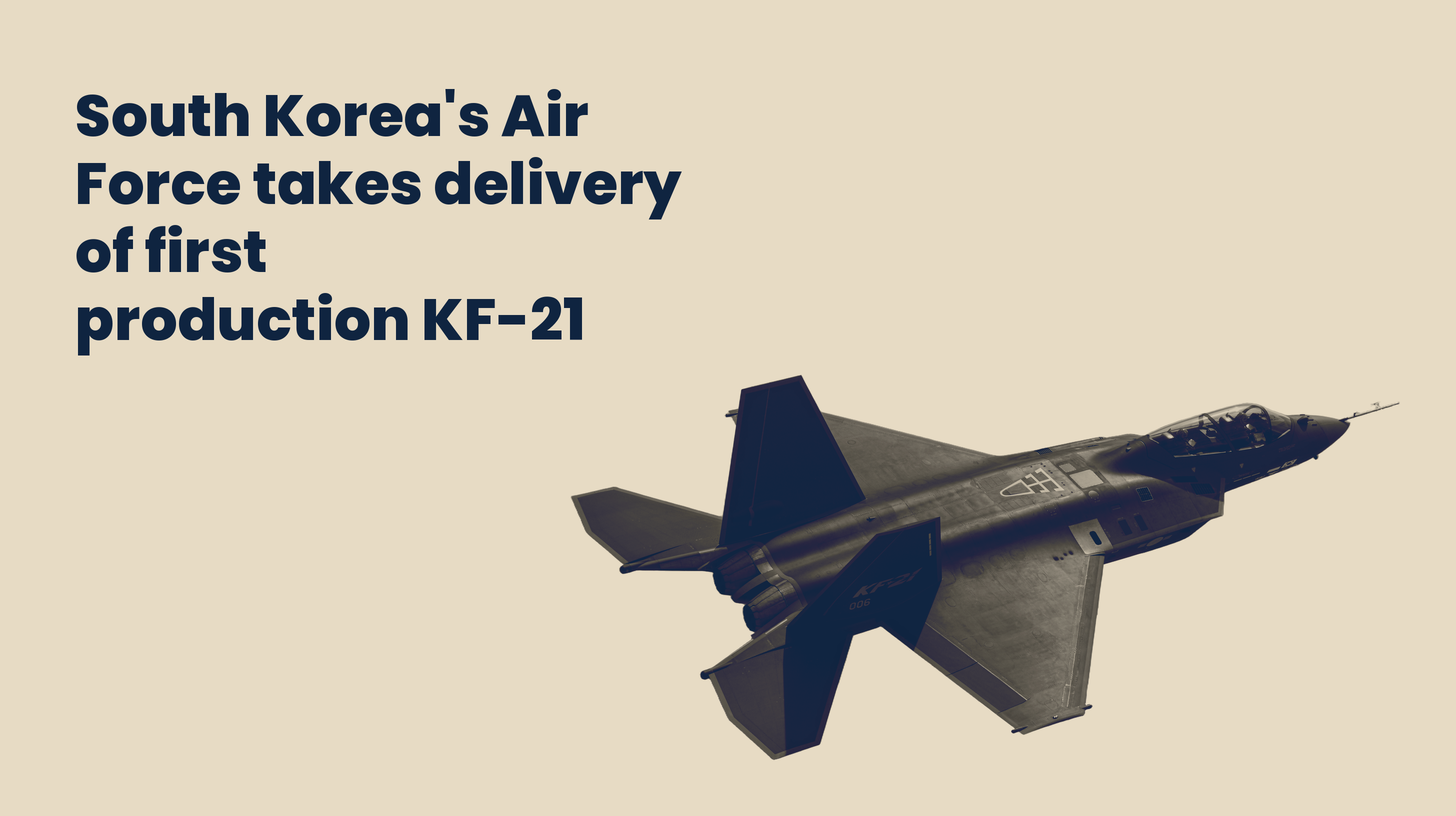
South Korea's Air Force has taken delivery of its first production KF-21 Boramae fighter jet, moving the program into operational service. Korea Aerospace Industries plans to deliver 40 air-to-air variants by 2028 and 80 more by 2032.
What's happening
- South Korea's Air Force took delivery of its first production KF-21 Boramae fighter jet, shifting the program from development into operational service.
- The aircraft flew from Korea Aerospace Industries' Sacheon plant to an Air Force unit in Yecheon, escorted by FA-50, TA-50 and T-50 aircraft.
- Delivery comes roughly four years and two months after the first prototype's maiden flight on July 19, 2022.
- Korea Aerospace Industries plans to deliver 40 air-to-air KF-21s by 2028 and 80 more by 2032, fielding over 100 jets by the early 2030s.
Why it matters
- The KF-21 will gradually replace the Air Force's aging F-5 fleet, reducing reliance on legacy jets nearing the end of service life.
- A domestic fighter production line strengthens South Korea's defense industrial base and cuts dependence on foreign-built platforms.
- Indonesia's role as a partner nation points to cost-sharing and potential export interest as production scales toward 100 jets.
Going deeper
- The program traces back to 2001 and formally launched in December 2015 after repeated budget delays and feasibility reviews.
- Korea Aerospace Industries rolled out the first prototype in April 2021 and began mass production in June 2024.
- The KF-21 completed combat compatibility certification in May 2026 and finished systems development the following month.
- The Air Force reactivated its 156th Fighter Squadron in June, about 14 years after its deactivation, to operate the new jets.
Financial impact
- South Korea's defense budget is set to increase next year, which officials expect will fund the initial 40-jet run and follow-on orders, timing not disclosed.
- Korea Aerospace Industries will recognize revenue from the 40-jet air-to-air batch through 2028 and the 80-jet air-to-ground batch through 2032.
The fine print
- Contract values and per-unit pricing for the production batches were not disclosed in the announcement.
- Indonesia's specific financial or industrial commitments as a partner nation were not detailed.
Source: defence-blog.com · Sep 22, 2026 · Drafted with Claude, reviewed by Industrial Base Alpha.