Mentioned:SpaceX
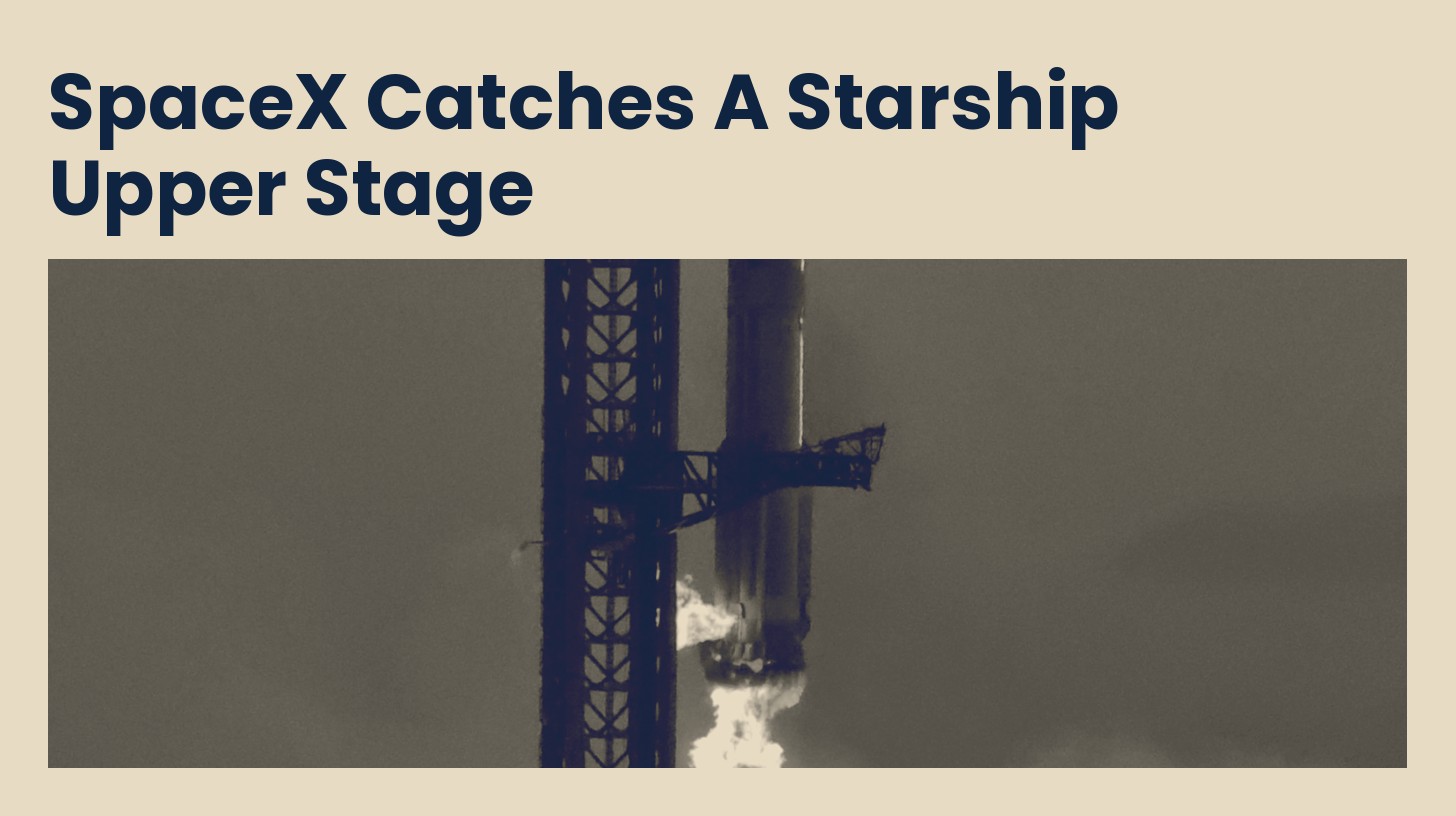
SpaceX recovered a Starship upper stage from orbit for the first time, with the Mechazilla tower's chopstick arms catching Ship 42 after 23 hours in flight. The successful catch unlocks full reusability and positions SpaceX toward weekly Starship launches in the first half of 2027.
What's happening
- Ship 42 lifted off from Starbase on Friday, deployed 26 Starlink V3 satellites during 14 orbits, and was caught by the Mechazilla tower after a 23-hour flight.
- The upper stage completed a boostback burn, exited orbit with a single Raptor engine ignition, and executed a landing flip with three Raptors before being captured by the tower's chopstick arms.
- Super Heavy Booster 22 aborted its catch attempt when only 32 of 33 Raptors relit for the boostback burn, forcing the booster to divert offshore and trigger its flight termination system.
Why it matters
- Full reusability of both stages eliminates the largest cost driver in launch operations, enabling SpaceX to dramatically increase production cadence and throughput for the heavy-lift market.
- Weekly launch cadence would require sustained manufacturing, assembly and turnaround rates that validate SpaceX's production capabilities and test the industrial base supply chain at scale.
- Rapid reusability reshapes the economics of space access, directly competing with expendable launch providers and affecting procurement decisions for national security payloads and commercial operators.
Going deeper
- SpaceX management stated on the Q3 earnings call that the goal is to land and relaunch rockets like an airplane, with weekly Starship flights expected in H1 2027.
- The company aims to reclassify the second stage for reflight by early 2027 and will ramp launch cadence as rapid reusability milestones are achieved.
The intrigue
- The booster anomaly that triggered automated abort and flight termination remains under investigation, raising questions about the reliability of 33-engine synchronization and guidance system redundancy at scale.
The fine print
- Ship 42 caught intact in principle enables a reflight, but no near-term reuse schedule has been disclosed.
- Weekly launch cadence is a stated target for H1 2027, but actual production rates and turnaround times remain unproven at that frequency.
Source: payloadspace.com · Nov 15, 2026 · Drafted with Claude, reviewed by Industrial Base Alpha.