Mentioned:Perpetua Resources$40M · Government Support
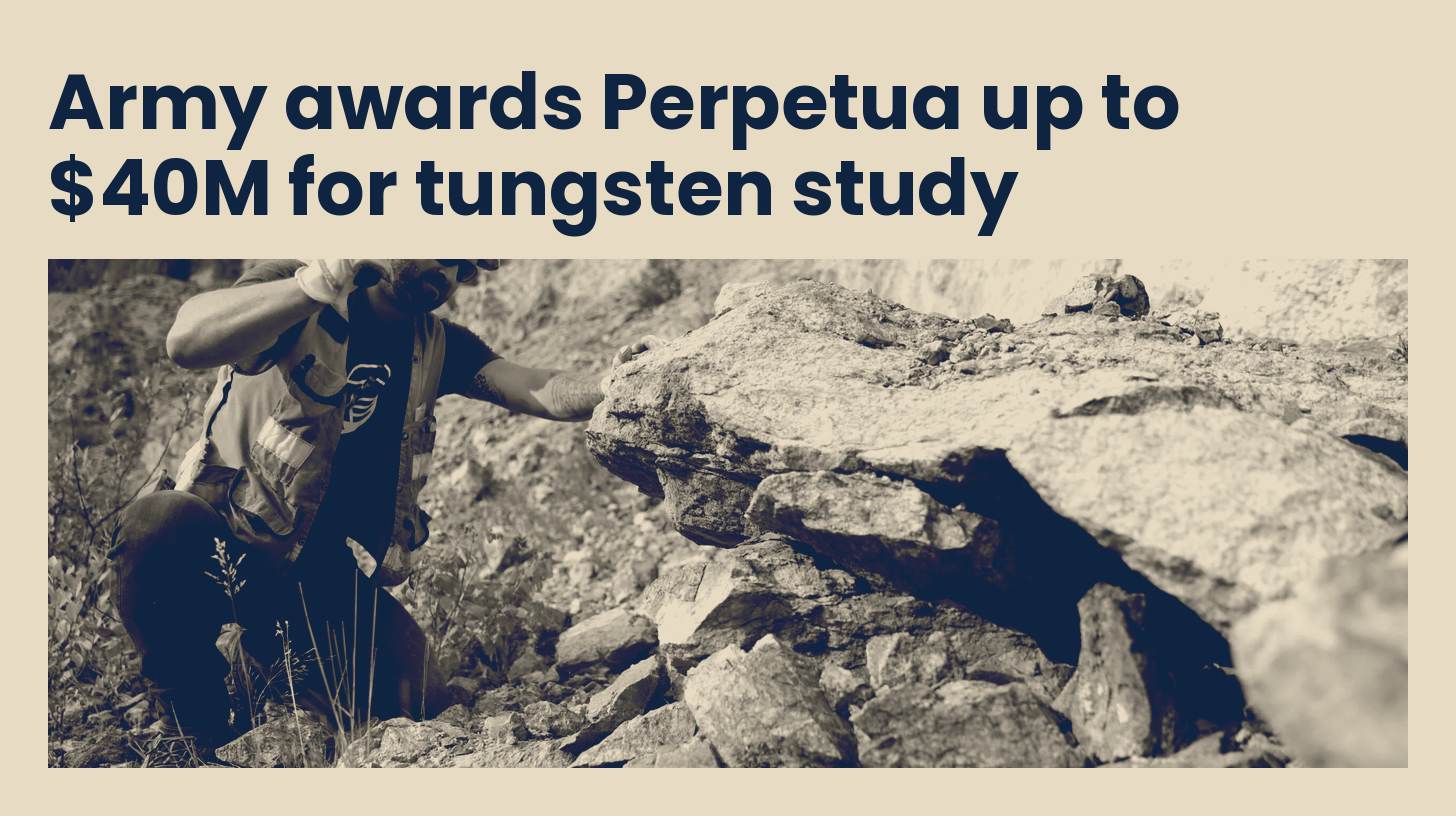
The U.S. Army awarded Perpetua Resources up to $40 million to evaluate technical and economic feasibility of producing tungsten concentrate at the Stibnite Mining District in Idaho. Perpetua will match the government contribution, bringing total planned investment to $80 million over 36 months.
What's happening
- The Army's Defense Ordnance Technology Consortium allocated $40 million to Perpetua Resources for a feasibility study on tungsten production at Stibnite, requiring Perpetua to match the investment.
- The 36-month program includes exploration drilling, laboratory testing, engineering, and permitting work to assess tungsten concentrate production viability at the historic mining district.
- The initial 18-month phase is budgeted at $18 million, split equally between Perpetua and the government, with later phases depending on technical results and additional funding approvals.
- Previous drilling identified tungsten deposits grading 4.6 percent tungsten over 9.8 meters and 1.2 percent tungsten over 22.9 meters in the proposed Hangar Flats pit.
Why it matters
- The U.S. has had no commercial tungsten mining since 2015, leaving defense manufacturers dependent on imports from limited suppliers vulnerable to Chinese export controls.
- Tungsten's properties, including exceptional hardness and high-temperature resistance, make it essential for defense components, industrial cutting tools, and specialized alloys critical to the defense industrial base.
- Stibnite supplied roughly half of U.S. tungsten and 90 percent of U.S. antimony during World War II, demonstrating the district's historical production capacity and resource quality.
- Successful development of domestic tungsten production would reduce supply chain risk for defense manufacturing and address federal sourcing requirements for critical materials.
Going deeper
- Metallurgical testing will determine whether tungsten and antimony can be recovered efficiently enough from Stibnite's deposits to support commercial mine economics.
- The program plans to test a 550-kilogram sample grading 4.2 percent tungsten and 9.2 percent antimony to assess processing efficiency and recovery rates.
- Further work could include designing and permitting an underground exploration decline for access to mineralization beneath Hangar Flats, contingent on drilling results and approvals.
- Perpetua also holds 1.37 million ounces of gold resources and over 95 million pounds of antimony resources at Stibnite not included in current mine plans.
Financial impact
- This award brings total U.S. government funding to Perpetua for critical minerals work to $126 million since 2022, providing cash to support exploration and feasibility activities.
- The initial 18-month phase costs approximately $18 million, with Perpetua's $9 million share increasing its near-term cash requirements; timing of cash disbursement not disclosed.
- The award does not constitute approval for commercial mining, meaning revenue generation remains contingent on successful feasibility results, additional permitting, and separate development and production funding.
The fine print
- The $40 million represents a ceiling value; obligated funding for each phase depends on technical results, metallurgical testing outcomes, and government approval for continued work.
- The program evaluates feasibility but does not authorize commercial mining; additional regulatory review, permits, and separate capital would be required before production could begin.
- Later phases of the program will depend on drilling results, metallurgical testing outputs, engineering work, permitting progress, and approval of additional funding by the government.
Source: interestingengineering.com · Oct 27, 2026 · Drafted with Claude, reviewed by Industrial Base Alpha.