Mentioned:No public companies identified
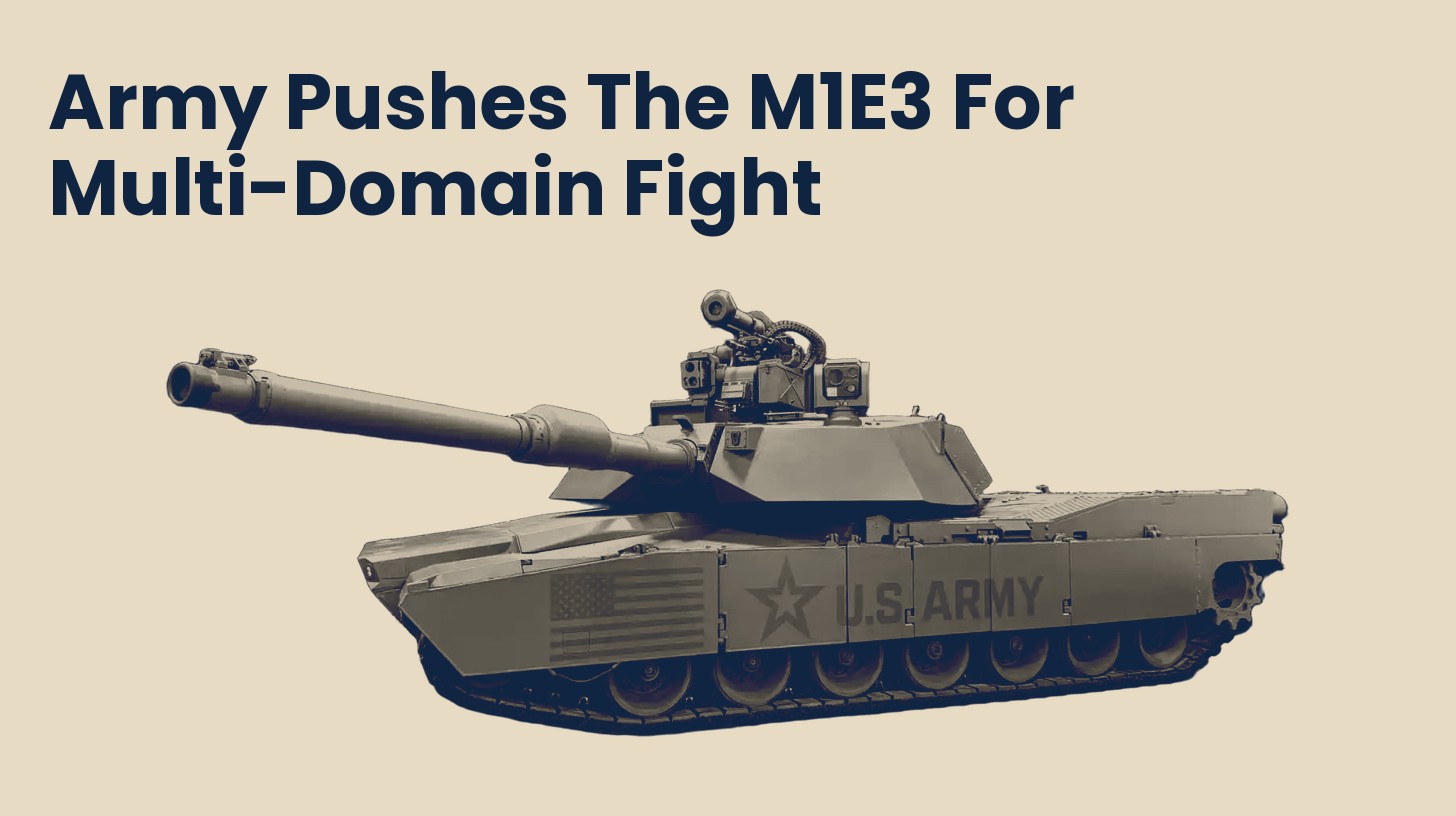
The Army accelerated the M1E3 tank program after cancelling the M1A2 SEPv4 in 2023, moving to a clean-sheet design that reduces combat weight to roughly 60 tons from over 76 tons. The new architecture addresses survivability, mobility and networking gaps required by the Army's multi-domain operations doctrine.
What's happening
- The M1E3 targets a combat weight of roughly 60 tons, a reduction of 14 to 16 tons from the fielded M1A2 SEPv3 at over 76 tons, through unmanned turret design and clean-sheet architecture.
- An unmanned turret with ammunition handling system relocates the three-person crew into the protected hull, dropping turret ballistic requirements and enabling integration of 360-degree hard-kill active protection systems.
- The design adopts Modular Open Systems Architecture from the start, enabling software-defined upgrades to arrive in weeks rather than requiring multi-year depot cycles.
- The M1E3 addresses four elements of Army warfighting doctrine: survivability through design rather than add-on armor, tactical and strategic mobility through weight reduction, convergence via networked battle management and automated targeting, and endurance through improved fuel efficiency.
Why it matters
- Existing Abrams variants at over 76 tons exceed the capacity of most European and Indo-Pacific bridges and organic recovery assets, funneling armor into predictable chokepoints where adversary precision fires concentrate.
- Weight reduction to 60 tons restores strategic, operational and tactical mobility necessary for large-scale combat measured in days, where every delay in deployment and maneuver costs initiative.
- Modular architecture enables rapid software-driven capability updates without depot overhauls, reducing the lag between threat evolution and platform response from years to weeks.
- Integration of unmanned turrets and hard-kill active protection systems as core design elements replaces stopgap cage armor and bolt-on systems that degrade mobility, increase power draw and create crew protection blind spots.
Going deeper
- The M1A2 carries decades of counter-IED underbelly plating and composite armor packages that created weight margins the platform cannot shed through incremental upgrades.
- Ukraine combat operations have inverted survivability assumptions by showing top-attack drones and loitering munitions defeat passive armor strategies, requiring active protection and reduced crew exposure.
- The M1A2 SEPv3 turbine engine consumes fuel at idle, tying every armored brigade combat team to large divisional fuel convoys that extend logistics tails and create vulnerability.
Source: Breaking Defense · Nov 24, 2026 · Drafted with Claude, reviewed by Industrial Base Alpha.