
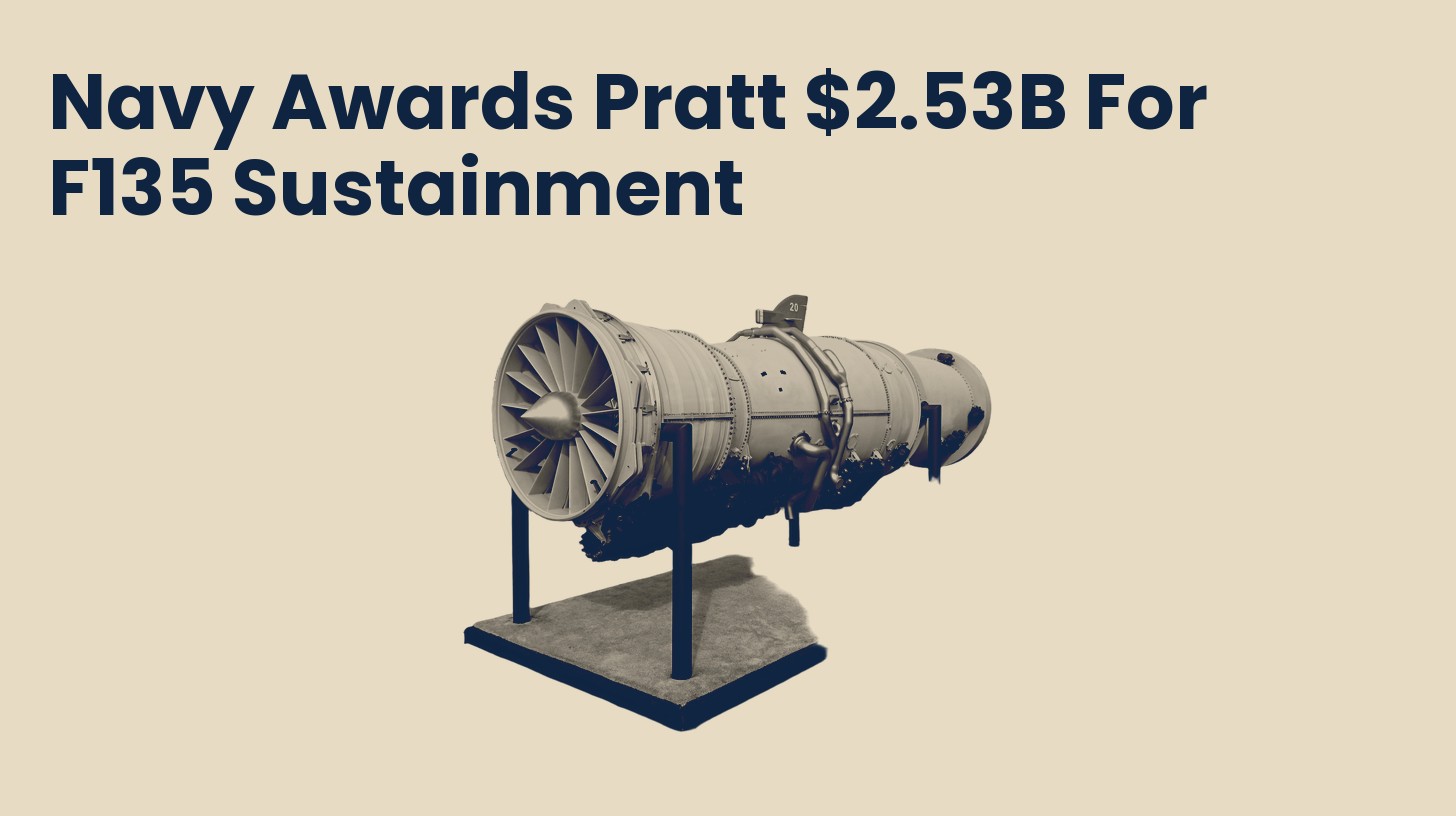
The U.S. Navy awarded Pratt & Whitney a $2.53 billion undefinitized contract for global F135 engine sustainment through November 2027. The award is $925 million larger than last year's sustainment deal and addresses critical capacity constraints affecting the global F-35 fleet.
What's happening
- The contract covers unit and depot-level maintenance, repair, spare parts, logistics and software sustainment for the F135 engine powering all three F-35 variants across 20 allied nations.
- Only $436.7 million of the $2.53 billion total is obligated at award, about 17 percent, with final pricing undisclosed and work completion targeted for November 2027.
- Five funding sources contribute: Air Force $147.5 million, international F-35 partners $99.4 million, Foreign Military Sales customers $75.4 million, Marine Corps $80.5 million and Navy $33.9 million.
- Work locations span East Hartford, Connecticut (40 percent), Oklahoma City's Tinker Air Force Base depot (21 percent), Indianapolis (12 percent) and overseas sites across six allied nations (14 percent).
Why it matters
- The 58 percent year-over-year increase signals escalating sustainment demand as the global F-35 fleet ages and production engines shift to meet urgent depot repair backlogs.
- GAO warned in June 2026 that the F-35 fleet's mission capable rate fell from 67 percent to 44 percent between fiscal 2021 and 2025, driven partly by engine module repair delays and insufficient spare inventory.
- Limited depot capacity and material constraints have created repair delays; RTX invested over $1 billion in five years raising engine output 20 percent but officials told GAO industry capacity may remain insufficient to meet demand.
- Pentagon seeks an additional $13.7 billion across fiscal 2026 through 2031 to reset F-35 sustainment, indicating the program faces structural cost and availability challenges beyond this single contract.
Going deeper
- The F135 uses four modular designs: fan, power, augmentor and nozzle; damaged modules go to depot for disassembly, repair and return to spares pool, requiring sufficient spare engines and depot throughput.
- GAO found in 2023 that F135 problems would add $38 billion in unplanned maintenance costs over the fleet's life, driven primarily by cooling system issues.
- RTX operates a network covering multiple depots, 39 military bases and 12 ships; the company has delivered more than 1,300 production engines to the global F-35 enterprise.
- Material was diverted from sustainment to production under the F135 performance-based logistics contract, contributing to module repair delays, and workers discovered more damage than expected during disassembly.
Financial impact
- RTX will recognize revenue on the income statement over the performance period through November 2027; $436.7 million is obligated at award in fiscal 2026 with remaining $2.093 billion subject to future funding decisions.
- The contract structure includes cost-plus, incentive-fee and fixed-price line items, though the split and final pricing remain undisclosed; timing of full contract funding is not specified.
- This sustainment contract follows the prior year $1.6 billion F135 sustainment award, demonstrating sustained backlog growth and recurring revenue stream for RTX's Pratt & Whitney division.
The intrigue
- The award was made without competition despite being an undefinitized contract, raising questions about alternatives and market consolidation in fighter engine sustainment.
- RTX and F-35 program officials told GAO industry capacity may remain insufficient even with added funding, suggesting future sustainment awards may face supply-side constraints rather than budget constraints.
The fine print
- The contract is undefinitized, meaning final terms, pricing and cost allocation across line items remain to be negotiated; no timeline for finalization is disclosed.
- Only 17 percent of the ceiling value is obligated at award; the remaining $2.093 billion depends on future congressional appropriations and Navy funding decisions.
- No engine availability targets or repair turnaround time goals are disclosed in the contract notice, leaving performance metrics undefined.
Source: defence-blog.com · Nov 26, 2026 · Drafted with Claude, reviewed by Industrial Base Alpha.