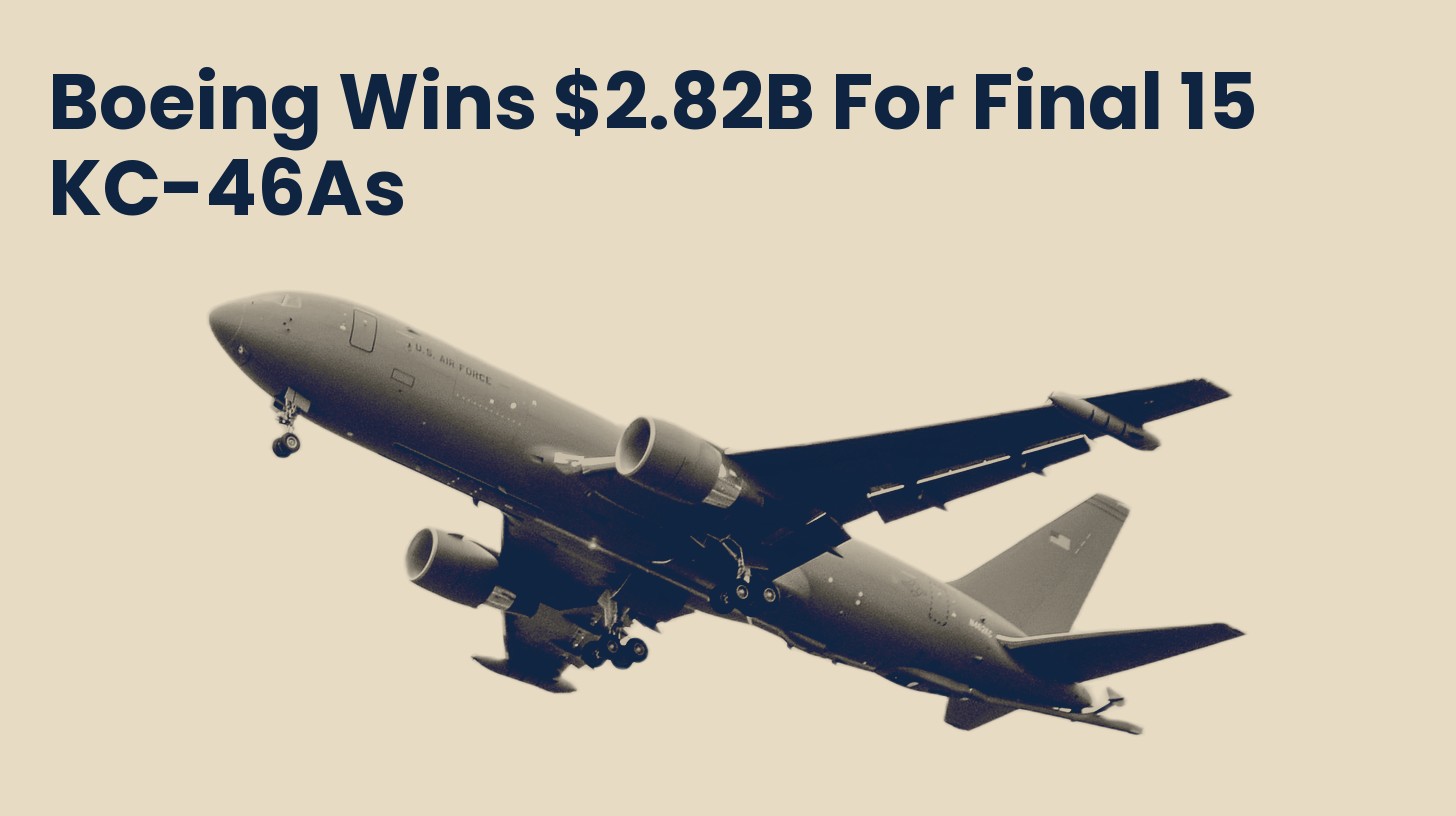
The U.S. Air Force awarded Boeing $2.82 billion for 15 KC-46A Pegasus tankers, completing the 13 production lots priced into the program's original 2011 contract. The tankers are due by mid-2030, about $350 million above the previous 15-aircraft lot purchased a year ago.
What's happening
- Boeing receives $2.82 billion for the final 15 KC-46A tankers under the original contract structure, with delivery expected by mid-2030.
- The Air Force has received 116 KC-46As so far, with 203 total on contract or in service worldwide including Japan and Israel.
- This completes all 13 production lots priced into the 2011 original contract; future KC-46 purchases depend on resolving known deficiencies.
Why it matters
- The Air Force seeks 263 KC-46As total to replace its KC-135 fleet built in the 1950s and early 1960s, making this program central to tanker capacity.
- Boeing's ability to resolve refueling boom and Remote Vision System issues directly affects whether the Air Force will exercise its option for up to 75 additional aircraft.
- Production cost increases have forced Boeing to absorb over $7 billion in losses on this firm-fixed-price contract, constraining the company's ability to invest in rate improvements.
Going deeper
- Air Force Vice Chief of Staff General John Lamontagne told Congress in March that the decision on the 75-aircraft extension was likely two years away.
- Boeing completed the first phase of flight testing on a redesigned RVS 2.0 camera system in June, with the Air Force projecting fielding by summer 2027, three years behind original schedule.
- The Air Force and Boeing agreed in May on a plan expected to increase KC-46 availability by more than 20 percent by 2030, targeting reliability and parts shortages.
Financial impact
- Boeing will recognize revenue over the production period through mid-2030 on the $2.82 billion order, bolstering backlog through fiscal 2030.
- The contract price of $188 million per aircraft represents approximately $350 million more than the previous 15-tanker lot at $2.47 billion, reflecting ongoing cost escalation.
- Boeing's cumulative KC-46 losses exceeded $7 billion as of late 2025, including $565 million in a single quarter attributed to higher production costs, pressuring gross margin on defense contracts.
The intrigue
- General Lamontagne's statement that deficiencies must be resolved before a new contract suggests the Air Force may withhold the 75-aircraft extension as leverage to enforce performance on boom and camera reliability.
- Boeing's aggressive cost absorption on a firm-fixed-price contract raises questions about whether production rate increases and supply chain stabilization can restore margin before the 75-aircraft option decision point.
The fine print
- The $2.82 billion order is the final lot under the original 2011 contract structure; any additional KC-46A purchases will flow through the separate Tanker Production Extension program.
- The Remote Vision System 2.0 upgrade is not yet fielded; summer 2027 is the Air Force's target, leaving three years of potential schedule risk before the 2029 decision on the 75-aircraft option.
Source: Defense News · Nov 25, 2026 · Drafted with Claude, reviewed by Industrial Base Alpha.