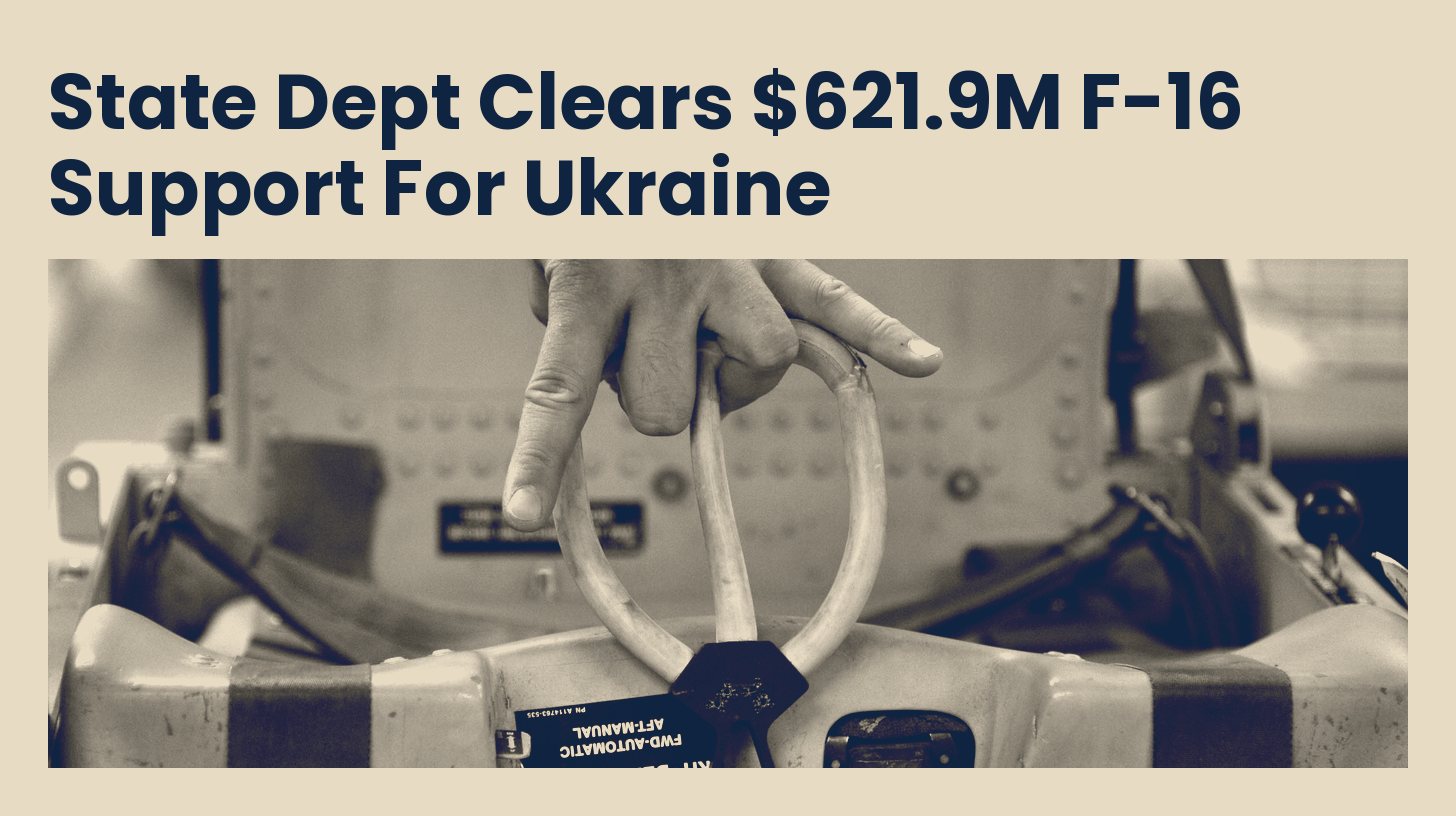
The U.S. State Department approved a $621.9 million Foreign Military Sale of F-16 sustainment equipment to Ukraine, funded entirely by Belgium, Denmark, the Netherlands and Norway through JUMPSTART. The package is roughly twice the size of each earlier U.S.-cleared F-16 support package for Ukraine.
What's happening
- The sale covers ejection-system cartridges, lab equipment and transportation support for F-16 fleet sustainment.
- Four NATO allies funding through JUMPSTART mechanism will pay the full $621.9 million with zero U.S. government funds involved.
- Contractors will be selected through competitive procurements run by the U.S. government with no additional U.S. personnel required in Ukraine.
- The package adds to a previously implemented case whose value was below the congressional notification threshold, though the breakdown between new and existing obligations is not disclosed.
Why it matters
- Ejection cartridges have limited service lives and must be replaced on schedule; without current cartridges, F-16 escape systems cannot be certified, keeping aircraft grounded.
- More than half of Ukraine's roughly 40 to 50 delivered F-16s were in maintenance limbo as of late September, with the fleet at risk of running out of available aircraft by end of 2026 at current pace.
- Sustainment equipment addresses critical supply-chain constraint: phase inspections stretch to 40 weeks in Belgium compared to 2 to 6 weeks in the United States due to parts waits and additional repairs.
- The sale demonstrates how JUMPSTART shifts financial burden from the U.S. government to allied nations while maintaining Foreign Military Sales structure for Ukraine's operational continuity.
Going deeper
- Cartridge Actuated Device and Propellant Actuated Devices are small explosive charges that fire F-16 ejection seats, canopy systems and emergency functions; fleets must replace them per maintenance schedules.
- The four funding nations have pledged approximately 110 F-16s total; Belgium, Denmark, Netherlands and Norway have delivered roughly 40 to 50 aircraft with five confirmed combat losses.
- The Netherlands completed transfer of 24 jets in 2025; Belgium and Norway deliveries have faced delays tied to F-35 replacement aircraft arrival and repair-facility constraints.
- Much depot-level maintenance occurs in Belgium; the Pentagon awarded Sabena Aerospace Engineering a contract valued up to $235.5 million for intermediate and depot-level F-16 and engine work through January 2029.
Financial impact
- The $621.9 million represents a Foreign Military Sale that will be recognized as revenue over the period of performance as equipment and services are delivered; timing of delivery not disclosed.
- No U.S. government funds are involved in this transaction, reducing burden on the U.S. defense budget for fiscal year 2026 and beyond.
- The agreement adds to previously existing contract obligations under a case that was below the congressional notification threshold, so total new obligated funds are not separately stated.
The intrigue
- The notice does not break out the cost of each item, quantities involved or a delivery schedule, leaving the composition and sequencing of the $621.9 million package unclear.
- Ukraine's defense ministry has pressed Lockheed Martin to expand F-16 maintenance to more sites within Ukraine rather than relying on Belgian depot work, but no expansion has been announced.
- Retired U.S. Air Force leadership and Lockheed Martin have separately proposed alternatives such as F-15 Eagles or a Ukraine-specific F-16 variant with extended range and new AESA radar, though neither has advanced to negotiation.
The fine print
- The notice states the items will be added to a previously implemented case; the breakdown of new versus existing obligations is not disclosed.
- No U.S. government or contractor personnel will be required to operate in Ukraine as part of this sale.
- Contractors will be selected through competitive procurements, meaning the final recipients and terms remain subject to U.S. government procurement rules.
Source: defence-blog.com · Nov 26, 2026 · Drafted with Claude, reviewed by Industrial Base Alpha.