Mentioned:Hanwha AerospaceHanwha Group$7.4B · Internal/Self-funded
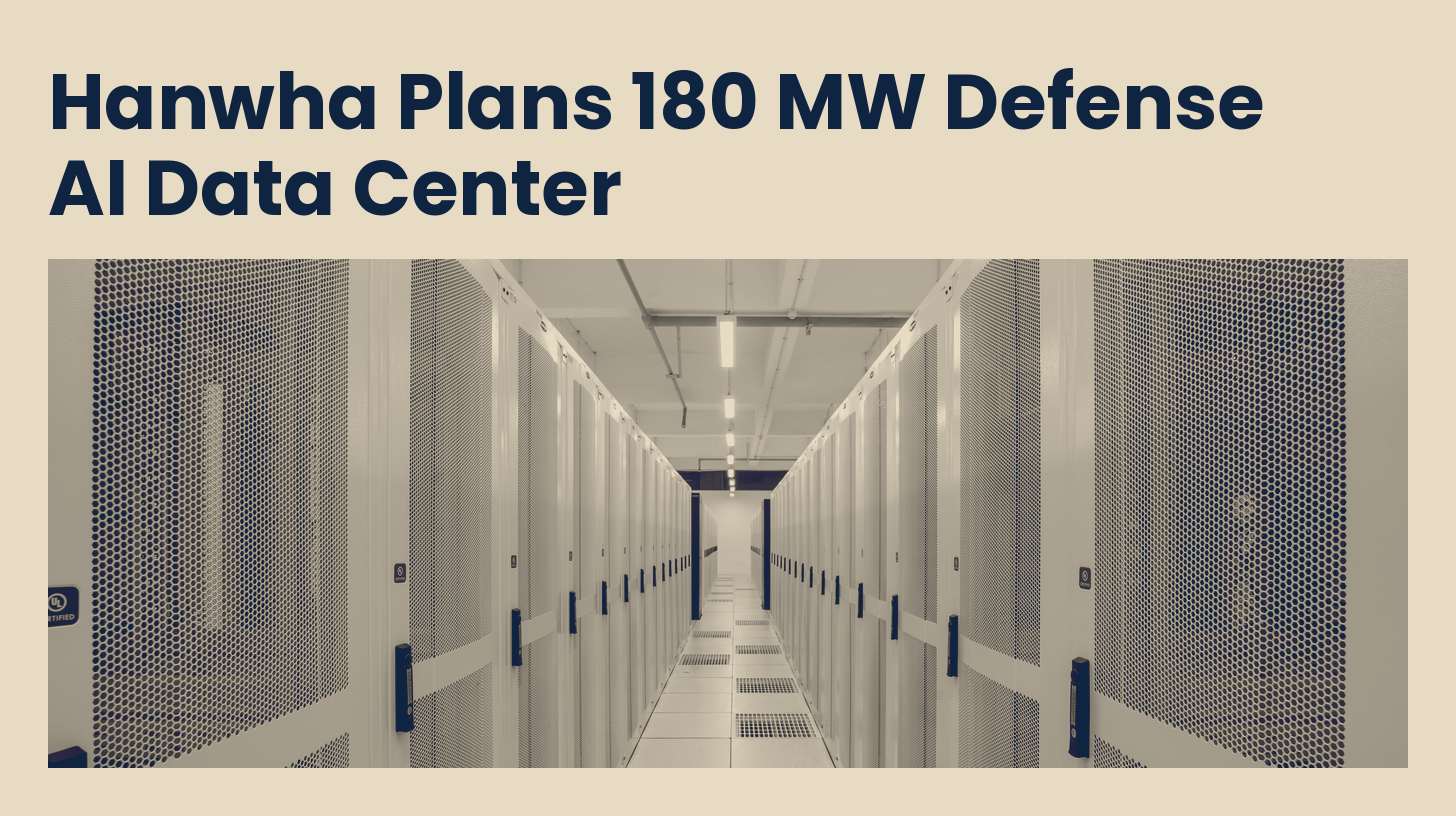
Hanwha Aerospace is building a 180-megawatt defense AI data center in Changwon, South Korea for $7.4 billion in self-funded capital, with operations starting July 2028. The facility aims to cut 4-5 years off military AI adoption timelines by offering isolated, secure infrastructure purpose-built for defense applications.
What's happening
- Hanwha Aerospace is constructing a 180-megawatt defense AI data center on 43,000 square meters adjacent to its Changwon plant, beginning operations in July 2028.
- The facility will house high-density GPU servers separated from commercial networks and secured to the highest national security standard, designed to operate through disasters and emergencies.
- Hanwha estimates a government-led alternative would require 6-8 years for feasibility, permitting, design and construction; the Changwon center compresses that timeline by 4-5 years.
- The project is phase one of Hanwha Group's 55 trillion won ($40.9 billion) aerospace and defense AI investment plan announced in July 2026 for South Korea's southeast region.
Why it matters
- South Korea's military gains isolated, purpose-built compute infrastructure for AI without waiting for a government procurement cycle, accelerating operational AI deployment across defense applications.
- A private operator model allows Hanwha to manage the data center under contract while the Ministry of National Defense retains ownership and control of military data, addressing security and sovereignty concerns.
- The 180-megawatt capacity represents approximately 13 percent of a single nuclear power plant's output, establishing significant industrial compute as a national defense asset and signaling South Korea's AI ambitions.
- Success positions Hanwha to export bundled data-center-and-weapons packages to allied nations using South Korean defense systems, creating new revenue lines tied to military modernization.
Going deeper
- Hanwha has operated the Jukjeon Integrated Data Center for defense affiliates since 2011, providing operational experience with classified defense workloads and infrastructure management.
- The South Korean government is aligning civilian and defense AI under a national strategy; Korea Aerospace Industries and Naver are building a sovereign AI model for defense, and KAI is developing an AI platform for predictive maintenance of military equipment.
- Hanwha Aerospace is training university students using defense data to build an AI workforce, addressing long-term talent and capability needs in military AI roles.
- Hanwha plans additional AI data center hubs in South Korea and abroad linked to its affiliates' power generation assets, suggesting a capital-intensive, integrated approach to controlling infrastructure end-to-end.
Financial impact
- Hanwha Aerospace is deploying $7.4 billion in internal capital for the first phase, reducing cash on hand and increasing capex in fiscal 2026 and 2027, with full 180-megawatt capacity deployment expected post-July 2028.
- Revenue recognition for defense AI data center services will begin in Q3 2028 upon initial service delivery; the revenue model and pricing with South Korean military have not been disclosed.
- The broader $40.9 billion Hanwha Group aerospace and defense AI investment plan will increase total capex across the group over multiple years, with timing and allocation between subsidiaries not disclosed.
- No terms regarding potential government cost-sharing, subsidies or long-term service contracts have been disclosed; the full financial impact on Hanwha Aerospace's balance sheet and cash flow depends on undisclosed operating and pricing arrangements.
The intrigue
- Hanwha's model of private construction and operation with military data ownership retention is novel for defense AI infrastructure; whether this arrangement becomes a template for other allied nations or remains South Korea-specific will shape Hanwha's export strategy.
- The feasibility and cost-effectiveness of Hanwha's private-led approach versus a government alternative is not independently verified; a government-led project's actual timeline and cost could differ materially from Hanwha's 6-8 year and implicit higher-cost estimates.
The fine print
- Initial service begins July 2028; capacity expansion to the full 180 megawatts occurs after that date, suggesting a phased revenue ramp that is not quantified.
- The operating model and contractual relationship between Hanwha and South Korea's Ministry of National Defense remain undisclosed, including service-level agreements, pricing, duration and renewal terms.
- Export of bundled data-center-and-weapons packages is contingent on allied nations' approval and their existing use of South Korean defense systems; regulatory and security clearances are not confirmed.
Source: militaryai.ai · Nov 25, 2026 · Drafted with Claude, reviewed by Industrial Base Alpha.