Mentioned:TXT Textron
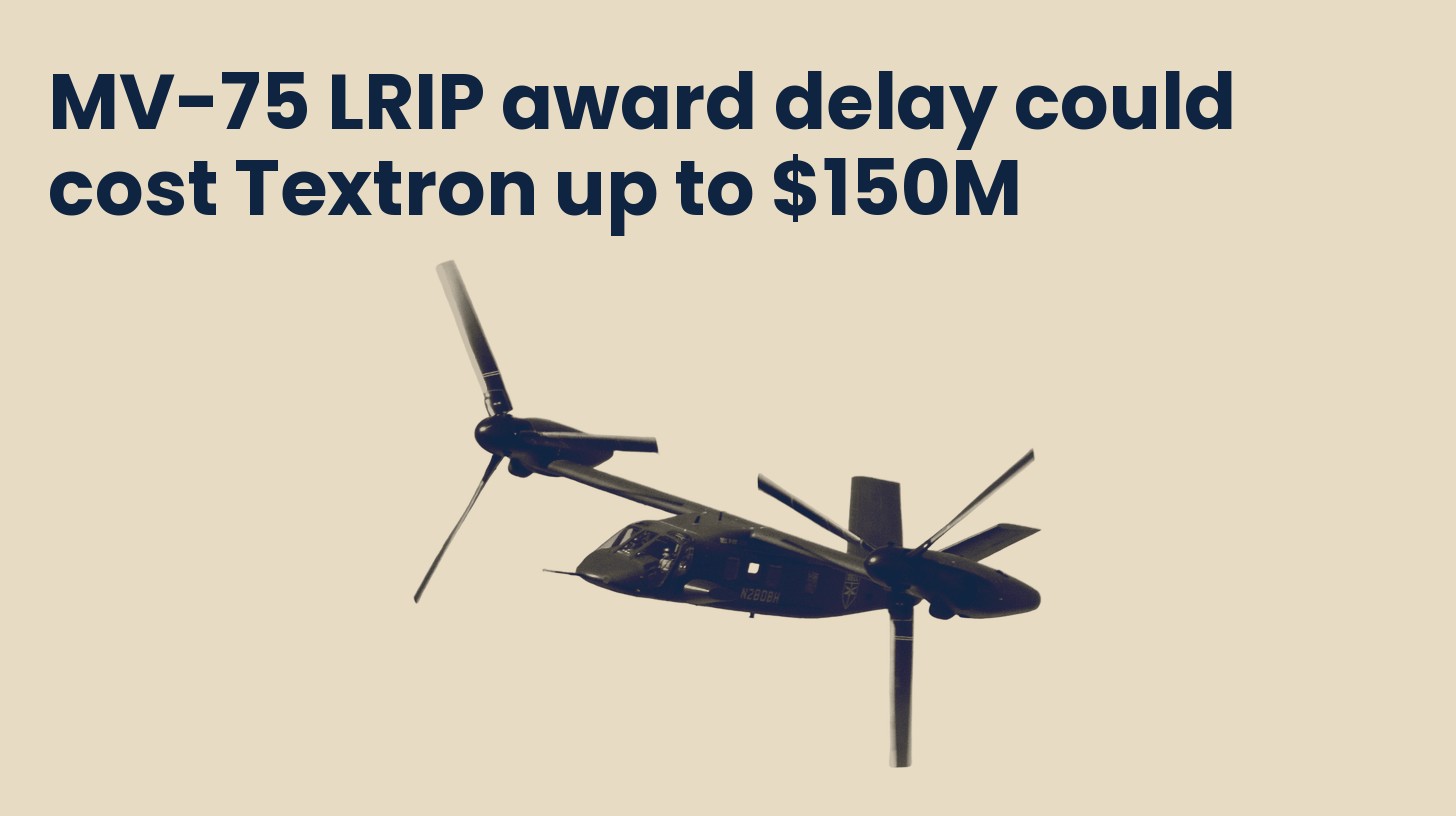
Textron warned investors that a delay in the Army's low-rate initial production contract award for the MV-75 Cheyenne II helicopter could increase program costs by $110 million to $150 million. The delay would stem from federal continuing resolution uncertainty that could push the award from Q4 2026 into Q1 2027.
What's happening
- Textron CFO David Rosenberg told investors the LRIP contract award could slip from Q4 2026 into Q1 2027 due to federal funding uncertainty under a continuing resolution.
- The company revised its cost estimate upward from $60 million to $110 million in the prior quarter to $110 million to $150 million if the delay extends further.
- The Army's proposed FY27 budget includes $2.3 billion for the MV-75, but that funding still requires congressional approval.
- Textron completed three wings, received first nacelles and built the first fuselage; the company expects to join the first fuselage with its wing assembly in Q4 2026.
Why it matters
- Recurring funding delays force Bell Textron to reduce spending, defer supplier payments and defer contract modifications, eroding program profitability and stretching the development timeline.
- The MV-75 is the Army's intended replacement for the UH-60 Black Hawk fleet starting in the 2030s; program delays compound risk to fielding the next-generation assault aircraft.
- Supplier cash flow stress accumulates when the government delays obligating contract modifications to cover accrued costs, creating second and third-order supply chain pressure.
Going deeper
- The Army exhausted nearly all available FY26 funding for the MV-75 in July 2026 and requested a $350 million reprogramming; Congress approved the request in Q3.
- Textron recorded a financial charge in Q2 FY26 due to funding delays and cannot recover that loss until the government officially adds funding to contracts.
- Bell is building eight prototype helicopters under the Future Long Range Assault Aircraft program; flight testing is expected in 2027.
Financial impact
- Income statement: Textron recorded a Q2 FY26 charge for MV-75 funding delays; the company cannot reverse that charge until contract modifications are officially obligated, timing not disclosed.
- Cash flow: Supplier invoices continue to trickle in through October and November 2026 against the $300 million in contract modifications approved in Q3; the company expects to obligate remaining modifications as the LRIP award timing becomes clear.
- Balance sheet: Textron's deferred revenue and contract liability position will depend on the pace of official government funding obligations; a Q1 2027 LRIP award extends the cash impact into the next fiscal year.
The intrigue
- Textron must manage supplier relationships and retain critical production resources while awaiting contract clarity; a multi-quarter delay raises the risk that key suppliers will deprioritize the program or increase overhead burden.
The fine print
- The $2.3 billion FY27 budget for the MV-75 requires congressional approval; the proposed funding is not yet obligated.
- The $110 million to $150 million cost increase is the company's current estimate and assumes a Q1 2027 award; further delays could increase the figure.
- The $350 million reprogramming approved in Q3 included $300 million in contract modifications to cover costs already accrued by Bell and suppliers; an estimated $50 million remainder was not immediately obligated.
Source: Breaking Defense · Oct 29, 2026 · Drafted with Claude, reviewed by Industrial Base Alpha.