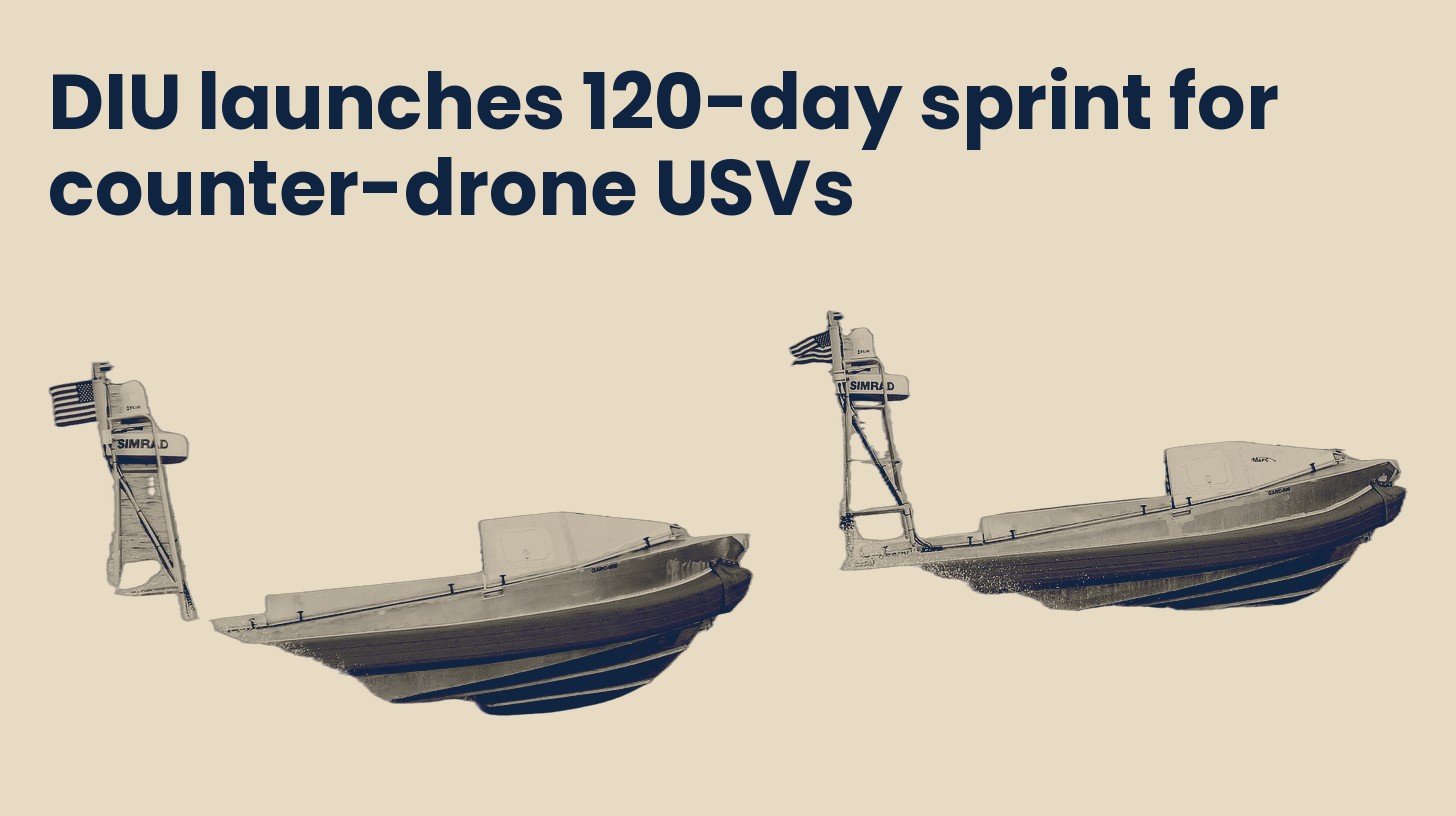
The Pentagon and Defense Innovation Unit launched a 120-day sprint to acquire counter-UAS armed unmanned surface vessels capable of engaging low-cost drone threats. The effort includes a three-phase 12-month prize challenge offering up to $100M in awards, with an additional $200M budgeted for follow-on prototyping and production.
What's happening
- DIU seeks production-ready USVs capable of integrating existing missiles including Longbow Hellfire, JAGM, APKWS and Stinger for counter-air operations within 120 days.
- Vessels must achieve minimum 200 nautical mile operational range, sustain 10-knot cruising speed and provide 360-degree detection and tracking of aerial and surface threats.
- Three-phase 12-month competition offers up to $40M for counter-air capabilities in phase two, with winners demonstrating systems within 30 days of selection.
- Operational testing scheduled for early 2027 at Joint Expeditionary Base Little Creek, Virginia, with follow-on production agreements supported by $200M budgeted funding.
Why it matters
- Addresses critical gap in surface fleet defense against low-cost asymmetric threats including Group 1-3 drones and attack helicopters that existing Navy systems struggle to counter.
- Fielding loss-tolerant unmanned vessels in four months compresses typical acquisition timelines and builds surge capacity for contested environment operations.
- Rapid rearming capability with minimal logistical support increases operational persistence and deployment flexibility across Pacific and Middle East theaters.
- Prize challenge model accelerates industrial base response to urgent operational requirement without traditional procurement gates.
Going deeper
- Saildrone conducted JAGM missile test at Rim of the Pacific 2026 exercise and has deployed to Pacific and Middle East for intelligence collection missions.
- BlackSea Technologies demonstrated integration using its Comet USV, while L3Harris proved rapid retrofit capability with VAMPIRE counter-UAS system mounted on vessels.
- French firm Exail supplying DriX H-9 USV to Office of Naval Research as testbed for unspecified counter-drone system, indicating allied participation.
- USS Carl M. Levin DDG 120 already equipped with new Coyote missile launcher for counter-UAS operations in Arabian Sea supporting Middle East operations.
Financial impact
- Prize challenge distributes $100M across three-phase 12-month competition with $40M allocated specifically for counter-air capabilities in phase two.
- Pentagon budgeted additional $200M for follow-on prototyping and production agreements, timing not disclosed.
- Participants required to demonstrate integrated systems within 30 days of selection, compressing development and integration timelines and accelerating cash outflows.
- Revenue recognition for winners will occur across 2027 and 2028 as contracts progress through demonstration, testing and production phases.
The intrigue
- Iranian Shahed drones have proven extremely difficult to counter with existing Navy air defense systems, creating operational urgency driving compressed 120-day acquisition timeline.
- Weapons employment remains under human supervision despite autonomous navigation and collision avoidance requirements, raising questions about engagement authority in contested environments with degraded communications.
The fine print
- All systems must operate autonomously in environments where communications and satellite navigation are degraded or denied, adding technical risk to integration efforts.
- Prize challenge offers up to $100M with actual awards contingent on demonstrated capabilities; ceiling value differs from obligated funding at selection.
- Rapid field rearming by two-person crews with minimal support equipment is highly desired but not mandatory, allowing vendors flexibility in logistics support design.
Source: navalnews.com · Oct 22, 2026 · Drafted with Claude, reviewed by Industrial Base Alpha.