Mentioned:SpaceX$1.6B · Contract Award
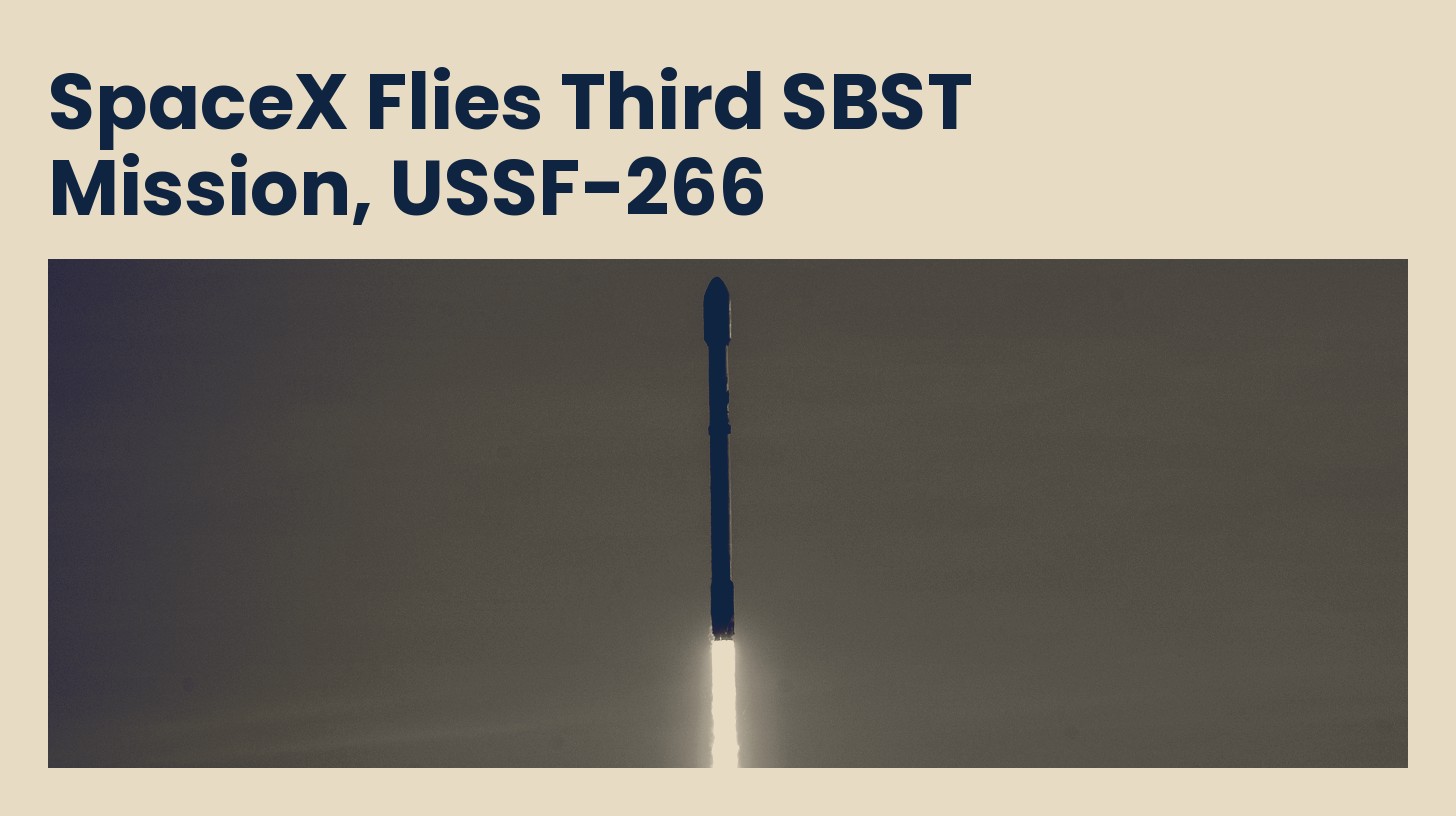
SpaceX launched USSF-266, the third in a series of classified payloads under a $1.6 billion Space Force task order for the Space Based Sensing and Targeting program. The mission lifts off from Vandenberg Space Force Base as part of an 18-launch commitment to be completed by end of 2027.
What's happening
- SpaceX conducted USSF-266, the third classified mission in the SBST series, from Vandenberg Space Force Base on November 24, 2026.
- The launch was executed under a $1.6 billion task order covering 18 total Falcon 9 launches scheduled for completion by end of 2027.
- This task order was awarded through the NSSL Phase 3 Lane 1 contract, which emphasizes rapid acquisition and launch flexibility for responsive space capabilities.
- The Space Force achieved a two-month acquisition timeline from requirement identification to task order award under Phase 3 Lane 1.
Why it matters
- The accelerated two-month acquisition timeline demonstrates the Space Force's ability to field operational space systems at speed to meet warfighter demand.
- SBST represents a shift toward responsive space architectures that prioritize rapid deployment over traditional long-lead acquisition cycles.
- SpaceX's sustained execution of 18 classified missions validates commercial heavy-lift capacity for strategic military payloads and reduces reliance on legacy launch cadences.
- Phase 3 Lane 1 contract structure enables multiple vendors to compete for future task orders, creating durable competition in responsive launch markets.
Going deeper
- Previous USSF-259 and USSF-481 missions in the SBST sequence each deployed 17 satellites into the Space Force tracking catalogue.
- Booster B1081 completed its 29th flight, underscoring SpaceX's operational cadence and reusability economics on government missions.
- The Space Force has not disclosed payload composition or mission objectives; SBST missions are classified under the Space Based Sensing and Targeting portfolio.
Financial impact
- The $1.6 billion task order recognizes revenue across 18 launches with completion by end of 2027; SpaceX revenue recognition will follow launch cadence and performance milestones.
- Task order ceiling value is $1.6 billion; obligated funds and payment schedule are not disclosed.
- This contract adds to SpaceX's government backlog under existing NSSL Phase 3 Lane 1 vehicle authorization, contributing to recurring revenue from Space Force accounts in fiscal 2026 and 2027.
The intrigue
- SBST mission objectives and payload architecture remain undisclosed, leaving ambiguity around whether this represents new strategic ISR, targeting capability, or test-bed deployment for future systems.
The fine print
- Task order completion is targeted for end of 2027; actual schedule is subject to range availability, weather, and operational constraints at Vandenberg Space Force Base.
- NSSL Phase 3 Lane 1 is a task order vehicle; additional lanes and task orders may be competed separately.
Source: spaceflightnow.com · Nov 23, 2026 · Drafted with Claude, reviewed by Industrial Base Alpha.