Mentioned:Zone 5 TechnologiesCoAspire
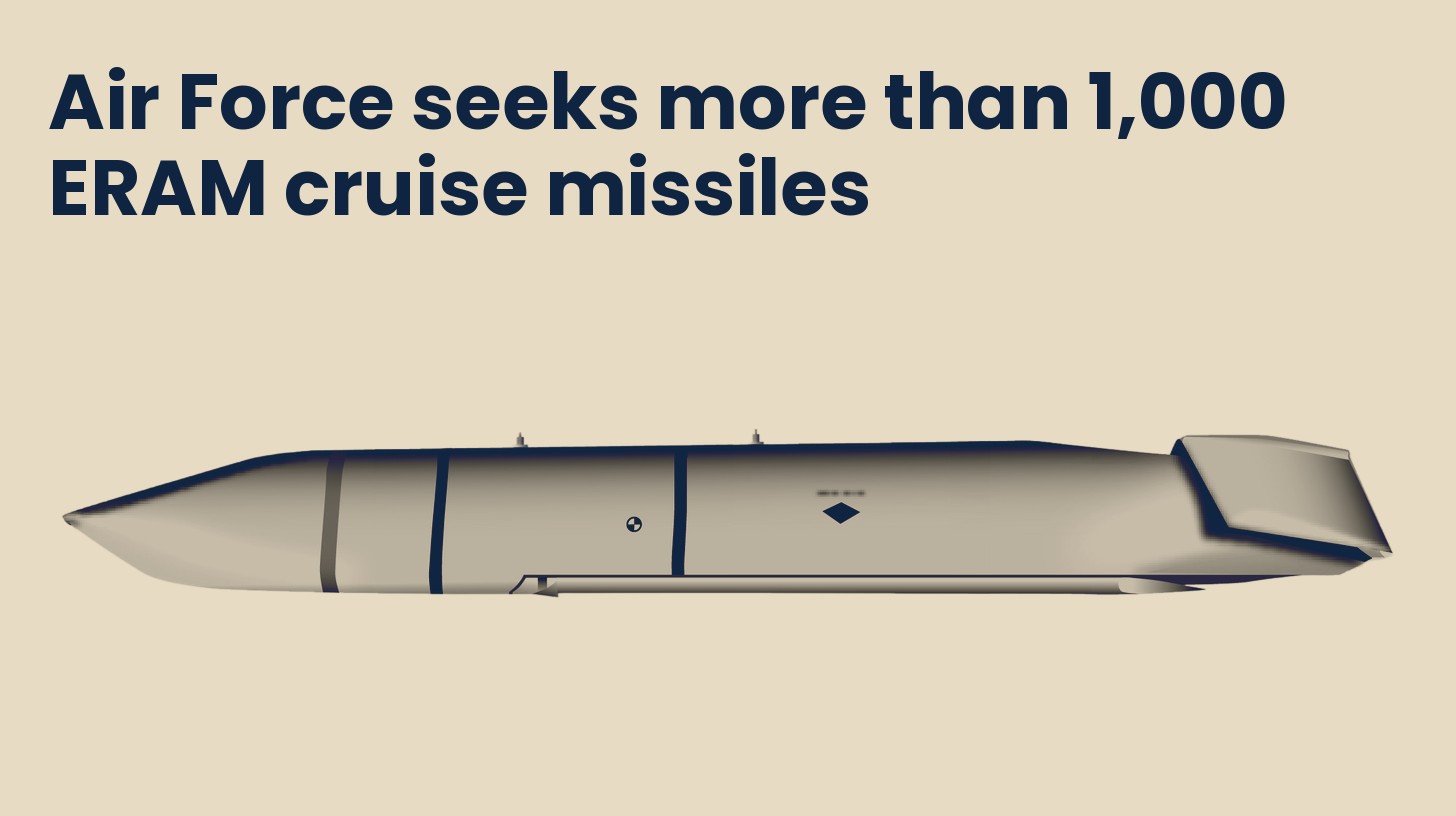
The U.S. Air Force is seeking companies to manufacture more than 1,000 ERAM cruise missiles with all deliveries completed within 15 months of award. The effort demands production rates exceeding 80 missiles per month, nearly double the existing 42-per-month baseline and marks the first step in a two-step Other Transaction Authority competition.
What's happening
- The Air Force Life Cycle Management Center at Eglin Air Force Base released RFI FA865927W0002 seeking 1,000+ Extended Range Attack Munitions for delivery within 15 months of contract signature.
- Production schedule requires 80+ missiles per month starting no later than 3 months after award, compared to the existing program baseline of approximately 42 per month.
- New requirements mandate integration of active infrared and anti-radiation seekers and full compatibility with F-16 Block 10/15/20 Mid-Life Update aircraft, the European upgrade standard operated by Ukraine.
- Bidders must hold Top Secret/Sensitive Compartmented Information facility clearance and meet nontraditional contractor, small business or cost-share qualifications under Other Transaction Authority rules.
Why it matters
- Doubling production rates to 80+ missiles per month represents a significant industrial capacity surge, requiring new manufacturing lines, supply chain expansion and workforce scaling across munitions suppliers.
- The 15-month compressed delivery timeline creates immediate pressure on component suppliers and assembly operations; any supply chain disruption could cascade across an already-strained defense industrial base.
- Integration of dual-band infrared and anti-radiation seekers expands ERAM's operational flexibility beyond GPS-denied navigation, enabling terminal-phase target engagement against air defenses and mobile targets.
- F-16 Mid-Life Update compatibility directly supports Ukraine's current fighter fleet and signals sustained U.S. commitment to affordable, mass-producible standoff munitions for near-peer conflict.
Going deeper
- ERAM development moved from initial 2024 industry solicitation through live-warhead test at Eglin Test and Training Range on January 21, 2026, completing proof-of-concept in less than 16 months.
- Zone 5 Technologies' Rusty Dagger design, designated AGM-188A, fired in the January 2026 test; Zone 5 and CoAspire are named as principal contractors under the State Department's August 2025 approval for 3,350 missiles valued at $825 million.
- A first production lot of 840 missiles was scheduled for delivery by end of October 2026; U.S. Air Force has not disclosed publicly how many reached Ukraine or have seen operational use.
- ERAM operates at Mach 0.6+ with 250+ nautical mile range, 10-meter circular error probable, and 500-pound-class warhead, positioning it between tactical guided bombs and high-cost cruise missiles like Storm Shadow.
Financial impact
- No contract value disclosed in RFI; award amount and revenue recognition timeline depend on second-step proposal phase and subsequent funding approval and allotment.
- State Department foreign military financing previously approved $825 million for 3,350 missiles plus navigation units; Denmark, Netherlands, Norway and U.S. FMF are co-funding the existing purchase program.
- Production ramp to 80+ missiles per month will drive operating cash outflow for tooling, component procurement and workforce expansion across prime contractors and supply base during 2027, with backlog building as production accelerates.
The intrigue
- RFI does not name Ukraine as customer, yet transfer alignment requirement for F-16 Mid-Life Update and new seeker integration capabilities point explicitly to Ukrainian operations, leaving official use unconfirmed.
- Zone 5 Technologies' reported involvement in June 22, 2026 strike on Russian semiconductor plant (per Russian claims and antenna debris analysis) has not been officially acknowledged by U.S. or Ukrainian governments, creating ambiguity around current battlefield deployment.
The fine print
- Award contingent on approval and funding availability; no commitment timeline stated and no obligated funds disclosed in RFI.
- Responses to first-round RFI required to remain eligible for second-step Commercial Solutions Proposals; only Air Force-selected bidders advance to full proposal competition.
- Production requirement of 80+ missiles per month represents a ceiling based on 1,000+ units over 12-month window; actual monthly rates may vary based on award and ramp schedule.
- Qualification rules require nontraditional contractor or small business status, or prime contractor must subcontract at least one-third of project cost to nontraditional firm, limiting competition to defined industrial base segments.
Source: defence-blog.com · Nov 5, 2026 · Drafted with Claude, reviewed by Industrial Base Alpha.